
CERAWeek 2026 – Security of supply takes centerstage, enhancing the business case for growing geothermal power production
CERAWeek 2026 opened in Houston with the Strait of Hormuz closed and energy security at the top of the agenda. Greg Leveille, GA Drilling board member and former ConocoPhillips CTO, reports on what that meant for geothermal, the funding now moving into it, and the case he and Project InnerSpace put to the oil and gas majors for entering geothermal power production. Reposted with permission from Tidal Wave Technologies.


As bombs were falling and missiles were flying across the Middle East, energy industry leaders from around the globe gathered in Houston for CERAWeek 2026.
Observations about the importance of energy security dominated the Executive Session. Many speakers noted that the closing of the Strait of Hormuz has created an unparalleled interruption in the flow of oil, LNG, fertilizers, and a host of other products. Several speakers speculated on how long it will take for trade to return to pre-war levels once the fighting stops. None were able to convincingly say what comes next.
Against this backdrop, discussions within the Innovation Agora portion of CERAWeek focused on: 1) the AI transformation – both from a business impact and energy demand perspective, and 2) the energy generation technologies that can provide the massive amounts of firm power required by AI data centers, namely natural gas, geothermal, and nuclear.
For geothermal, the focus of discussion was around how quickly can this source of clean, firm power scale?
Kyle Haustveit, the Assistant Secretary for the U.S. Department of Energy’s Hydrocarbons and Geothermal Energy Office, provided an upbeat assessment, comparing where geothermal power is today to shale gas in the early years of the 21st century.
Speakers representing geothermal developers, service providers, OEMs, technology startups, universities, and oil & gas operators shared similar messages.
Encouragingly, funding is flowing into geothermal, with the U.S. Department of Energy having committed $171.5 million to support next generation geothermal field tests and exploration drilling, the X-Prize Foundation indicating they are working to structure a prize to encourage innovative solutions for dramatically reducing the cost and time required to install geothermal power plants, and several geothermal operators having recently successfully closed funding rounds (e.g., Fervo, Ormat, Zanskar).
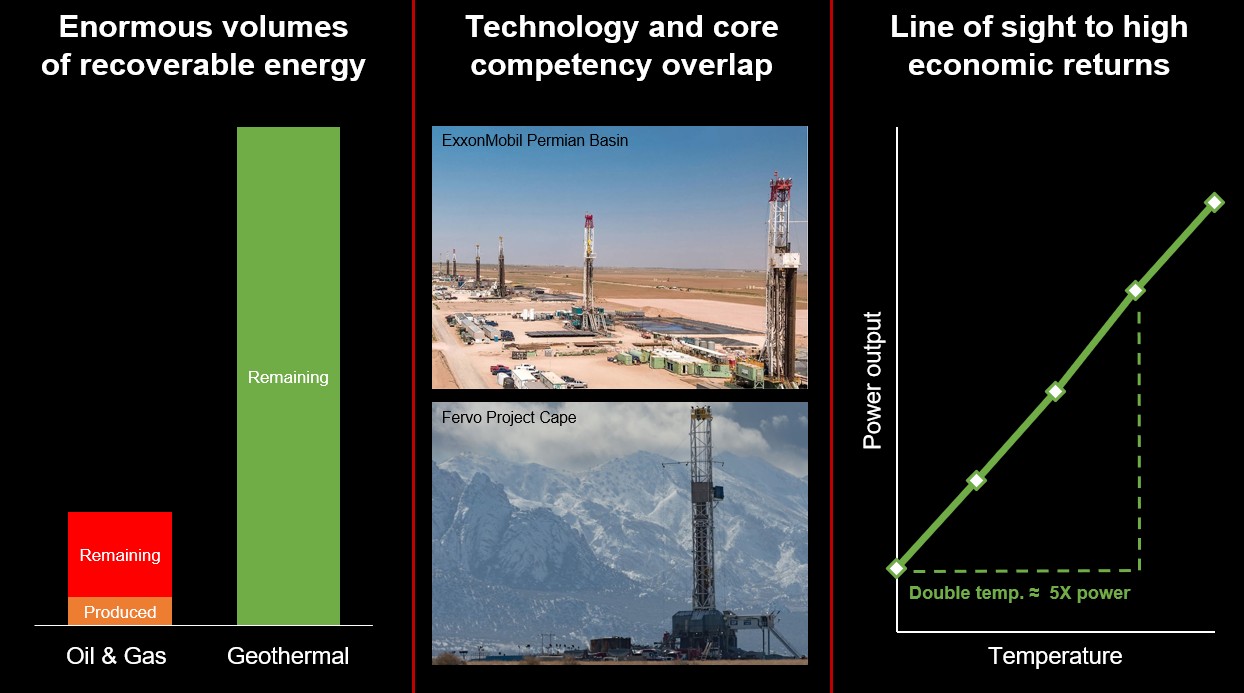
Regarding whether oil and gas majors will move to aggressively pursue geothermal power production, Tim Lines from Project InnerSpace and I presented reasons why doing so made perfect sense given the size of the prize, technology and core competency overlaps, and the potential for attractive economic returns (see figure below).
Finally, I’d like to provide a shout out to Project InnerSpace, who sponsored and organized a “Geothermal House” in the Innovation Agora.
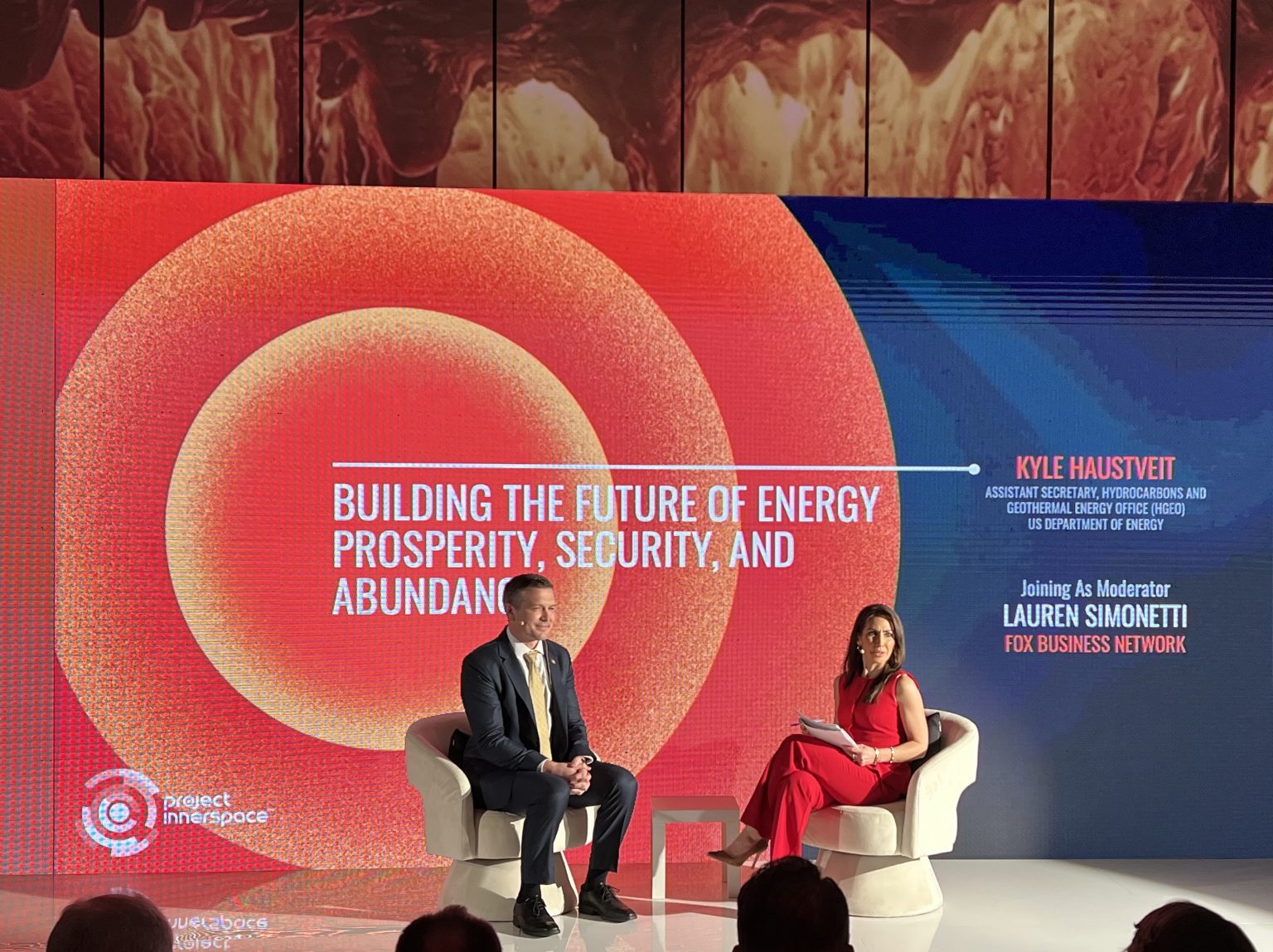
At Geothermal House, conference attendees could learn about the distribution of heat in the Earth’s crust using Project InnerSpace’s Geomap tool (LINK), access reports and other materials generated by Project InnerSpace (LINK), and attend talks by geothermal thought leaders (LINK), including Kyle Haustveit, the Assistant Secretary for the U.S. Department of Energy’s Hydrocarbons and Geothermal Energy Office (see picture below).
Geothermal House enormously increased the profile of geothermal energy during CERAWeek, with nearly 20% of attendees visiting the house over the four days of the conference.
Thank you to Project InnerSpace for the time, energy, and funds invested to bring Geothermal House to CERAWeek 2026.
Here’s a LINK where you can learn more about this non-profit, philanthropically-funded organization who are doing much to help geothermal energy achieve liftoff.


