
Creating a future with abundant, affordable, secure, reliable, and clean energy
The energy debate is usually framed as a choice: produce more oil and gas, or push for net zero whatever it costs. Greg Leveille, GA Drilling board member and former ConocoPhillips CTO, argues that this is a false choice, and makes the case for a dual pathway in which the subsurface technology, workforce and supply chain built by the oil and gas industry are used to scale geothermal power. Reposted with permission from Tidal Wave Technologies.


Sometimes in life we are forced to make “either or” types of choices. Yet at other moments, we can choose to simultaneously pursue two or more options.
I mention this because many in the world today see the energy industry as being at a figurative fork in the road. There are those amongst us who dismiss or vastly minimize the need for lowering GHG emissions, claiming that climate change is at best a second order consideration, one that falls far down the list compared to providing abundant, affordable, secure, and reliable energy for the 8.3 billion people who inhabit our planet. And there are others who wish to transition abruptly to 100% carbon-free sources of energy regardless of the economic, societal, and human well-being costs involved.
So, do we need to choose between these two options? Do we need to either take the road on the right (i.e., minimal concern about climate change, maximum focus on producing more energy), or the one on the left (i.e., achieve net zero by 2050 no matter the cost)?
For me, this is a false choice. One based upon highly flawed “either or” logic. One that at both extremes defies common sense. One that eliminates from consideration or obfuscates far better options than the two choices outlined above.
I make this claim with conviction because I experienced during my nearly forty-year career in the oil and gas industry how innovation can deliver amazing outcomes. Outcomes that defy conventional wisdom. Outcomes that impact the fate of nations and our world in unexpected ways.
For example, at the dawn of the 21st century, America was the world’s largest energy importer. Its domestic energy output was falling fast, particularly output of oil and natural gas. LNG import terminals were being built along the country’s coastlines and pipelines to move oil and gas from Canada and Alaska to the Lower 48 States were being engineered.
And all of this was being done because conventional wisdom foresaw that America’s fate was to become ever more beholden to other countries for its energy needs.
However, as we all now know, this Y2K vintage conventional wisdom was horribly wrong.
It was wrong because it failed to foresee how the oil and gas industry would be able to combine two existing mature technologies, horizontal drilling and hydraulic fracturing, and by doing so, revitalize American energy production to the point that the country has become a net energy exporter – a country that today accounts for over 20% of our planet’s oil production and 25% of its natural gas output – a country that has delivered the largest energy production related breakthrough yet made in the 21st century.
What is particularly encouraging about this story from an energy innovation perspective is that the breakthrough that allowed America to achieve this totally unexpected outcome resulted from combining two mature technologies in a novel way, with the only new element being the type of rocks the technology was applied to.
Combining two technologies in a novel way is of course a relatively easy way to innovate. Far easier than developing an entirely new approach from scratch.
Equally easy in my opinion is innovating by adopting a technology or suite of technologies from an adjacent industry, which is what I believe will drive the next world changing energy production breakthrough of the 21st century, namely the rapid scaling of geothermal power output as a result of tech transfer from the oil and gas industry.
Factors that make this such a compelling possibility include: (a) the amount of energy stored in geothermal resources is enormous, far larger than that associated with all forms of fossil fuels combined (b) many of the subsurface related technologies, knowledge, and work flows used by the oil and gas industry are highly applicable to geothermal exploration, appraisal, development, and operations, (c) the oil and gas industry’s supply chain, workforce, and technology development pipeline can be leveraged to accelerate the scale up of geothermal power, and (4) many countries have compelling reasons to rapidly grow geothermal power output.
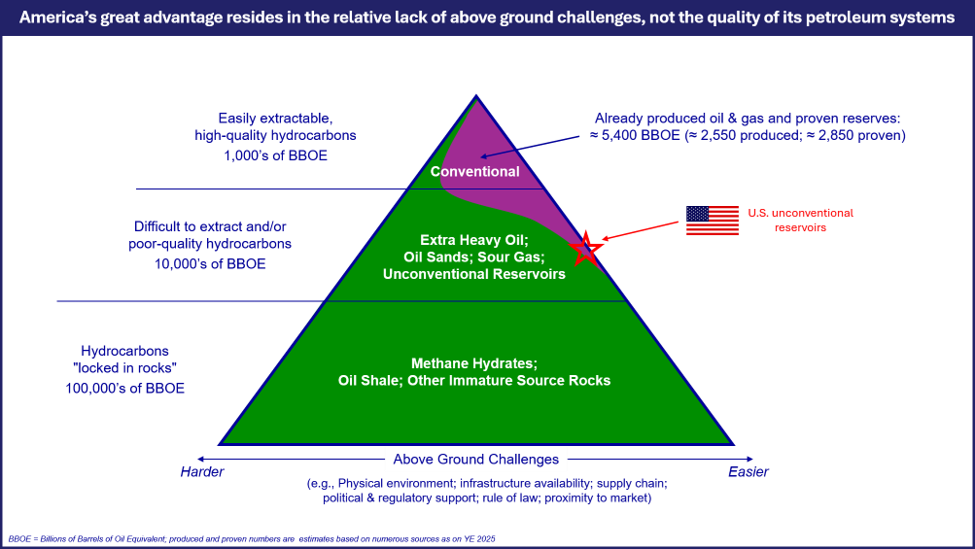
Regarding the last point, obvious examples of “compelling reasons” abound, be that to: (a) help satisfy burgeoning demand for power driven by data center construction (e.g., the United States), (b) reduce dependence on imports for a country’s energy needs (e.g., nearly all of east and south Asia, home to more than half our planet’s human population but a trivial portion of the Earth’s oil and gas resources; also Europe and many parts of Africa and South America), (c) stabilize electricity grids in regions that have installed large amounts of intermittent power supply (e.g., California, China, some parts of western Europe), and (d) prepare for the day when current sources of energy reach peak production and begin to decline (e.g., U.S. oil and gas production, which has already moved further down and further across our planet’s oil and gas resource pyramid than any other country on the planet, making the U.S. vulnerable to being the first to deplete its endowment of commercially viable oil and gas; see figure below).
There is also of course one (potentially) compelling global reason to quickly grow geothermal power output, with this being to decrease the rate at which GHGs are building up in the atmosphere.
And while this “reason” is not universally agreed upon, which is why I added “potentially” in parentheses in the sentence above, I would argue that even if you are one of our planet’s inhabitants who believe that: (a) CO2 is a useful gas, one that plants use to grow, which makes having considerably more of it in the atmosphere a good thing, (b) atmospheric CO2 levels were once an order of magnitude or more higher than they are at present and life still flourished on our planet, so there is no need to worry about the relatively small changes humans are causing, and/or (c) the numerical models used by climate scientists are flawed and biased towards overpredicting the rate at which temperatures will rise with increasing levels of greenhouse gas in the atmosphere, I would ask you to consider the implications of the following plot, which shows the rate of change in atmospheric CO2 levels over the past 50 million years.
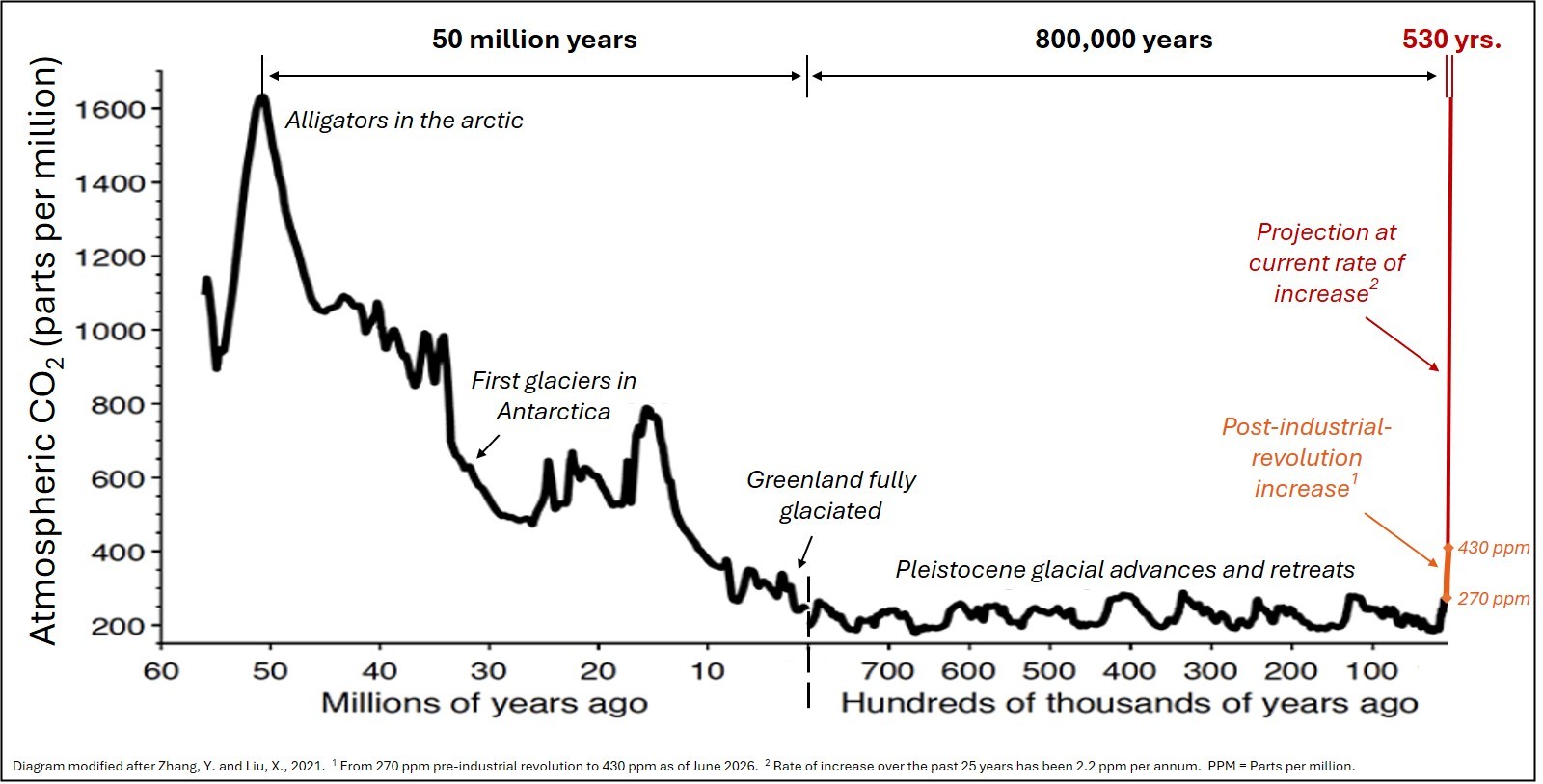
As the plot illustrates, atmospheric CO2 levels were much higher 50 million years ago (and life was flourishing back then), and levels changed significantly coming forward toward the present (and life still flourished even though significant change occurred from the start to the end of this period).
However, never in the past 50 million years has atmospheric CO2 levels changed as quickly as they are changing now, with CO2 levels having taken approximately 50 million years to fall from 1600 to 270 ppm just prior to the industrial revolution, whereas unless humankind dramatically reduces the amount of CO2 we are putting into the atmosphere, CO2 levels will return to 1600 ppm in about 530 years.
This is way too fast for the biosphere to respond without undergoing tremendous amounts of stress, and is even too fast for humankind, our planet’s most adaptable large life form, to easily manage the change.
So how should companies, countries, and humankind as a whole approach fulfilling their energy needs?
Should the focus be on producing more energy, concentrating on currently commercially viable sources of energy like oil and gas that are abundant, affordable, secure, and reliable even if they contribute to the rapid buildup of GHGs in the atmosphere? Or should it be on achieving net zero by 2050 no matter what the cost?
Before answering, please ask yourself whether this is even an “either or” question? Or is there a hybrid option that would be better? One that preserves the near-term benefits that oil and gas deliver while working to transfer the subsurface technologies, knowledge, and work flows that have made oil and gas the largest source of energy on our planet over into geothermal energy production?
Personally, I am opting for this “hybrid option”. A dual pathway approach if you will. One that preserves all the benefits that oil and gas can deliver in the near-term, but which ultimately scales the geothermal industry to the point where it can provide a large share of our planet’s energy needs, and by doing so, greatly reduce the amount of GHGs being emitted into the atmosphere.
Encouragingly, I am not alone in pursuing this approach. Nor was I anywhere close to being the first to set out on this journey. Rather, there are many who already have a foot in both camps. Companies like GA Drilling, ResFrac, and Neubrex that have developed dual use technologies. Oil and gas operators like Devon Energy, who is at the vanguard of a large number of oil & gas operators who have stood up teams to evaluate and invest in geothermal opportunities. Large oil and gas service companies like SLB, Halliburton, Baker Hughes, NOV, H&P, Nabors, and Liberty Energy who provide services to both geothermal operators and their traditional oil and gas clients, and who in some cases have invested in pure play geothermal enterprises. Long established geothermal companies that are adopting technologies from the oil and gas industry at a prodigious rate. And the U.S. government, who recently created an office of Hydrocarbons and Geothermal in recognition of the enormous amount of overlap between these two industries.
Now is therefore the time to push back on those that confront us with an “either or” choice about our energy future. Rather, we can decide to move forward down both the pathway advocated for by those on the right and the pathway advocated for by those on the left. By doing so, we will make progress towards the energy future we all desire, one where every person on our planet has access to abundant, affordable, secure, reliable, and eventually clean energy.
Please therefore join me in pursuing continued oil and gas development in the near-term while building a robust geothermal energy industry over the next 25 years – an industry that by adopting appropriate oil and gas subsurface advancements will be able to rapidly scale and eventually rival and surpass oil and gas as our planet’s largest source of energy.


