
GeoNerd Digest - 27th Edition: Eavor and Fervo Push Geothermal Frontiers in Drilling and Sensing
In our 27th edition we continue with a review of the most interesting papers from Geothermal Rising Conference 2025. This time we will focus on achievements of two frontrunners in geothermal project development: Fervo Energy and Eavor Technologies Inc..
In three previous GeoNerd Digest Digests we explored how both companies have been reinventing geothermal energy from two very different angles. Eavor has championed a closed-loop system (the Eavor-Loop) that circulates fluid through sealed wells, promising heat extraction without needing natural aquifers. Fervo, on the other hand, has applied efficient hard rock drilling and fiber-optic monitoring to create predictable and replicable engineered geothermal systems. Both approaches aimed to mitigate the traditional risks of hydrogeothermal projects.
Now, fresh off the presses in 2025, two technical papers provide a wealth of new data on each company’s flagship projects, building on what we’ve discussed in earlier Digests. These new results show how far each company’s technology has come: Eavor’s first commercial multi-lateral project in Germany is demonstrating rapid drilling performance gains, while Fervo’s Utah project is achieving unprecedented seismic imaging of subsurface fractures. The analysis that follows will recap our earlier insights on these companies and dive into the key findings of the new papers – highlighting technological breakthroughs, operational learnings, and what it all means for the future scalability of geothermal energy.
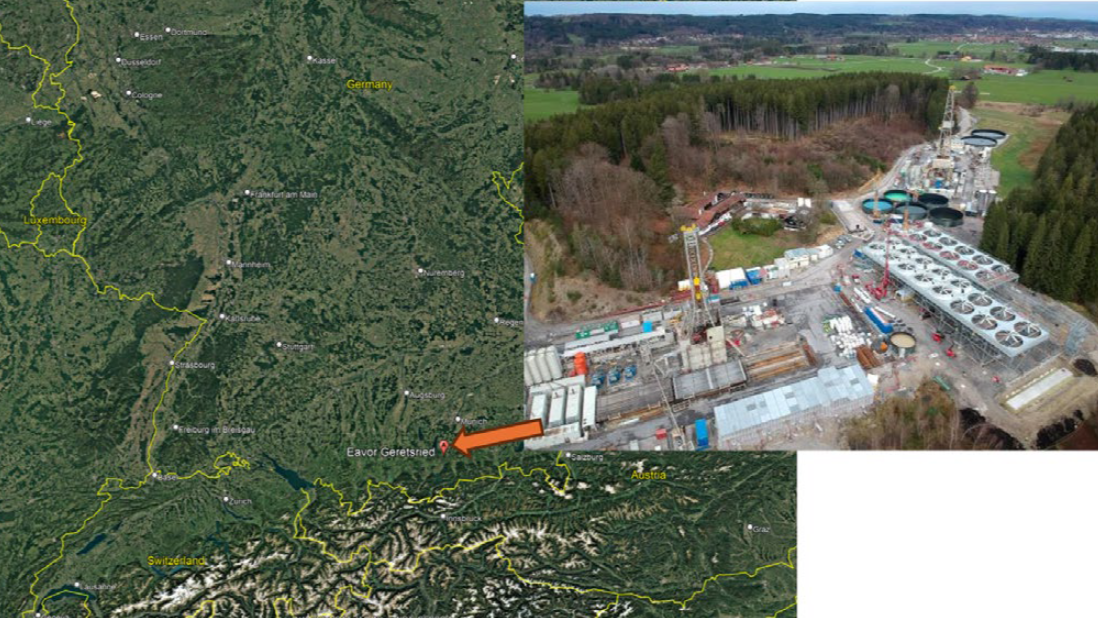

Eavor’s Geretsried Project – Drilling Breakthroughs in Closed-Loop Geothermal
Eavor’s closed-loop concept has always been bold – effectively creating a giant underground “radiator” with multiple horizontal wellbores extracting heat by conduction. In theory, this approach eliminates exploration risk (since no natural permeability is needed), but it lives and dies by drilling performance and cost. In earlier GeoNerd coverage, we noted both the promise and skepticism around closed-loop geothermal, emphasizing that drilling speed and economics would be the deciding factors.
The new paper from Eavor’s team, “Multi-Lateral Drilling Learning Curve at Eavor’s Geretsried Project” by Mark Hodder, Alex Vetsak Eddy Arida and Kristen N. , shows encouraging evidence that those drilling challenges can be overcome. The Geretsried project in Bavaria – Eavor’s first commercial-scale implementation – involved drilling six pairs of long lateral wells (twelve laterals total, each ~3 km) from a single pad.

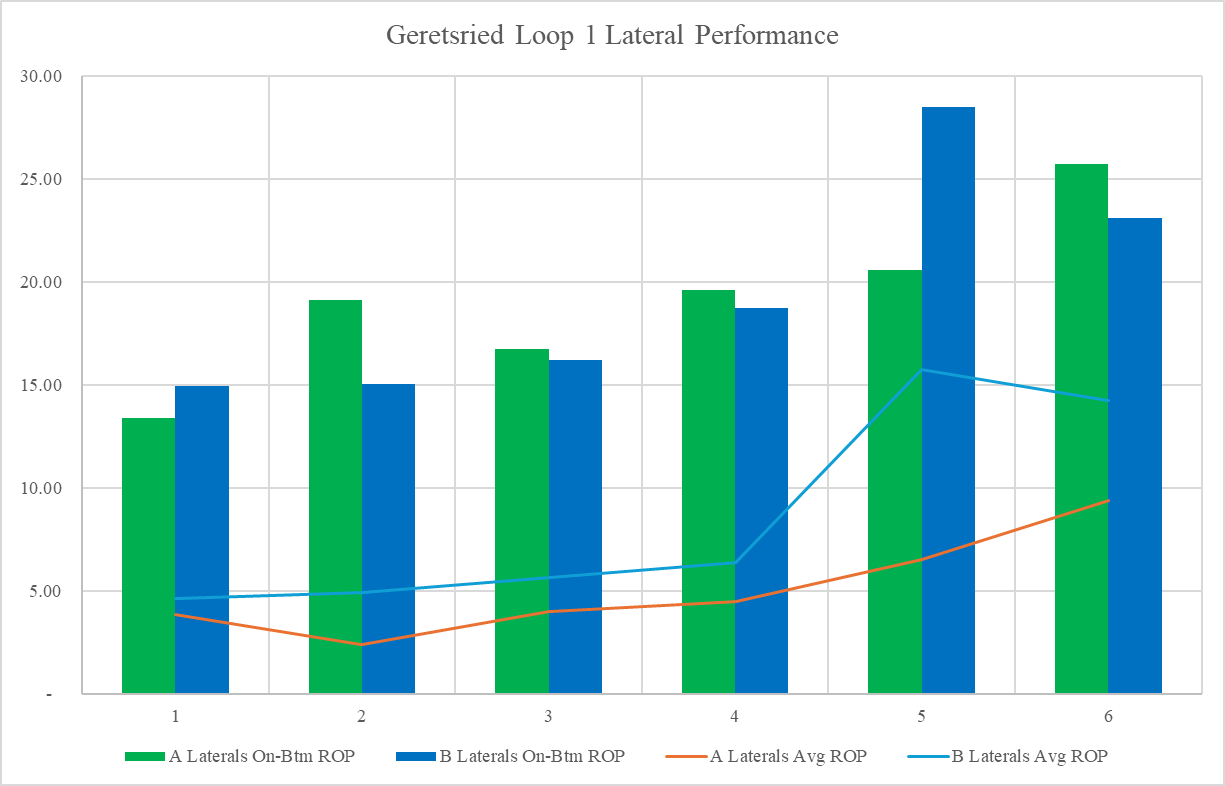
By iterating on each successive lateral, the team dramatically improved their rate of penetration (ROP) and overall efficiency. In fact, on-bottom ROP increased by over 90% from the first lateral to the sixth, thanks to continuous learning and optimization. The laterals that initially took many days to drill were completed nearly twice as fast by the end of the campaign, a clear validation of the learning curve effect in action.
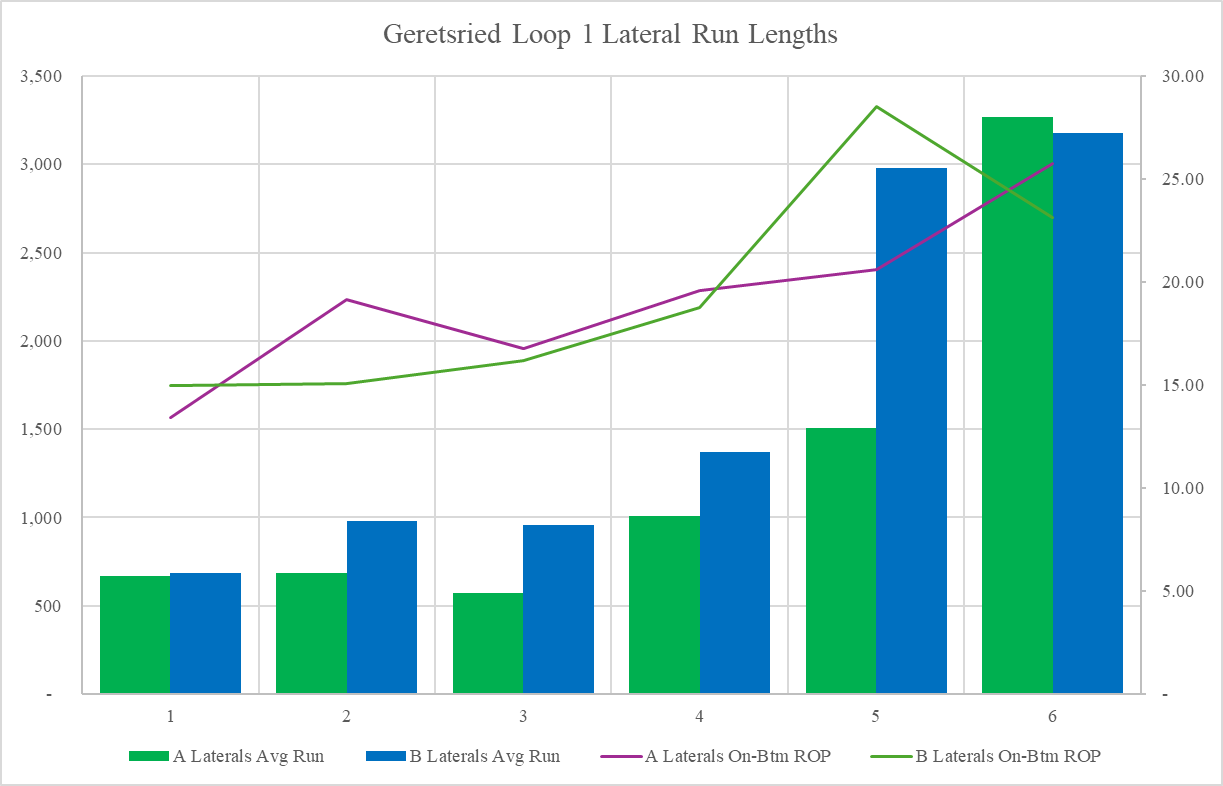
Beyond just drilling faster, Eavor also achieved longer bit life and fewer trips, which is crucial for cost control. Early on, each lateral required multiple drill-bit trips due to wear, but by later runs the team was able to drill entire 3-km laterals with a single bit. This improvement in bit run length (several laterals were drilled to total depth on one bit) slashed the non-productive time spent tripping in and out of the hole. The paper reports that by the sixth lateral, “several one-bit lateral runs to total depth (TD)” were achieved – a major milestone that indicates both better bit durability and better management of drilling dysfunctions (like vibration and stick-slip) that can prematurely destroy bits. Figure below illustrates this trend, showing how average lateral bit run lengths increased in tandem with ROP, ultimately reducing days per lateral dramatically. In short, the Geretsried drilling campaign proved that repetition and incremental improvements can drive closed-loop drilling costs down significantly, bringing Eavor closer to competitive economics for its heat loops.
The second part of the paper is dedicated to enabling technologies that Eavor deployed and refined during the project. One such technology is Insulated Drill Pipe (IDP) – a special double-walled drill pipe that keeps the drilling fluid cooler as it circulates down to the bit. We touched this topic in the Digest no. 15. By using insulated pipe, Eavor could push into these hot rocks without overheating the bottom-hole assembly, effectively allowing conventional tools to survive in geothermal conditions.

Another innovation was Eavor’s Rock-Pipe open-hole sealing method. In a closed-loop well, after drilling a lateral you must seal it off (to force fluid through the rock and back up the production well, rather than leaking into the formation). Traditional cementing isn’t feasible for open-hole laterals of this length, so Eavor developed a proprietary two-stage sealing system nicknamed “Rock-Pipe.” After each lateral intersection, a special sealant is circulated through the open hole to create an impermeable lining along the rock itself. This maintains the closed-loop integrity and prevents fluid losses to the formation – essentially using the rock as the pipe once the sealant sets. Rock-Pipe helped reduce well construction cost compared to running casing in the lateral, and it is a novel solution to keep the system closed without slowing down the drilling of subsequent laterals.
Crucially, Eavor also tackled one of the trickiest parts of multi-lateral closed loops: precisely intersecting two wellbores deep underground. To connect a lateral from the “A” well to its twin lateral from the “B” well (thus completing the loop), the drilling team relied on Active Magnetic Ranging (AMR). We’ve previously noted how Eavor would need to accurately steer one well toward the other – akin to “needle-in-haystack” well targeting. In Geretsried’s first laterals, they used conventional wireline-based ranging tools, which involved periodically pausing drilling to run a sonde and measure the relative direction to the other wellbore. This was time-consuming, requiring multiple “shots” and a lot of extra tripping. Midway through the project, Eavor introduced a new AMR system called EavorLink that places the magnetic source and sensors directly in the bottom-hole assembly, enabling continuous “on-the-fly” ranging while drilling. This was a game-changer: from lateral 4 onward, they no longer had to pull out for each ranging shot. The result was a greater than 80% reduction in time spent on ranging and intersection activities. In other words, what used to take days of stopping to check alignment was largely eliminated by the integrated AMR tool, vastly speeding up the loop completion. Successful wellbore intersections were achieved on all lateral pairs, and having this accurate downhole positioning also helped manage directional uncertainty on these ultra-extended-reach wells.

Finally, the paper describes improvements in multi-lateral sidetracking operations. Drilling multiple laterals from one main well requires milling window exits in casing and steering new laterals – a process that can be slow and tricky. The Geretsried experience wasn’t without challenges: some laterals needed multiple sidetrack attempts due to the tool initially tracking along the casing or requiring a re-drill. The team experimented with different whipstock and motor configurations, even using a dedicated sidetrack BHA on some laterals to get better separation. The learning here is being fed forward: Eavor identified that using a more centralized liner and refined milling techniques will allow future projects to initiate sidetracks using the main drilling assembly itself, removing an extra trip. With these optimizations, they expect to consistently achieve sidetracks in ~4 days each (versus significantly longer in early attempts).

All told, the Geretsried project’s results give a strong vote of confidence that closed-loop geothermal can hit the steep learning curve needed to drive costs down. After years of hype and some skepticism, Eavor’s field data suggests that faster drilling – the linchpin of closed-loop viability – is increasingly within reach.
Fervo’s Cape Modern Project – Illuminating Fractures with Advanced Seismic Monitoring
While Eavor was drilling its way to success in Germany, Fervo Energy has been busy fracturing and mapping the subsurface in Utah. A paper titled “Fracture Characterization and Stress Communication Revealed by Induced Seismicity at the Cape Modern Geothermal Field, Utah” by Nori Nakata, Hilary Chang, Zhengfa Bi, Florian Soom, Chet Hopp, Avinash Nayak, Aleksei Titov and Sireesh Dadi pulls back the curtain on just how much insight Fervo is gaining from geophysical monitoring at their project site. Spoiler alert: it’s a geek paradise of seismic data, with massive sensor networks, AI-assisted analytics, and 3D visualizations of faults and fractures in the reservoir. These advancements aren’t just academic – they directly inform how Fervo can manage permeability and reduce risks (like unwanted seismic events) as they scale up EGS.
First, let’s talk about the sensor network Fervo deployed at the Cape Modern field. It’s one of the most comprehensive seismic monitoring setups ever seen in geothermal. The paper reports a multi-sensor array including nearly 20 permanent seismometers (both shallow borehole and surface stations) plus an on-demand army of around 800 surface seismic nodes spread across the field. On top of that, there are fiber-optic Distributed Acoustic Sensing (DAS) cables in two wells, each acting as thousands of virtual seismometers along the borehole. This dense array allows Fervo to record an incredibly detailed picture of all the micro-earthquakes that occur during both stimulation (fracking) and production. For context, EGS projects intentionally induce lots of tiny quakes as they inject water to reopen fractures – tracking these microseismic events is how engineers map out where fluid pathways are being created. At Cape Modern, Fervo essentially blanketed the area with instruments to capture every twitch of the earth in high resolution. The surface nodal network was so extensive that even the neighboring DOE Utah FORGE site (located nearby in Milford, Utah) is covered in the monitoring area. Figure below shows a map of the field, including the sensor placements and relation to the FORGE site – it’s a seismic nerd’s dream setup.
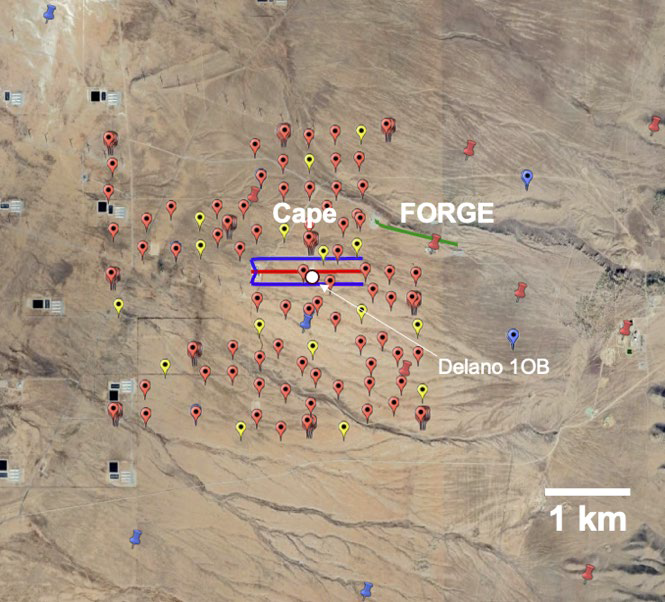
With this rich data, Fervo applied a cutting-edge, AI-assisted seismic processing workflow to analyze the induced seismicity. According to the paper, they implemented automated event detection (to pick out microquakes from continuous data), precise earthquake location algorithms, and even full moment tensor inversions to determine the focal mechanisms of the quakes (i.e. how the faults slipped).
One especially innovative aspect was a multi-stage image processing method to reconstruct 3D fault surfaces from the cloud of earthquake epicenters. In simpler terms, instead of just plotting dots where each microquake occurred, Fervo’s researchers developed an algorithm to connect the dots into coherent planes that represent actual fault zones. They used Gaussian kernel smoothing and “surface voting” techniques to tease out continuous fault planes from the scattered data. The result? A detailed 3D map of the fracture network activated in the reservoir, including both the main faults and smaller subsidiary fractures. Figure below illustrates this result – red translucent planes show the identified fault surfaces, with the microseismic event locations plotted as points in 3D space. This kind of visualization is incredibly useful because it shows which faults are carrying most of the slip and potentially fluid flow. The paper notes that the identified complex fault network is “likely to control fluid flow” in the reservoir – in other words, these are the paths the injected water is taking to circulate heat, as well as the structures that might delimit how far the stimulation can propagate.

Another highlight of Fervo’s approach is the use of DAS for advanced seismic measurements. DAS turns a fiber-optic cable into a long string of vibration sensors – effectively giving hundreds of readings along a wellbore. At Cape Modern, DAS was not only used to pick up tiny events that surface instruments might miss, but also to capture high-frequency details of the seismic waves. This enabled analyses like earthquake stress-drop calculations and attenuation (Q factor) profiling in the subsurface.
The paper reports that using the fiber in the Cape Delano 1OB well, they measured stress drops in the microquakes ranging from ~1 to 20 MPa. Stress drop is basically how much stress is relieved by a quake – higher values can indicate more violent slip or stronger fault patches. The fact that they could resolve stress drops for very small events is impressive, and it was made possible by the high-resolution DAS recordings. They found that these microquakes generally align with the regional stress field in terms of their fault orientations, which is good (expected) news. Interestingly, the data also showed weak correlation between stress drop and distance from injection, and variability in the focal mechanisms, suggesting that changes in pore pressure (from fluid injection) were influencing the seismic behavior in complex ways. In plain language: pumping water in is changing the stress state not just at the injection point but dynamically through the region – “stress communication,” as the title says. The temporal and spatial patterns of the seismicity imply a dynamic redistribution of stress during and after the stimulations. This is a vital observation for EGS operations: it means that when you create a fracture network, you also alter stresses beyond the immediate area, which can affect both how the reservoir grows and any seismic hazard potential.
So what are the implications of all this for permeability and fracture control? Essentially, Fervo’s advanced monitoring is giving them a subsurface x-ray of their reservoir. By knowing exactly where fractures are and how they are behaving under stress, Fervo can make informed decisions to optimize permeability – for example, adjusting injection pressures or volumes in real time to connect desirable fractures while avoiding triggering unwanted fault slip. The ability to map fault planes means they can identify if a stimulation is hitting a pre-existing large fault (which might pose a seismic risk or a fluid loss pathway) and then potentially mitigate that. The DAS-based stress and attenuation data also help in understanding the rock’s response: for instance, zones of lower seismic attenuation (higher Q) could indicate more brittle, fractured rock that might be the sweet spots for flow. In sum, Fervo’s Cape Modern project demonstrates a new level of real-time reservoir management. They are not flying blind underground; they have the tools to see and steer the fracture network development. This kind of capability is what will make EGS projects more predictable and financeable – by taming the uncertainty of the subsurface with data. It’s a great example of bringing oil & gas style subsurface science into geothermal, and it shows why Fervo has been able to attract attention with their results so far.
Different Approaches – The Same Goal
In essence, Eavor’s closed-loop and Fervo’s EGS represent two ends of a spectrum. Eavor minimizes subsurface risk by isolating from the formation, at the expense of more intensive drilling. Fervo embraces the subsurface complexity, using data and smart stimulation to turn unconventional reservoirs into productive ones. One isn’t “better” than the other in general – each has ideal scenarios. Eavor might be favored in areas with extremely low natural permeability or where any fluid injection is undesirable (e.g. sensitive regions or where water is scarce), whereas Fervo’s approach could extract more heat with fewer wells if the geology can be managed, since an open fractured reservoir can have a larger heat exchange area once connected. It’s exciting to see that both are advancing.
If you were able to read up to this point, let us know your opinion on the following questions:
1. “Closed-loop or EGS: Which geothermal model is better suited for global scaling?”
2. “What’s the next frontier in geothermal tech: deeper wells, smarter monitoring, or hybrid systems?”
3. “How do we ensure geothermal expansion doesn’t repeat oil & gas’s growing pains?”
Let’s discuss! The GeoNerd community on LinkedIn is eager to hear your thoughts. 🚀💬
Copyright Notice:
This summary is based on the papers "Multi-Lateral Drilling Learning Curve at Eavor’s Geretsried Project" by Mark Hodder et al. and "Fracture Characterization and Stress Communication Revealed by Induced Seismicity at the Cape Modern Geothermal Field, Utah" by Nori Nakata et al. published at GRC 2025. All figures are reproduced from the report under fair use for review purposes.


