
GeoNerd Digest – 28th Edition: Field Validation of Vacuum-Insulated Coaxial Geothermal System
We continue in our review of the most interesting papers from Geothermal Rising Conference 2025. This time we will re-visit the Vacuum-Insulated Coaxial Geothermal Systems reviewed in our 14th edition. In this setup, a working fluid circulates down one pipe (or the annular space) and back up another concentric pipe, absorbing heat from hot rock formations along the way. The coaxial configuration allows heat extraction without directly producing reservoir fluids, making it viable even in dry, impermeable formations.
However, a known challenge is thermal loss between the hot upflow and cool downflow within the well. We discussed how Vacuum-Insulated Tubing (VIT) can act like a giant thermos, drastically reducing heat loss in the wellbore. By maintaining a vacuum gap between concentric pipes, VIT helps the ascending hot fluid retain its heat, boosting the efficiency of the closed-loop system.

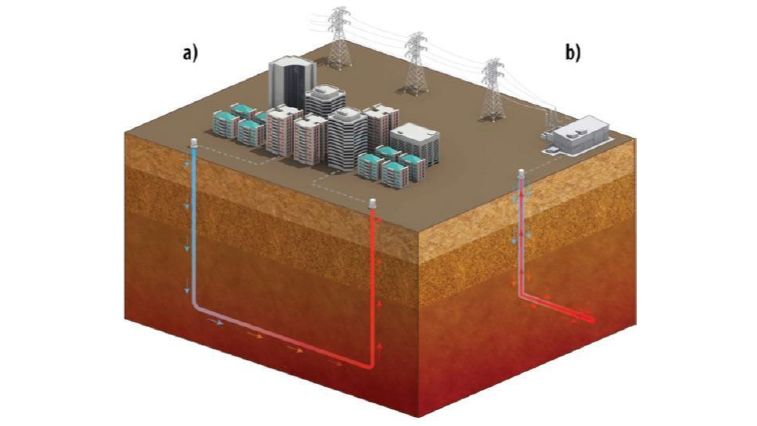

New Study Validates Theory with a 3.5 km Test Well
In this edition, we review a GRC paper titled “Techno-Economics of Co-axial Geothermal Systems Equipped with Vacuum-Insulated Tubing.” by Mohammad (Jabs) Aljubran. It is noteworthy for bringing together field data and advanced modeling to assess coaxial VIT systems. Prior theoretical work relied on models like the Slender-Body Theory (SBT) – an analytical approach to predict heat transfer from the rock to a slender wellbore. What’s new here is that the authors put SBT to the test against real-world data from a deep coaxial well.
The team used a 3.5 km deep NOV´s test well outfitted with vacuum-insulated tubing to gather empirical data. A schematic diagram below illustrates the well configuration: a VIT-equipped inner production tube inside an outer casing, forming an annulus for injection. Cold fluid is injected down the outer annulus and heated by the formation at the bottom, then it returns up through the insulated inner pipe.
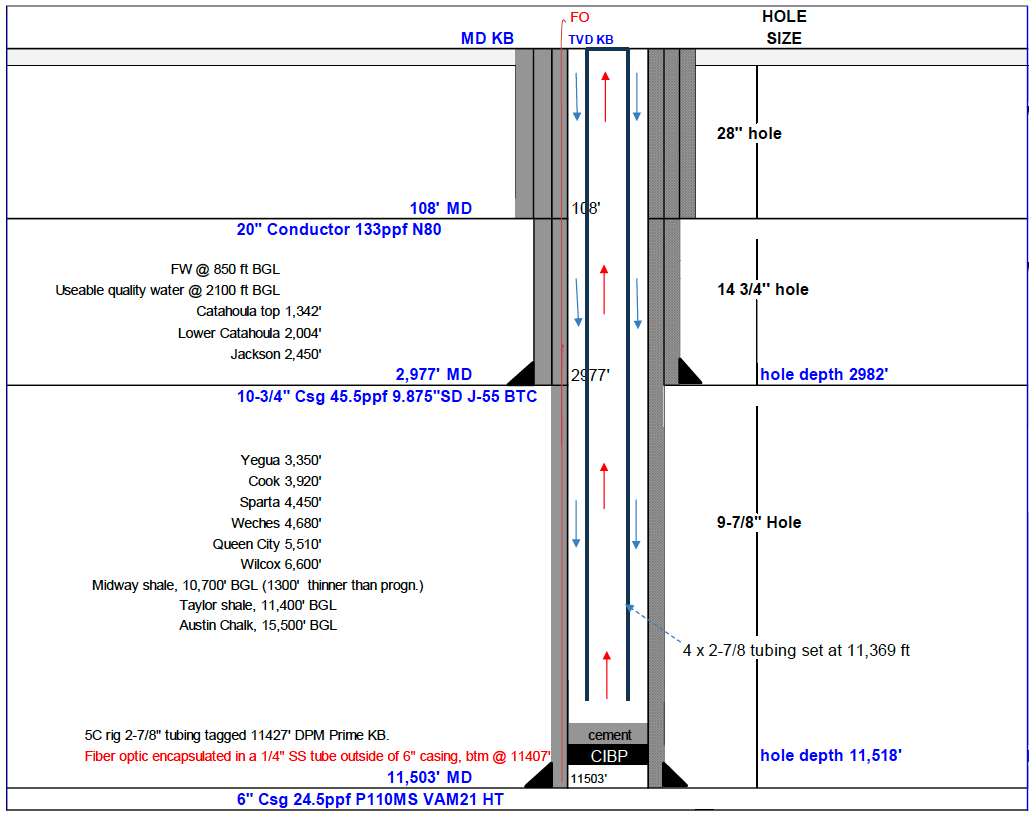
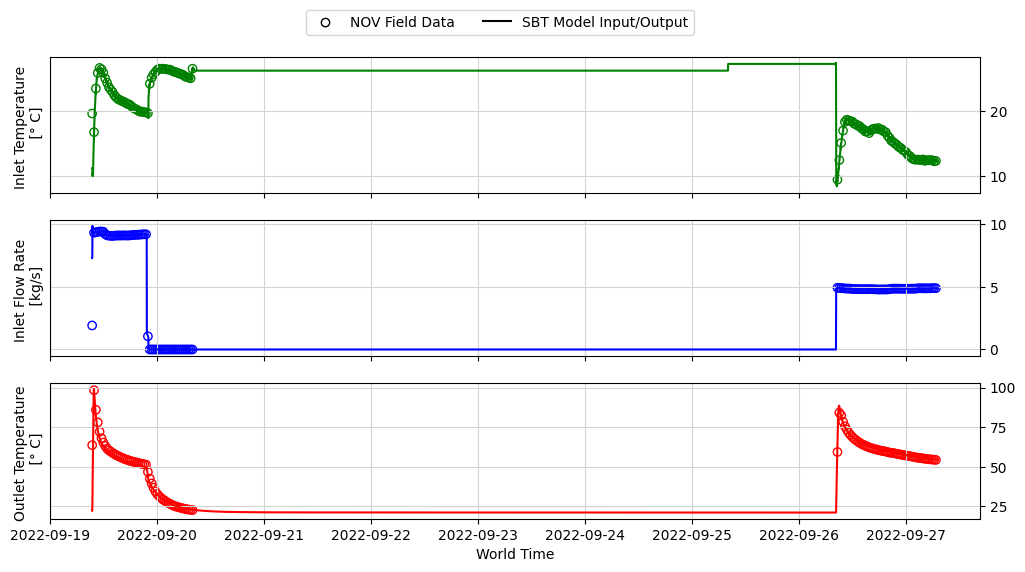
This setup allowed the researchers to measure temperature profiles of both the injection path and the production flow under operating conditions. Figure below presents the temperature vs. depth profiles for the downflow and upflow fluids. The injection fluid enters the well cool and gradually warms towards the bottom, while the produced fluid emerges from the reservoir hot and (thanks to the VIT) loses very little heat on the 3.5 km ascent. These profiles closely matched the SBT model’s predictions, validating that SBT can reliably capture the thermal behavior of a deep coaxial closed-loop system. This is a big deal – it means engineers can confidently use SBT-based tools to forecast performance of similar systems, knowing the model holds up in practice.
Beyond just the heat transfer, the authors coupled the validated SBT model with a lifecycle economic tool called Flexible Geothermal Economics Model (FGEM). Using FGEM, they performed a techno-economic analysis of the coaxial VIT system over its lifetime. In other words, they didn’t stop at measuring temperatures – they translated those thermal results into power output, costs, and ultimately the Levelized Cost of Electricity (LCOE) for the system. This holistic approach allows them to examine how design choices and site characteristics would affect the dollar-per-megawatt-hour outcome for electricity from such a well.
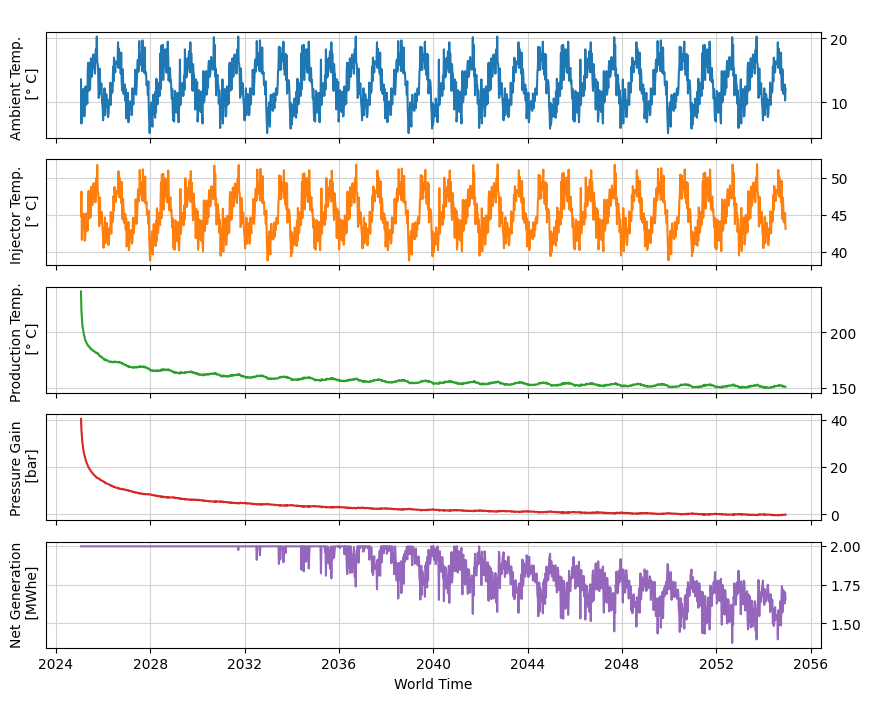
Techno-Economic Results: Temperature Profiles to LCOE Heatmaps
With the physics validated, the paper dives into the economics of coaxial VIT systems. One key outcome is the baseline LCOE they calculated for the test well scenario: about $643 per MWhₑ (643 USD per megawatt-hour of electricity). This number is extraordinarily high compared to conventional power – reflecting the reality that, with today’s technology and costs, a single 3.5 km closed-loop well produces power at a premium price. The analysis highlights why the LCOE is so high and what factors are most responsible:
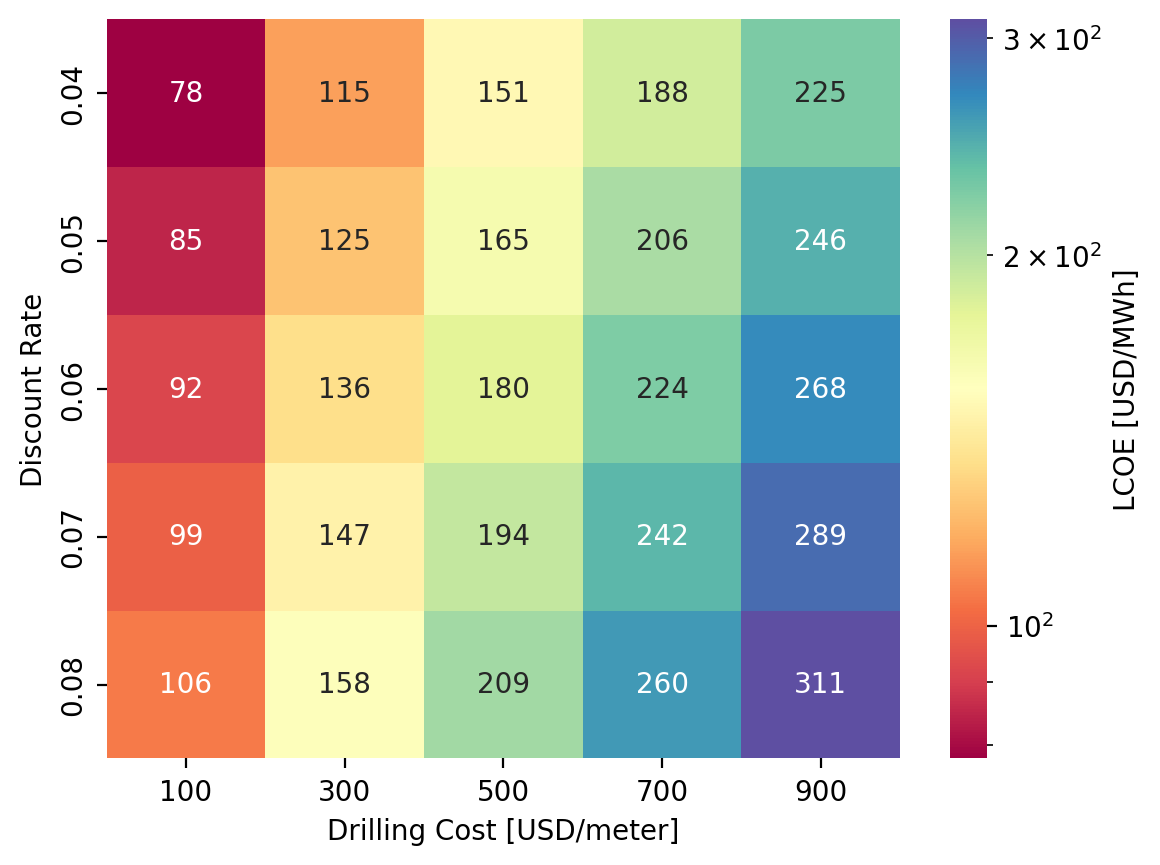
- Drilling Costs Dominate: Drilling a deep well is expensive, and those upfront costs heavily burden the LCOE. In the baseline case, the cost of drilling (and completion) contributes a large share of the total project cost. The study confirms that if we want closed-loop geothermal to be competitive, drilling innovation to cut costs is absolutely critical. This echoes also earlier GeoNerd discussions – ultra-cheap drilling, on the order of a few hundreds of dollars per meter or less, could be a game-changer for geothermal economics.
- Importance of Insulation: The quality of the VIT (its thermal insulation performance) is the other major driver of system efficiency. Better insulation means hotter fluid reaching the surface, which means more power output for the same well – directly improving LCOE. The authors found an interesting threshold for VIT performance: around 0.08 W/(m·°C) effective thermal conductance. Using tubing with an even lower heat loss coefficient than 0.08 yields only diminishing returns. In practical terms, once the tubing is about ~0.08 W/m·°C or better, the well is retaining most of its heat; making the insulation “super-duper” (say 0.01 W/m·°C) won’t significantly lower LCOE further, unless other parts of the system change. This is a valuable insight for developers choosing between insulation technologies – it suggests there’s an optimal point beyond which extra insulation might not justify its cost.
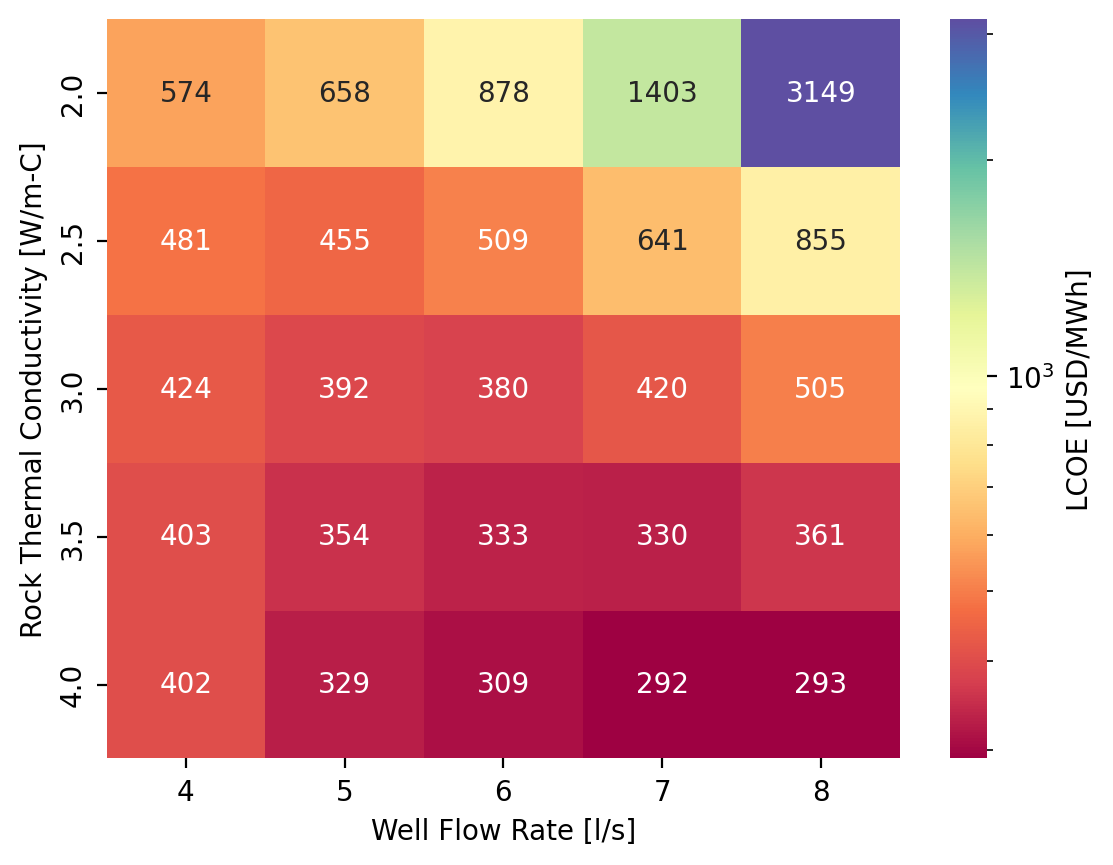
- Thermal Conductivity of the Rock: Crucially, the geology itself has a huge impact on energy output. The paper’s sensitivity analysis shows that higher rock thermal conductivity drastically improves the economics of a coaxial closed-loop well. Why? In more conductive rocks, heat from the surrounding formation replenishes the wellbore more readily as you draw heat out. The authors present heatmap diagrams (see below) illustrating LCOE sensitivity to various parameters, and the trend is clear – if you put the same coaxial system in a formation with, say, 3-4 W/m·K conductivity instead of 2-3 W/m·K, the LCOE can drop dramatically. In essence, a more thermally conductive reservoir acts like a better “heat exchanger,” feeding heat to the well more efficiently.
- Flow Rate Trade-offs: Although not explicitly listed in the “main findings” bullet points, the study’s LCOE heatmaps also explore mass flow rate effects. Just as we’ve discussed before, there’s a balancing act with flow: a higher flow rate increases the total heat carried to surface (more mass of fluid heated, so more thermal power), but it also tends to lower the outlet temperature (the fluid doesn’t stay downhole long enough to get as hot). The heatmaps show how LCOE responds to this trade-off. There’s an optimal flow range where the LCOE is minimized – too low flow underutilizes the well’s potential, while too high flow yields cooler fluids that convert to electricity less efficiently. The take-away is that operators will need to tune flow rates to find the sweet spot for maximum economic return.
Key Findings at a Glance
To summarize the core results of this paper:
- Baseline Cost of Electricity ~643 $/MWhₑ: Under current assumptions (deep single well, present-day drilling costs, etc.), closed-loop electricity is very expensive. Drilling costs and heat losses are the chief contributors to this high LCOE. Any path to competitiveness must tackle these factors head-on.
- VIT Performance Sweet Spot (~0.08 W/m·°C): Vacuum-insulated tubing greatly boosts performance by reducing heat loss. The study found that an insulation effectiveness around 0.08 W/(m·°C) provides most of the benefit. Using even better insulation yields only marginal gains in LCOE, implying an optimal level of insulation beyond which returns diminish.
- Rock Conductivity Matters: The native thermal conductivity of the formation is a make-or-break factor. In rocks that conduct heat well, the closed-loop system can sustain higher output (and thus lower cost per energy). This means project economics improve substantially in high-conductivity settings – choosing a site with favorable geology (or understanding your site’s thermal properties) is crucial for closed-loop projects.
- Sensitivity Visualized: The paper’s results include colorful 2D heatmaps showing how LCOE varies with different pairs of parameters. For instance, one heatmap plots LCOE as a function of flow rate and insulation level; another as a function of rock thermal conductivity and flow, etc. These visuals make it easy to spot trends: steep LCOE reductions when moving to better insulation or cheaper drilling, and the strong influence of geology. Such visual tools can guide design decisions – e.g., if your target LCOE is, say, below $100/MWh, the heatmaps can tell you what combinations of flow, insulation quality, drilling cost, and rock properties might get you there (and which combinations won’t!).
Broader Implications for Geothermal Development
This study is a reality check and a roadmap for coaxial closed-loop geothermal. What are the broader implications? A few big-picture takeaways:
- Driving Down Drilling Costs: It’s clearer than ever that high drilling costs are the Achilles’ heel of deep geothermal projects. To make closed-loop systems economically viable, continued innovation in drilling technology is paramount. This could mean anything from faster drilling techniques, to improved drilling tools for hard rock, to radically new approaches. The concept of “factory drilling” (highly repeatable, optimized processes) or advanced automation/AI in drilling could help bring costs from the current $1000+ per meter down into the low hundreds per meter. Such cost reductions would directly and significantly shave down the LCOE, as demonstrated by both this paper and other studies. The industry and research community must keep pushing on this front – every 100$ drop in per-meter drilling cost yields a big win in project economics.
- Site-Specific Thermal Characterization: Geoscience comes back to the fore – not every site will yield the same results for a closed-loop system. Developers need to pay close attention to the thermal properties of the subsurface when evaluating projects. Before drilling, thorough characterization of the rock thermal conductivity, heat capacity, and undisturbed temperature gradient at a site will help predict the performance of a closed-loop well. This could involve deeper exploration wells, lab measurements on core samples, or even geophysical techniques that infer rock type and thermal properties. The big implication is that site selection for closed-loop geothermal should prioritize favorable thermal geology (for example, massive granitoid formations, salt domes, or other high-conductivity environments). In the broader sense, this might concentrate closed-loop projects in certain regions unless drilling costs become so low that even less conductive rocks can be economically used. It also suggests an opportunity: perhaps we can enhance a site’s effective conductivity (for instance, via water circulation in surrounding rock or creating artificial high-conductivity pathways) – an area for future research.
Finally, it’s worth noting the positive message: a validated model like SBT combined with economic analysis tools gives us a powerful framework to iterate and optimize closed-loop designs virtually. We can now play with “what-if” scenarios with some confidence: What if we drill deeper? What if the rock is 30% more conductive? What if we use CO₂ instead of water as the working fluid? By modeling these, we can hone in on the most promising combinations before investing in steel and cement.
Questions for Discussion
- Ultra-Low-Cost Drilling: Given that drilling cost is the largest LCOE driver, what do you think are the most promising approaches to achieve the step-change in drilling economics? (e.g. novel rock disintegration and removal technologies, automation and AI optimization, factory-style drilling rigs, etc.) Which approach do you believe could realistically bring costs down into the target range for closed-loop projects?
- Insulation vs. Investment: The study indicates that beyond a certain insulation efficiency (~0.08 W/m·°C), additional gains are limited. How should the industry approach the development of new insulation materials or designs for geothermal? Are there alternative ways to reduce thermal losses in wells (for example, active thermal coatings or clever flow schemes) that might complement or replace high-end vacuum tubing?
- Selecting the Right Sites: With rock thermal properties being so influential, how can project developers best incorporate site-specific thermal characterization early in the planning process? What techniques or data would you use to identify areas with high thermal conductivity and favorable conditions for closed-loop systems?
Share your thoughts! The GeoNerd community on LinkedIn is eager to hear your thoughts. 🚀💬
Copyright Notice:
This summary is based on the paper "Techno-Economics of Co-axial Geothermal Systems Equipped with Vacuum-Insulated Tubing" by Mohammad (Jabs) Aljubran, Corey Dufrene, Chuck Wright and Guizhong (Gary) Chen published at GRC 2025. All figures are reproduced from the report under fair use for review purposes.


