
GeoNerd Digest – 30th Edition: Beyond Wind and Solar: What Enhanced Geothermal Adds to the Energy Transition
If you could tap into the Earth’s heat almost anywhere, would that change how we think about the energy transition? That’s exactly the question behind a recent global modeling effort that puts Enhanced Geothermal Systems (EGS) under the spotlight. Not as a silver bullet, not as a fringe technology—but as a serious system-level option in a world aiming for 100% clean, renewable energy.


This edition of GeoNerd Digest explores what happens when EGS is added to a fully electrified, wind–water–solar (WWS) energy system across 150 countries, covering almost the entire global energy demand. Along the way, we’ll walk through the most telling figures from the analysis and what they reveal about costs, land use, storage, and system design. The paper to be reviewed is titled "The impact of enhanced geothermal systems on transitioning all energy sectors in 150 countries to 100% clean, renewable energy" by Mark Jacobson et al. from Stanford University.
EGS in a fully electrified world
Traditional geothermal relies on rare geological sweet spots: shallow reservoirs of hot water or steam near volcanic or tectonic activity. EGS flips that logic. Instead of waiting for perfect geology, EGS creates it. By drilling several kilometers deep and engineering permeability in hot rock formations, EGS allows heat extraction in regions previously considered unsuitable for geothermal power. The heat is then used to generate electricity—typically via closed-loop binary systems—or potentially heat for district heating.
The paper´s modeled future assumes that almost all energy sectors—power, transport, heating, and industry—are electrified or supplied by direct renewable heat. Electricity comes from wind, solar, hydro, and geothermal, supported by storage, demand response, and grid balancing.
EGS enters the system as a baseload electricity source, supplying a steady share of power around the clock. In the core scenario, EGS provides around 10% of total electricity generation. This isn’t because 10% is magically optimal everywhere. It’s a conservative, globally feasible assumption that allows the system-level impacts of baseload geothermal to be isolated and tested.
A very good summary of the demand, cost and payback time for the business as usual (BAU) and base-WWS scenarios (no-EGS) is shown in Table 1.

Energy demand collapses after electrification
One of the most striking results appears early in the analysis. Figure below shows annual average end-use energy demand across all 150 countries under three conditions: business-as-usual, 100% WWS without EGS, and 100% WWS with EGS.

The takeaway is immediate and powerful:
- Electrification plus renewables cuts total final energy demand by more than 50%
- The reduction is driven by efficiency gains in transport, heating, and industry
- Adding EGS does not change demand—it changes how that demand is supplied
Also, cost is often the decisive argument in energy debates, and the modeling addresses it head-on. From the figure above we can conclude that across all regions:
- BAU carries enormous hidden costs from air pollution and climate impacts
- A 100% WWS system cuts private energy costs by ~60%
- Total social costs drop by ~90%
Crucially, the bars for WWS with and without EGS sit almost on top of each other. Depending on future drilling costs, EGS slightly lowers or slightly raises total system cost—but the difference is marginal compared to the massive savings versus fossil-based systems.
Baseload geothermal doesn’t break the cost curve
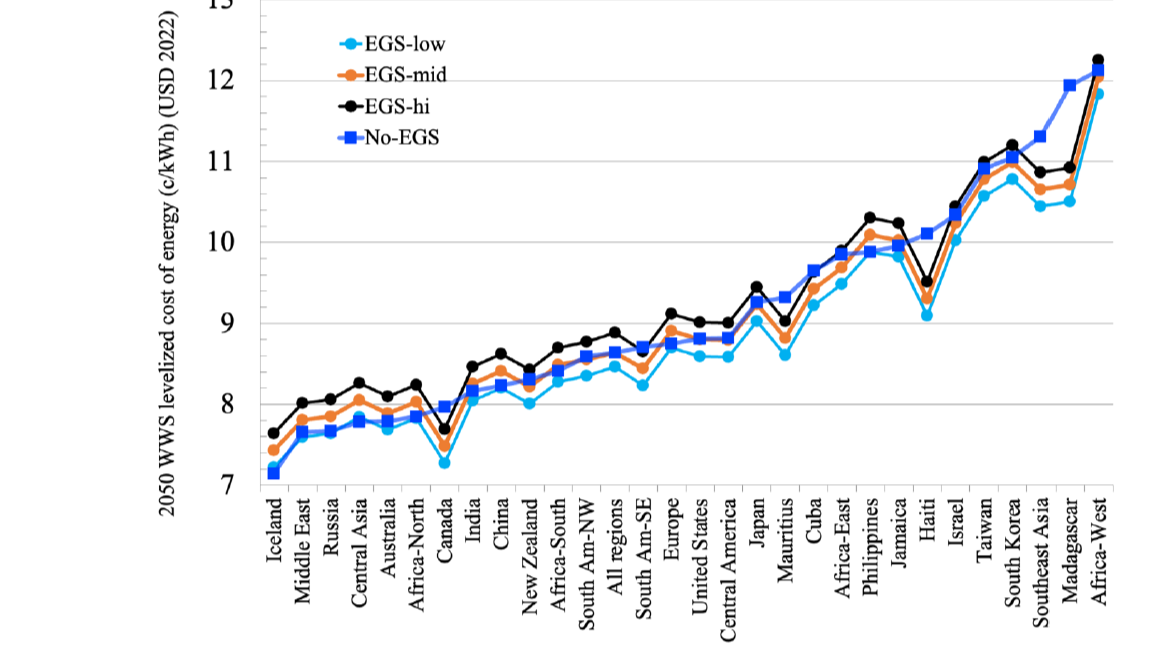
Another key insight comes from figure below which compares electricity costs across regions for:
- WWS without EGS
- WWS with low-, mid-, and high-cost EGS assumptions
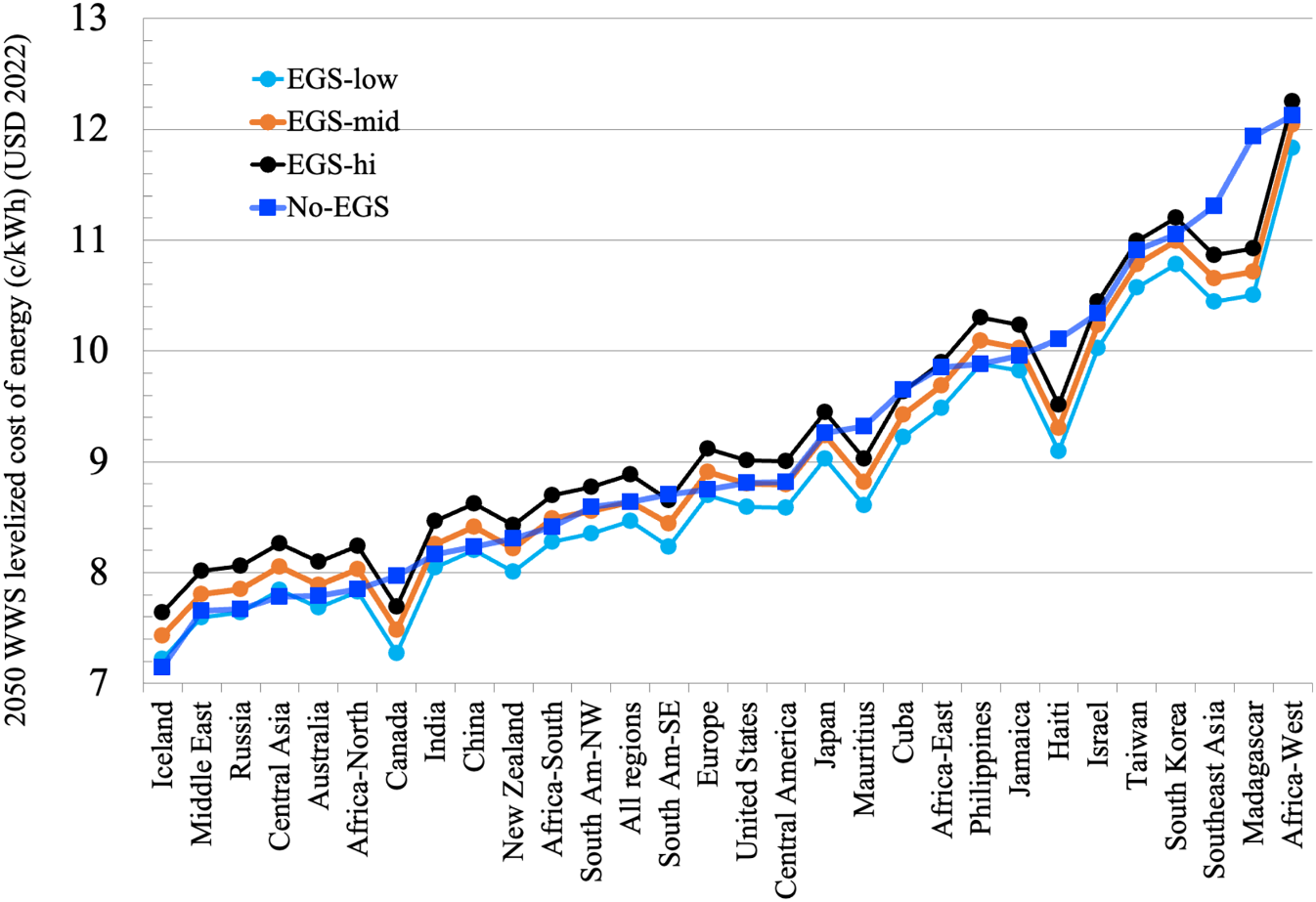
The curves are remarkably close. In the mid-cost case, adding EGS results in almost identical system costs to a no-EGS system. Even at higher assumed EGS costs, the increase remains modest. This challenges a common assumption: that adding firm, baseload generation is essential to keep renewable systems affordable. The modeling shows that 100% renewables can already be cost-competitive—and that EGS mainly reshapes the system rather than rescuing it.
Where EGS really matters: land and infrastructure
If EGS doesn’t dramatically change costs, why does it matter? The answer becomes obvious in figure below (land-use requirements). This figure shows the percentage of national land area required for new energy infrastructure under different scenarios. When EGS is added:
- Total land footprint decreases
- The biggest reductions occur in land-constrained regions
- Wind and solar capacity needs drop significantly

For countries with limited space—dense populations, limited onshore wind, or strong competition for land—EGS becomes a system enabler rather than a marginal add-on. In practical terms, EGS reduces the pressure to cover large areas with energy infrastructure, helping ease permitting conflicts and social acceptance challenges.
Fewer batteries, simpler grids
A related effect is highlighted in figure below (Installed capacity mix), which compares generation and storage capacity requirements with and without EGS. Adding EGS leads to:
- Lower wind and solar nameplate capacity
- A substantial reduction in battery storage capacity
- Less reliance on short-duration balancing assets

Baseload geothermal raises the minimum level of continuous power on the grid. That means fewer batteries are needed to bridge gaps when wind and solar output dip. For grid planners, this translates into a system that is not only clean, but structurally simpler.
Tradeoffs: no free lunch
EGS is not presented as a universal solution, and the analysis is clear about its tradeoffs.
- Cost uncertainty: Drilling remains capital-intensive, and future cost reductions are not guaranteed
- Jobs: Because EGS reduces total installed capacity of wind, solar, and batteries, overall job creation is slightly lower than in a no-EGS WWS system
- Seismic risk: Induced seismicity is a real but manageable concern
Importantly, none of these issues undermine the viability of a 100% renewable system. They simply define where and how EGS makes the most sense.
A strategic role - not a mandate
One of the most important conclusions is that system costs are relatively insensitive to how much EGS is used. Whether EGS supplies 5%, 10%, or even 20–30% of electricity, overall costs change only modestly. This gives policymakers and system designers flexibility:
- Use EGS where geology and land constraints justify it
- Skip it where wind, solar, and storage already perform well
EGS becomes a strategic option, not an ideological requirement. To close this edition, here are a few thought provoking questions worth debating:
- If EGS does not significantly lower system costs, should land use and grid simplicity be stronger drivers of energy policy decisions?
- In land-constrained countries, could EGS be the difference between a feasible and an impractical 100% renewable pathway?
- How should policymakers balance slightly lower job creation with EGS against reduced infrastructure, land use, and storage needs?
- Should public investment prioritize bringing EGS costs down now, or focus on scaling wind, solar, and storage even faster?
- Does the availability of baseload geothermal weaken the argument for nuclear power in deeply decarbonized energy systems?
GeoNerd Digest is a space for system-level thinking—where geology, grids, economics, and policy meet. If this sparked ideas, disagreements, or questions, let’s keep the conversation going.
Copyright Notice:
This summary is based on the paper "The impact of enhanced geothermal systems on transitioning all energy sectors in 150 countries to 100% clean, renewable energy" by Mark Jacobson, Daniel Sambor, @Yuanbei F. Fan, Andreas Mühlbauer and Genevieve DiBari. All figures are reproduced from the reports under fair use for review purposes.


