
GeoNerd Digest – 31st Edition: United Downs Geothermal Power and Lithium Production Plant
As I introduced in my recent linkedin post, the upcoming GeoNerd Digest editions will be dedicated to the most interesting papers from European Geothermal Congress which was held last year in Zurich and its proceedings were published a couple of weeks ago. Since Geothermal Engineering Ltd (GEL) recently announced commisioning of its United Downs Plant, there is no better topic to start with.



Besides general overview of the United Downs project, this edition will focus on two innovative features of the plant: 1. lithium production (explained in the paper Co-production of Geothermal Energy and Lithium in Cornwall, UK: Continued Development of the United Downs Geothermal Project by Thomas O.) and 2. use of ORC Radial Outflow Turbine (explained in the paper The United Downs Project: The UK's First Integrated Deep Geothermal System Harnessing an EGS Reservoir with advanced Organic Rankine Cycle by Giacomo Menghetti).
United Downs (near Redruth, Cornwall) is delivering the UK’s first deep geothermal electricity. The system couples a two‑well geothermal doublet in hot granite with a binary Organic Rankine Cycle (ORC) plant and total reinjection as shown in figure below.

Power and Lithium Co-generation
Thomas O. et al. highlights the integrated co-production of geothermal energy and lithium as a strategic opportunity for the UK. The original objective of the project was to demonstrate that fractured granites in southwest England could sustain commercial geothermal production and thereby de-risk future developments across Cornwall and the wider UK. Following successful well testing, high lithium concentrations in the deep geothermal brines triggered a parallel programme focused on critical mineral extraction.
Geologically, the project is located within the Carnmenellis Granite and targets the Porthtowan Fault Zone (PTFZ), a NNW–SSE trending fracture system aligned with the regional maximum horizontal stress. Two deviated wells form the geothermal doublet: the production well (UD1) drilled to 5,275 m measured depth and the injection well (UD2) drilled to 2,393 m measured depth. UD1 intersects the fault zone between approximately 4,100 m and 4,700 m depth in an 8½-inch open-hole section and is cased to 4,000 m. An electric submersible pump installed at 1,400 m depth lifts geothermal fluids to the surface. Reservoir testing confirmed high-temperature geothermal waters at approximately 180°C and demonstrated natural fracture permeability within the granite, enhanced through low-pressure stimulation.
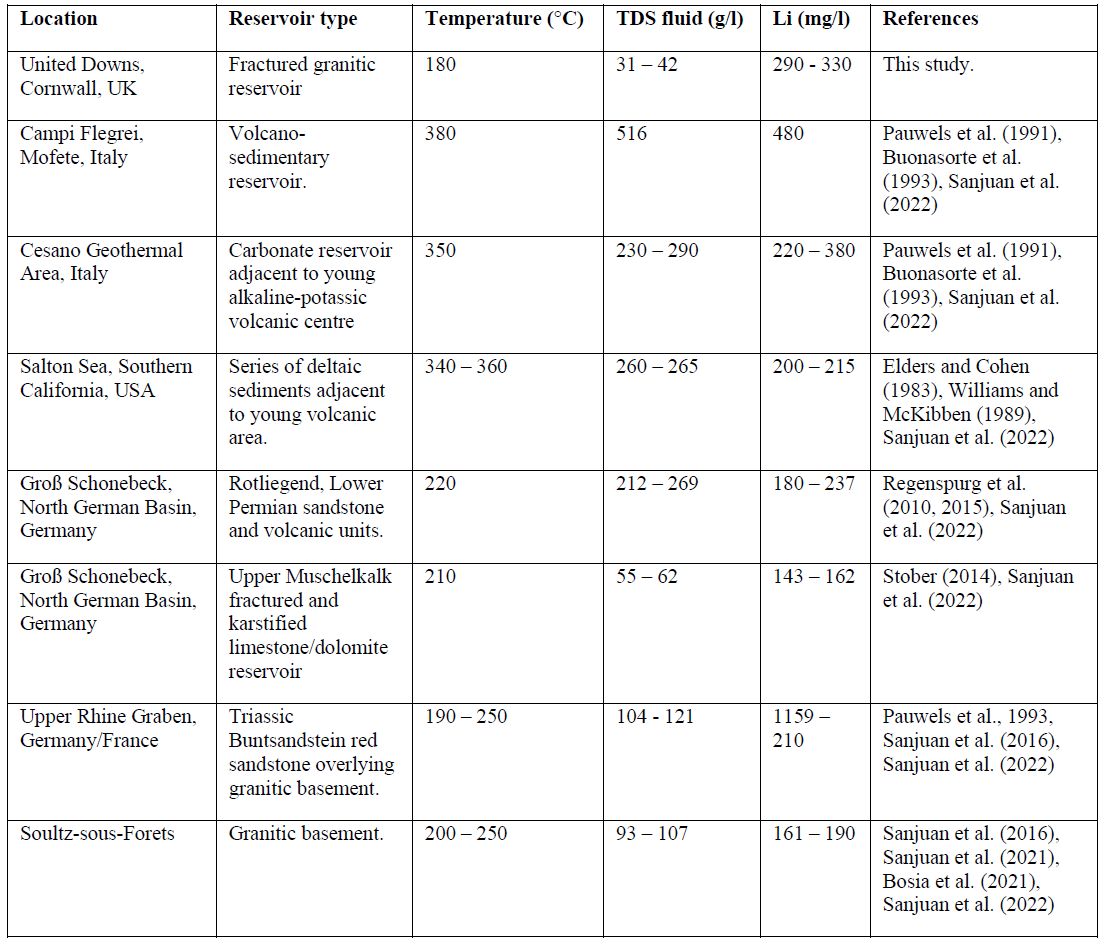
Geochemical analysis of the deep geothermal waters revealed lithium concentrations ranging between 290 and 330 mg/L (ppm), which are considered globally significant for geothermal systems. Total dissolved solids (TDS) range between 31 and 42 g/L—relatively moderate compared to other high-temperature geothermal brines worldwide. For comparison, some volcanic systems exhibit TDS levels exceeding 500 g/L with lithium concentrations around 480 mg/L, while Upper Rhine Graben systems show lithium concentrations up to approximately 1,159 mg/L but at lower temperatures of 190–250°C. The United Downs brine therefore combines elevated lithium content with manageable salinity and a temperature of 180°C, creating favorable conditions for direct lithium extraction (DLE) following power production.
Development of lithium extraction at United Downs has progressed in three major phases. The first phase consisted of a pilot study using ion-exchange DLE technology on brine samples collected from UD1. The second phase was a technical and economic feasibility study, partially grant-funded, which evaluated multiple commercial DLE technologies, assessed scalability, conducted mass and energy balances, identified potential offtakers, secured land for development, and initiated structured community engagement. The study also examined capital expenditure (CAPEX) and operational expenditure (OPEX) implications of different extraction pathways.
The third phase culminated in the design and construction of a 100 tonnes per annum (tpa) lithium carbonate equivalent (LCE) demonstration plant, completed in early 2025. Two shortlisted DLE technologies underwent extensive testing before final selection of an adsorption-based DLE process. This technology demonstrated high lithium recovery rates with low impurity levels and comparatively high technology readiness levels (TRL). Adsorption DLE at United Downs uses water rather than acid to rinse lithium from the resin, minimizing chemical reagent consumption, preventing resin degradation, and lowering OPEX. The demonstration plant includes full process design, equipment procurement, construction, commissioning, and integrated testing. Data collected during operation will directly inform commercial scale-up.
Community and stakeholder engagement has been extensive throughout development. During the demonstration project alone, the team participated in more than 80 community events, including 19 school visits and 6 open days, engaging over 3,000 individuals. Political engagement at both local and national levels has also supported the project’s positioning within the UK’s emerging critical minerals strategy.
Looking forward, the company is targeting commercial lithium production at United Downs in the range of 1,000–1,500 tpa LCE following successful demonstration testing. Planning permission has already been secured for two additional geothermal sites in west Cornwall—Manhay and Penhallow—which are forecast to deliver approximately 4.9 MW gross power output each using similar geothermal doublet designs. These sites also hold potential for lithium extraction pending resource confirmation. Given the extensive fault systems across Cornwall and similar geological characteristics, replication potential is considered high.
ORC Radial Outflow Turbine
Giacomo Menghetti et al. describes a seven-day reservoir circulation test in July 2021 simulating full power plant operation using an electrical submersible pump. The design incorporates wide well spacing and a downhole production pump to create a pressure sink, aiming for near 100% fluid recovery and long-term thermal sustainability.
At the surface, geothermal brine enters the ORC plant and is cooled to about 50°C in shell-and-tube heat exchangers equipped with duplex tubes. The thermal energy is transferred to an organic working fluid, which is preheated, evaporated, and superheated before expansion in Exergy ORC’s proprietary Radial Outflow Turbine (ROT). The turbine design allows up to nine stages on a single disk, operates at relatively low rotational speeds, and accommodates multiple pressure admissions.

Gross electrical output reaches about 3 MWe. However, auxiliary consumption is significant: approximately 500 kWe for the ORC system, 580 kWe for the production pump, and 320 kWe for reinjection pumps. After subtracting these loads, net power output is approximately 1.6 MWe. The plant is expected to reduce CO₂ emissions by roughly 6,500 tonnes per year compared to fossil-fuel-based electricity generation. In addition to electricity, the project is planned to supply up to 10 MWth of zero-carbon heat to the Langarth Garden Village development.
Discussion and Conclusion
To close this edition, here are a few thought provoking questions:
- If geothermal offers baseload renewable power + district heat + lithium… should it be prioritized differently in EU/UK funding frameworks?
- Does integrating lithium extraction improve the economics of deep geothermal enough to accelerate deployment? Or does it add complexity and risk?
- With 180°C brines and ~300 ppm lithium concentrations — is this the tipping point for geothermal lithium in Europe?
- How replicable is the United Downs model across other granite-hosted fault systems in Europe?
Overall, the United Downs project demonstrates how deep EGS reservoirs combined with advanced ORC technology can deliver low-carbon electricity, district heating, and critical raw materials from a single integrated system. With 5 km deep wells, 180°C brine temperatures, 3 MWe gross output, 1.6 MWe net power, 10 MWth heat supply, 340 ppm lithium concentration, and 6,500 tonnes of annual CO₂ savings, the project stands as a technically ambitious and strategically important milestone for geothermal development in the UK and Europe.
Copyright Notice:
This summary is based on the papers "Co-production of Geothermal Energy and Lithium in Cornwall, UK: Continued Development of the United Downs Geothermal Project" by Thomas O., Ryan Law and Poppy Edgecombe and "The United Downs Project: The UK's First Integrated Deep Geothermal System Harnessing an EGS Reservoir with advanced Organic Rankine Cycle" by Giacomo Menghetti and Marta Giudici. All figures are reproduced from the reports under fair use for review purposes.


