
GeoNerd Digest – 32nd Edition: Lessons from the Haute-Sorne EGS Project
This week we continue in a review of technical papers from EGC2025 - in this edition focusing on two complementary papers from the Haute-Sorne Enhanced Geothermal System (EGS) project (Canton Jura, Switzerland). Both papers tell a single, highly actionable story: deep geothermal success is not just about finding heat—it’s about making crystalline rock “predictable” enough to drill efficiently and stimulate safely.

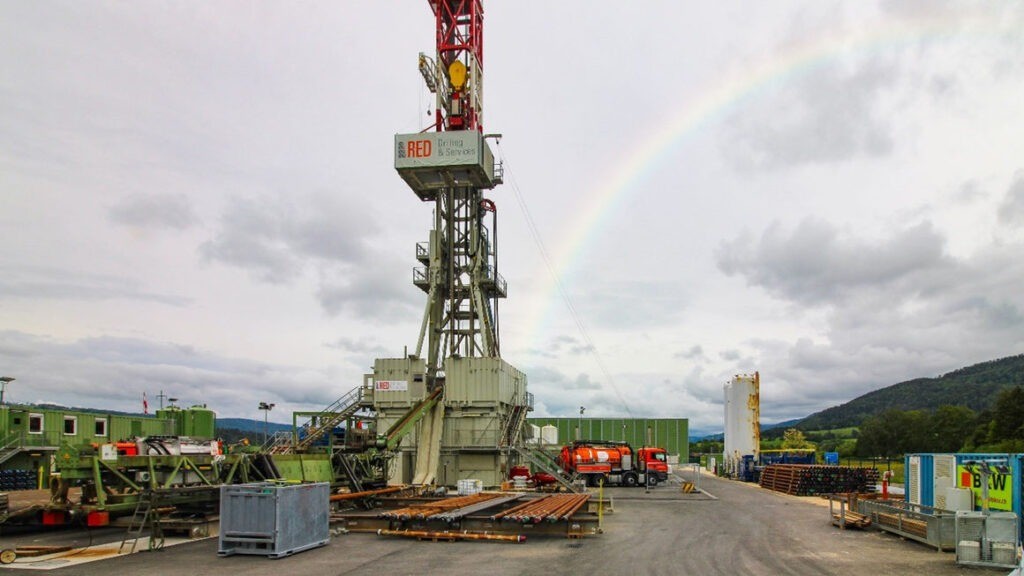

The first paper titled "Hot dry granite drilling optimization through iterative bit selection and mechanical specific energy management" by Alexis Garcia et al. shows how physics-based “limiter redesign”, step-testing, and iterative polycrystalline diamond compact (PDC) bit evolution can turn hard-rock drilling from “trial-and-error” into a disciplined process that manages dysfunction and wear. In their case study, the GVL-1 well reached total depth ahead of plan, and the authors argue that maximizing early depth-of-cut (to delay rapid wear-flat-driven ROP decline) plus targeted cutter/bit selection are central to performance gains in granite and gneiss.
The second paper titled "First results from the exploration phase of the Haute-Sorne EGS project in Canton Jura, Switzerland" by Peter Meier et al. broadens the lens: it reports the first exploration phase outcomes (geophysics, drilling, logs/measurements) and lays out a risk-managed stimulation test plan grounded in lessons from Basel and field experience from western U.S. EGS projects. It highlights how Ambient Noise Tomography helped anticipate lithologic changes, how initial 3D seismic interpretation suggests an absence of major faults affecting the local seismic-risk model, and how the project embeds dense monitoring + a Traffic Light System (TLS) into the stimulation design.
Taken together, the most transferable insight for geoscience practice is this: drilling optimization and seismic-risk mitigation are coupled.
Drilling of the Glovelier-1 (GVL-1) exploration well
Alexis Garcia et al. targets one of geothermal’s biggest cost drivers: hot, hard crystalline drilling—where rate of penetration (ROP) degradation and bit damage can quickly dominate time and cost. It applies lessons and workflows used in Utah FORGE to the Haute-Sorne GVL-1 well (figure below), emphasizing dysfunction control and mechanical specific energy (MSE) surveillance as a real-time decision support tool.

A central concept of the study is the physics-based limiter redesign workflow (figure below), which identifies the operational parameter that limits drilling performance at a given moment. Typical limiters include weight on bit (WOB), rotation speed (RPM), or flow rate, and the method focuses on understanding how these parameters interact with the drilling system. Instead of relying on empirical adjustments, the workflow uses physical principles and real-time monitoring—particularly mechanical specific energy (MSE)—to detect inefficiencies and redesign drilling parameters or tools. Training of the entire drilling team was a key component of this approach, ensuring that engineers, operators, and rig personnel could recognize and respond to drilling limiters during operations.

The study also addresses the phenomenon of early rate-of-penetration (ROP) decline commonly observed in hard rock drilling. In crystalline formations such as granite, ROP typically decreases by 30–50% within the first tens of meters of drilling, largely due to the development of wear flats on PDC cutters. These wear flats increase friction and reduce cutting efficiency even before significant cutter failure occurs. The research emphasizes increasing the depth of cut per revolution, mainly by increasing WOB, to drill more footage before these wear flats form, thereby prolonging effective drilling performance.
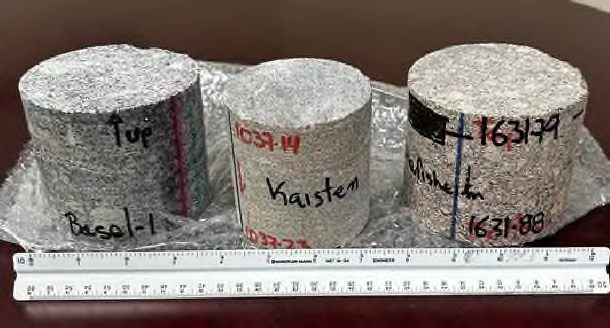
To better understand the drilling behavior of the target formations, laboratory experiments were conducted on core samples from three rock types: monzonite, metapelite, and granite (figure below). Single-cutter tests with polycrystalline diamond compact (PDC) cutters measured axial, tangential, and lateral forces during rock cutting. Results showed that the monzonite sample required 10–15% higher cutting forces than the granite benchmark used in earlier FORGE studies, indicating a stronger rock formation. These laboratory measurements helped guide the selection of cutter geometry, cutter materials, and bit design parameters for the geothermal drilling application.
The paper also evaluates the performance of chisel-shaped PDC cutters compared with conventional round cutters (figure below). Laboratory and full-scale tests demonstrated that chisel-shaped cutters concentrate stress more effectively on the rock, causing fractures sooner and improving chip removal. This design can shorten the shearing length and reduce cutter wear, while also improving stability and reducing vibrations in the drilling process. As a result, chisel cutters were selected for the geothermal drilling program because they can tolerate higher loads and improve drilling efficiency in very hard formations.

During field operations, several drilling limiters and operational challenges were encountered. These included borehole instability in unexpected sedimentary intervals, vibration issues related to shale shaker resonance, and bottomhole assembly (BHA) wear caused by high WOB. The drilling team used real-time monitoring and step tests to adjust parameters and evaluate bit performance. Multiple PDC bit designs with different blade counts, cutter sizes, and depth-of-cut control elements were tested to determine the optimal configuration for drilling the crystalline basement. The ROP and footage range is much lower when compared to Fervo´s / Utah FORGE achievements: 4.8 - 11.5 m/hr and 61 - 274 m in basement section (under blue line in figure below).

Overall, the study demonstrates that combining physics-based drilling practices, iterative bit design, and laboratory cutter testing can significantly improve drilling performance in geothermal wells. The GVL-1 well reached its total depth 26 days ahead of the authorized schedule (figure below), showing the effectiveness of these methods. The authors conclude that aggressive cutting structures, optimized cutter geometry, and continuous monitoring of drilling efficiency—especially through MSE analysis—are essential for improving drilling efficiency and reducing costs in deep geothermal projects targeting hard crystalline formations.

Borehole measurements and upcoming phases
Peter Meier et al. describes the project´s three phases. The first phase focuses on exploration, including geophysical surveys, drilling of a 4 km deep exploration well, and a stimulation test. The second phase involves drilling a second deviated well, creating a geothermal reservoir through multi-stage hydraulic stimulation, and performing circulation tests between wells. The final phase would involve building the geothermal power plant.
Before drilling of GVL-1 began, several geophysical investigations were carried out to better understand the subsurface. These included Ambient Noise Tomography in February 2024 and 2D seismic surveys in April 2024, followed later by a 3D seismic campaign in January 2025. According to the geological interpretation illustrated below, the well penetrated several sedimentary formations before reaching the crystalline basement. The data confirmed predicted lithological changes and revealed the presence of previously uncertain Permocarboniferous sediments more than 700 m thick, including coal-bearing layers.

The well ultimately reached the expected crystalline basement composed mainly of granite and gneiss. Borehole measurements showed that these rocks contain numerous natural fractures that could potentially be stimulated to create an artificial geothermal reservoir. Preliminary temperature measurements at 4000 m depth indicate a typical Swiss geothermal gradient of about 30°C per kilometer. Importantly, no induced seismicity was detected during drilling or cementing, which is a critical factor for project acceptance given the historical seismic concerns associated with geothermal projects in Switzerland.
The next major step is a stimulation test planned for summer 2025, targeting a promising fracture zone between approximately 3800 and 3825 m depth. The design of this test is informed by experience from previous geothermal projects, particularly the Basel project in Switzerland and the Utah FORGE research project in the United States. The stimulation involved injecting roughly 500 m³ of water while monitoring microseismic activity using downhole geophones and fiber-optic sensing systems. The goal was to characterize fracture behavior and reservoir permeability while maintaining strict seismic risk limits.

Because of the seismic events associated with earlier geothermal projects such as Basel (2006) and Pohang (2017), the Haute-Sorne project incorporates extensive risk mitigation and monitoring measures. These include a dense seismic monitoring network with 11 stations, a sophisticated Traffic Light System (TLS) for controlling injection operations, and strict regulatory requirements. Environmental safeguards also include groundwater monitoring, protective casing for aquifers, and environmental liability insurance covering up to CHF 100 million in potential damages.
Overall, the exploration phase demonstrates encouraging technical progress and indicates that the geological conditions are suitable for developing an EGS reservoir. The project has benefited from technological advances and operational experience gained from international geothermal research efforts such as Utah FORGE and FERVO Energy’s EGS developments. If the upcoming stimulation and reservoir creation steps succeed, the Haute-Sorne project could deliver Switzerland’s first electricity-producing geothermal power plant and demonstrate a scalable model for deep geothermal energy development in Europe.
Comparative synthesis for geoscience practice and research
These papers are best read as two halves of one system: (a) how to drill crystalline rock efficiently and (b) how to characterize and stimulate it responsibly. They overlap on the same well (GVL-1) and converge on a shared principle: reduce uncertainty early, then manage what remains with high-resolution monitoring and deterministic workflows.
A key connection is the interplay between “engineering noise” and “subsurface signal.” The drilling paper shows how surface/downhole dysfunctions (vibration, borehole quality issues, tool limits) can constrain WOB/RPM and degrade performance; the exploration paper shows how seismic-risk governance, operational noise limits, and monitoring requirements shape what is permissible during stimulation. In practice, better drilling stability supports better data, and better data supports safer stimulation decisions—closing a loop that is as much geoscience as it is drilling engineering.
Conclusion and Discussion
The drilling story is a reminder that “granite is granite” is not a plan. The team combined field operations with lab single-cutter testing to anticipate how different Swiss crystalline rocks might load and wear a PDC cutting structure. In the lab, one rock sample clearly demanded higher cutting forces than the benchmark granite—exactly the kind of signal that should shape bit aggressiveness, cutter grade/shape, and how hard you dare to push WOB early in a run.
The second drilling insight is one every geoscientist working with drillers should memorize: in hard rock, ROP often drops early and fast, not necessarily because the system is failing, but because wear flats form quickly and change cutting efficiency. The operational response is not hand-waving—it’s step tests, clear “limiter” identification, and pushing depth-of-cut early within the constraints of vibration, weight transfer, and wellbore quality.
And it worked. The GVL-1 drilling curve shows actual depth progressing ahead of plan—evidence that disciplined, physics-based drilling can materially compress schedule in crystalline basement.
Now zoom out. The exploration-and-planning paper shows what “making the subsurface legible” looks like at project scale. Ambient Noise Tomography is presented as a surprisingly useful predictor of lithologic changes along the well—a cost-reduction lever if it proves repeatable. Finally, the stimulation-readiness narrative is built around bounded risk: pick a candidate interval with favorable natural fracture characteristics, instrument it heavily (including downhole sensors and fiber), and inject stepwise under a Traffic Light System designed to react to what the rock actually does.
A couple of questions triggered by this unique project:
- Both papers emphasize iterative learning from previous wells and projects. How can the geothermal industry accelerate this learning cycle—through shared data platforms, collaborative field laboratories, or standardized reporting?
- In hard rock geothermal drilling, should future innovation focus more on bit technology, or on system-level optimization such as BHA design, vibration control, and digital drilling analytics?
- To what extent can drilling and stimulation practices developed in the U.S. geothermal context be transferred directly to European crystalline basement environments like Switzerland?
- Projects like Haute-Sorne target 5 MW, while developments like FERVO aim for hundreds of megawatts. What are the main technical and economic barriers that still need to be overcome to scale EGS to gigawatt-level deployment?
Copyright Notice:
This summary is based on the papers "Hot dry granite drilling optimization through iterative bit selection and mechanical specific energy management" by Alexis Garcia, Andre El-Alfy, Sam Noynaert, Prabhakaran Centala, Dawid Wojaczek and Stefan Moldoveanu and "First results from the exploration phase of the Haute-Sorne EGS project in Canton Jura, Switzerland" by Peter Meier, Olivier Zingg, Andre El-Alfy, Falko Bethmann, Raymi Castilla, Benjamin Lübbers, Fabien Christe, Claire E. Julia Heilig, Andres Alcolea, Ben Dyer, Dimitris Karvounis, Dieter Ollinger, Rémi Fiori, Robin Allenbach, Waleed SAATI, Marie-Anne Etter , Yvette Allimann . All figures are reproduced from the reports under fair use for review purposes.


