
GeoNerd Digest – 33rd Edition: From Repurposed Wells to CO₂ Circulation
The Groß Schönebeck site in Germany is once again attracting attention. Recently, Green Therma announced plans to deploy a novel closed-loop geothermal system at this location—marking an important step in the evolution of deep geothermal technologies. This raises a natural question: what do we already know about the potential of this site for closed-loop applications?

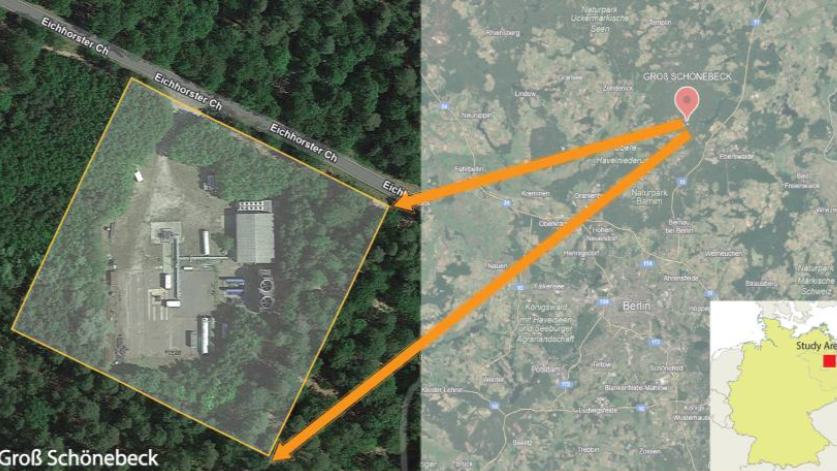

To explore this, we take a closer look at recent research, including a detailed numerical study of a single-well closed-loop deep borehole heat exchanger (DBHE) at Groß Schönebeck. The paper by Lingkan Finna Christi et al. provides valuable insights into how existing wells can be repurposed, what performance can be expected, and how such systems behave over long-term operation.
At the same time, another topic keeps coming up in my discussions with a couple of geothermal experts: the use of CO₂ as a working fluid in closed-loop systems. Many are asking—how far are we from real implementation, and does CO₂ truly offer a meaningful advantage over water? To address this, we also examine the study by Vlasios LEONTIDIS et al., which compares water and CO₂ across multiple European sites. Their work sheds light on thermosiphon effects, system performance, and the realistic trade-offs between thermal output and operational benefits.
Together, these two perspectives—real-site application at Groß Schönebeck and fluid innovation through CO₂—help us better understand where closed-loop geothermal stands today, and where it may be heading next. Also, both EGC 2025 papers conclude our mini series reviewing the most interesting papers of this event. In our upcoming editions we will focus on the most interesting papers from Stanford Geothermal Workshop 2026.
Repurposing hydrocarbon wells at the Groß Schönebeck site
The main objective of the paper titled "Numerical simulation of a single-well closed-loop deep borehole heat exchanger (DBHE) at the Groß Schönebeck site" is to evaluate whether existing deep hydrocarbon wells can be repurposed for geothermal energy extraction using a coaxial closed-loop system. The study demonstrates the feasibility of using such infrastructure as an alternative to conventional Enhanced Geothermal Systems (EGS), which have faced productivity challenges at the site.
The Groß Schönebeck site has a long history as a geothermal research platform, originally based on a deep gas exploration well E GrSk 3/90 drilled in 1990 and later complemented by a second geothermal well Gt GrSk 4/05 (A2). Due to issues such as low permeability, clogging, and corrosion, doublet-based geothermal production has been limited. The site can now serve as a testbed for alternative concepts, including the DBHE approach, which avoids direct fluid interaction with the reservoir.
The geothermal potential of the site is strongly influenced by its geological setting, particularly the Zechstein salt formation. This formation has high thermal conductivity and low permeability, making it suitable for closed-loop systems where heat transfer occurs mainly by conduction. The so-called “chimney effect,” described in the text, enhances heat accumulation in salt structures, which can be effectively exploited by borehole heat exchangers.
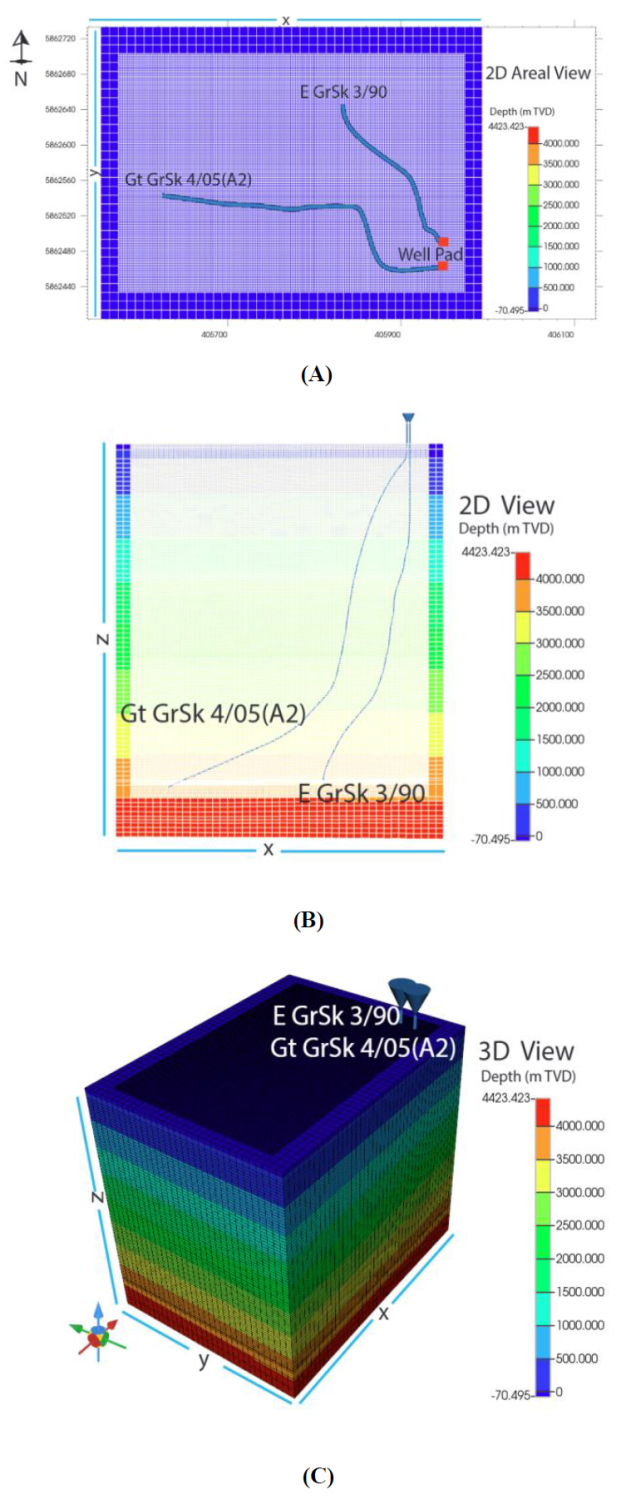
The methodology is based on a coupled numerical model using the CMG STARS simulator combined with a wellbore model (Flexwell). The model incorporates mass, momentum, and energy conservation, as well as conductive heat transfer between the well and surrounding rock. A detailed geological model (shown below) is used to represent 15 geological layers and accurately simulate the thermal behavior around the wells. (A) represents 2D Areal view of model setup (i,j direction); (B) stands for 2D Areal view of model setup (i,k direction); and (C) is a 3D view of the model setup (i, j, k directions).
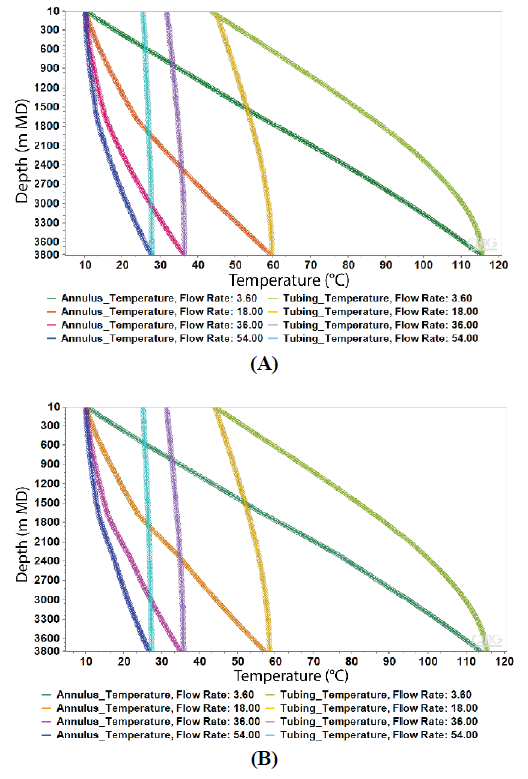
Simulations are performed for different operating conditions, including varying flow rates (3.6 to 54 m³/h) and inlet temperatures (10–80°C). The results show that flow rate has a strong influence on system performance. As seen below, higher flow rates reduce the temperature gained by the fluid due to shorter residence time, while lower flow rates allow higher heating but reduce overall energy extraction.
The long-term behavior of the system is also analyzed over a 30-year period. Figure below show that although the reservoir temperature gradually declines—by about 37°C at depth—the outlet temperature remains relatively stable. This indicates that the DBHE system can provide consistent heat output over long periods, which is advantageous for baseload applications.

Thermal power generation depends on both flow rate and inlet temperature. According to the contour plots in Figure 9 on page 7, the highest thermal power—up to approximately 1000 kW—is achieved at high flow rates (36–54 m³/h) and low inlet temperatures (below 20°C). Increasing the inlet temperature reduces the temperature difference and thus lowers the energy output, highlighting the importance of optimizing operating conditions.

In conclusion, the study shows that repurposing existing wells as closed-loop DBHE systems is a technically viable option for geothermal energy extraction at Groß Schönebeck. The optimal operating conditions are identified as low inlet temperatures (~10°C) and moderate flow rates (~18 m³/h), yielding stable performance over decades. While the system produces moderate thermal power compared to conventional geothermal systems, its reliability, low reservoir dependency, and potential for reuse of existing infrastructure make it an attractive solution for sustainable heat production.

And What About CO₂ as a working fluid?
The paper "Modelling heat transport and thermosiphon flow in closed-loop deep geothermal systems" investigates heat transport and thermosiphon-driven flow in closed-loop deep geothermal systems, with a particular focus on comparing water and CO₂ as working fluids. It is developed within the HOCLOOP project, which aims to advance closed-loop geothermal technologies using innovative drilling and system designs. The study evaluates whether replacing water with CO₂ can enhance performance through improved heat recovery and natural fluid circulation driven by density differences.
The authors model geothermal systems at three European sites—France, Italy, and Poland—representing different geological conditions and temperature regimes. These systems use co-axial borehole heat exchangers with a horizontal extension, where fluid is injected through the annulus and returns via a central pipe. The study compares water and CO₂ under realistic operating conditions, including pressure- and temperature-dependent fluid properties.
To perform the simulations, three numerical tools are applied: GWellFM, BHEModel2.0, and GTW. All models solve mass, momentum, and energy balances and simulate heat transfer between the fluid and surrounding rock. They differ mainly in how they treat thermodynamics and transient heat conduction. A validation case (illustrated in Figure 1 on page 3) shows that all models provide consistent predictions of outlet temperature and pressure, with only minor discrepancies due to differences in fluid property calculations and numerical approaches.
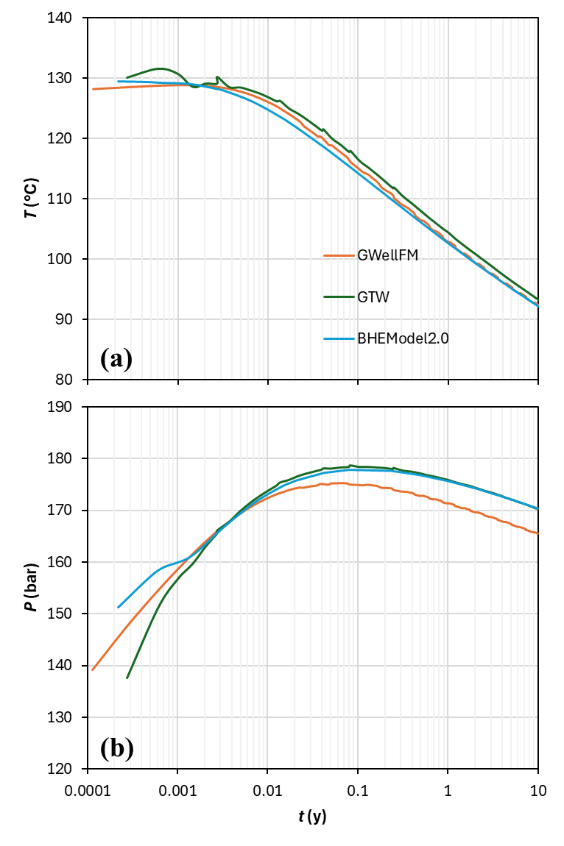
The French case study focuses on the Paris Basin, a low-temperature sedimentary environment. Results show limited thermal performance for closed-loop systems, with a rapid decline in output temperature and power over time due to cooling of surrounding rocks. As shown below, water consistently outperforms CO₂ in terms of thermal output.
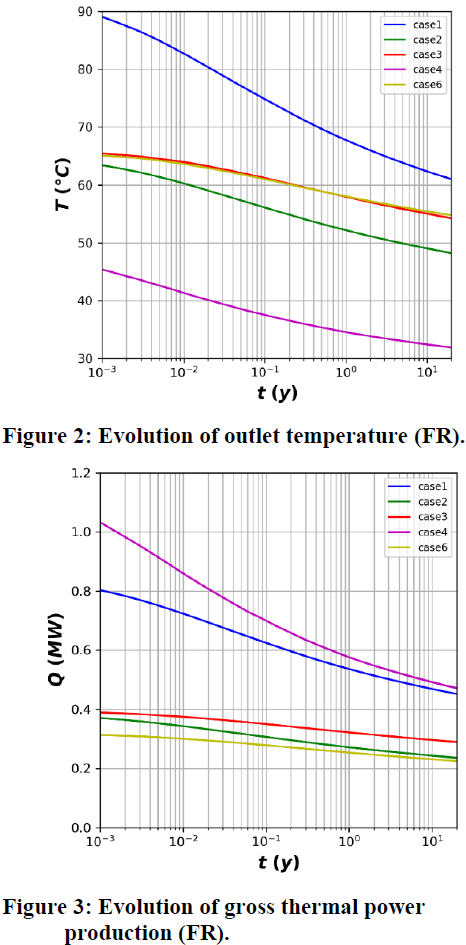
However, figure below illustrate that CO₂ generates higher outlet pressures due to the thermosiphon effect, which can support natural circulation.

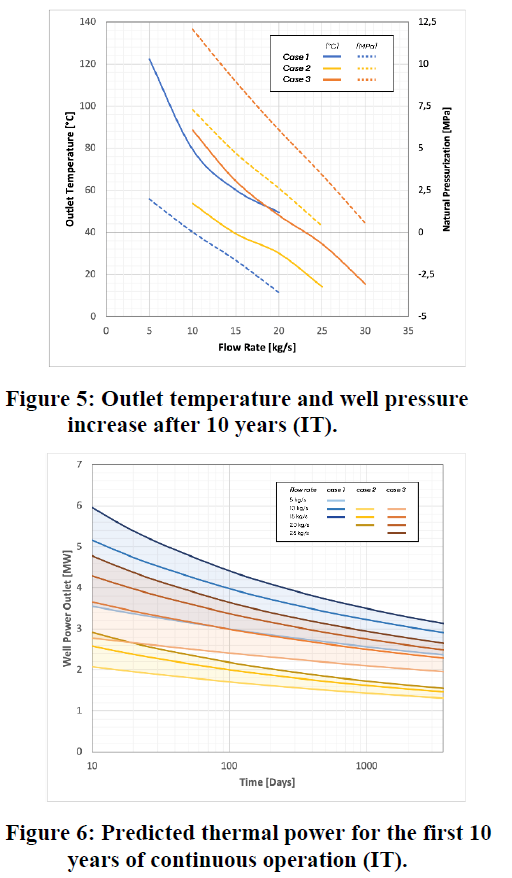
In contrast, the Italian case (Gavorrano) benefits from a higher geothermal gradient and longer wells, leading to significantly higher energy production. As shown in charts on page 5 (Figures 5–7), water systems achieve higher thermal output—over 3 MW after 10 years—while CO₂ systems produce slightly less heat. However, CO₂ enables stronger natural circulation due to higher pressure gains, reducing or eliminating the need for pumping at certain flow rates.
The Polish case examines a salt dome structure and highlights a different advantage of CO₂. Figures below show that while CO₂ results in lower thermal output compared to water, it creates substantial overpressure at the surface. This pressure can be exploited to generate electricity, making CO₂-based systems potentially suitable for combined heat and power applications. The study also notes that CO₂ remains in a supercritical state throughout operation.
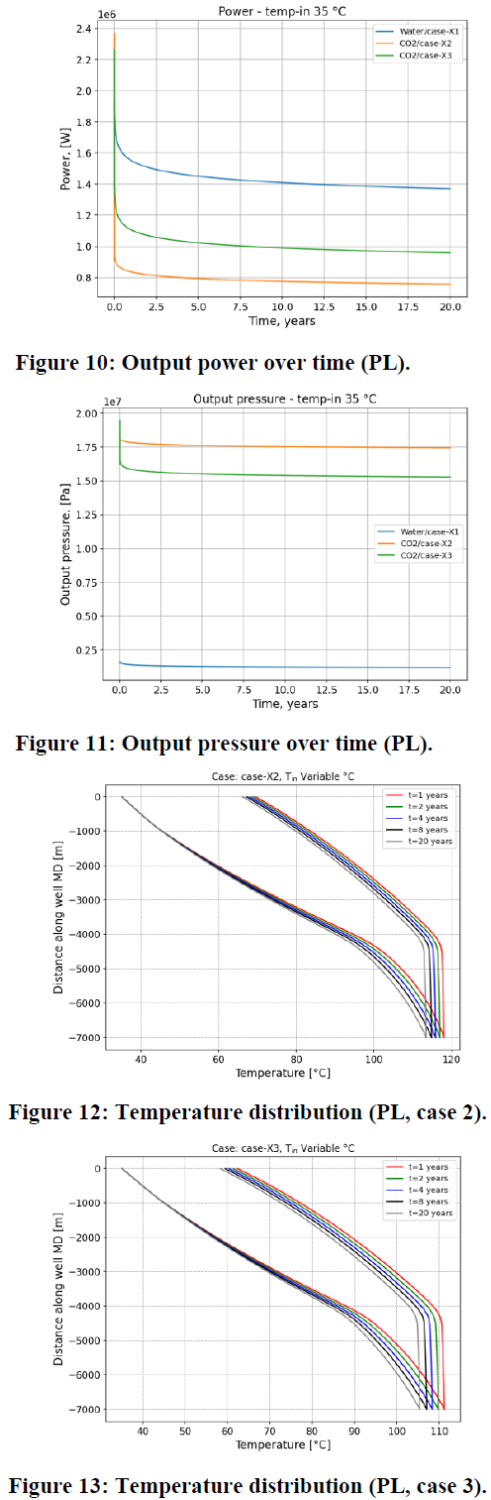
Across all case studies, a key observation is the rapid initial decline in system performance due to thermal depletion of the surrounding rock. This effect is visible in multiple time-evolution graphs throughout the paper. Both water and CO₂ systems experience this decline, but water extracts more heat initially, leading to faster local cooling.
In conclusion, the paper finds that water generally provides higher thermal output, especially in low-temperature settings, while CO₂ offers advantages in terms of natural circulation and potential electricity generation. The choice of working fluid depends strongly on geological conditions and project goals. Although CO₂ systems require higher pressures and more complex surface infrastructure, they may improve overall system efficiency and enable hybrid energy production in suitable environments.
Questions triggered by both papers
- Would you trade higher thermal output (water) for better self-circulation and pressure benefits (CO₂)?
- How important is long-term stability vs. peak performance in geothermal projects?
- Could closed-loop systems become the missing link for scaling geothermal across Europe?
- What would it take for YOU to consider CO₂-based systems in a real project?
Copyright Notice:
This summary is based on the papers "Numerical simulation of a single-well closed-loop deep borehole heat exchanger (DBHE) at the Groß Schönebeck site" by Lingkan Finna Christi, Mrityunjay Singh, Maximilian Frick, Hannes Hofmann, Ben Norden and Ingo Sass and "Modelling heat transport and thermosiphon flow in closed-loop deep geothermal systems" by Vlasios LEONTIDIS, Pietro Ungar, Paweł Wojnarowski, Thibaud Chevalier, Daniele Fiaschi, Leszek Pająk, Magnus Wangen and Christine Souque. All figures are reproduced from the reports under fair use for review purposes.


