
GeoNerd Digest – 38th Edition: Closed-Loop Geothermal: One Project, Two Verdicts
For this edition of the GeoNerd Digest, we step away from the conference proceedings and put two very different public write-ups side by side. Both are about the same concept: closed-loop geothermal, the "engineered radiator in the crust" concept that promises geothermal energy almost anywhere, without permeable reservoirs and without fracking.

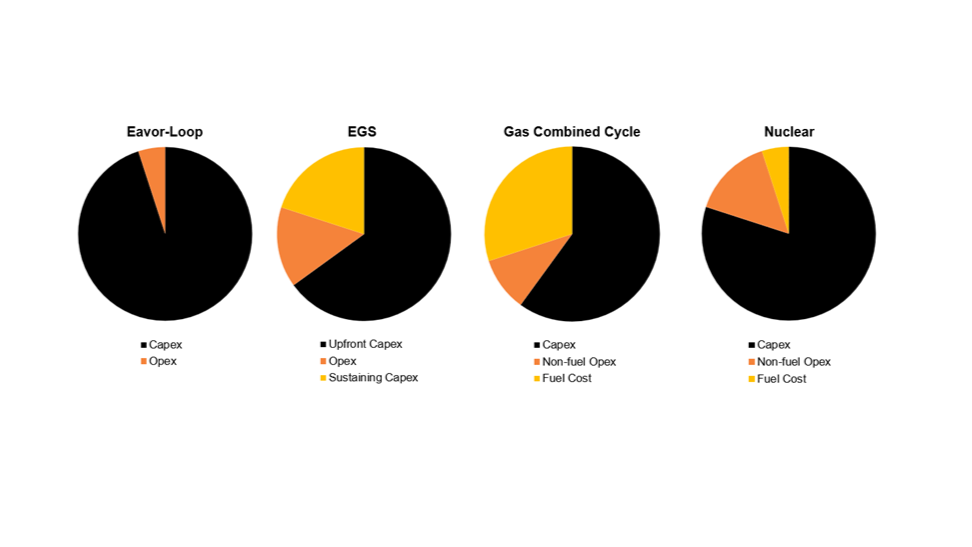

The reason this question is suddenly so live is Geretsried, Bavaria, which was meant to be the proof. It is Eavor Technologies Inc.'s first commercial-scale Eavor-Loop, deliberately sited on the ground of a failed conventional geothermal project where earlier wells had found rock that was, in Eavor's own words, "hot but dry". The full development was designed around four loops, each with twelve roughly 6 km lateral pairs, for around 72 km of total reservoir exposure and a nameplate of 8.2 MW electric and 64 MW thermal. That is the headline that drew the funding and the attention, including roughly €92 million through the EU Innovation Fund.
The field result landed well short of that headline. Loop 1 was stopped after six drilled and intersected lateral pairs rather than twelve, and only a portion of those ended up contributing meaningfully to flow. Reporting through 2025 and 2026 put gross output in the range of fractions of a megawatt to a couple of megawatts electric, with effectively nothing delivered to the grid for an extended period. Because this is a publicly funded, first-of-a-kind project, the gap between the 8.2 MWe nameplate and the delivered reality drew sharp scrutiny, including pointed questions from GeoExpro about how willing Eavor was to share its drilling results at all. That scrutiny is fair, and it is exactly the moment to go back to the underlying physics and ask whether the concept was ever going to clear the bar.
So this edition reviews two documents that bracket that debate. The first is Mark McClure's 2023 ResFrac Corporation analysis, which argues from first principles that deep closed-loop is fundamentally disadvantaged. The second is the May 2026 technical update from Eavor's CTO, Matthew Toews, which is the most candid account we have of what actually happened in the ground at Geretsried. The interesting part is not that they disagree. It is how much they agree on the physics, and where the genuine disagreement actually sits.
The skeptic's case: Mark McClure (ResFrac)
"Technical barriers for deep closed-loop geothermal" is a clear, deliberately structured argument, and its strength is that it never hides behind hand-waving. McClure states his thesis up front: closed-loop heat exchangers rely on conduction, and sometimes free convection, to move energy into the well, and both are far slower than the forced convection that feeds a conventional geothermal well. Slower energy transport means lower power per metre of wellbore, which means worse economics. Everything in the piece follows from that one physical fact.
A real strength is how McClure quantifies the problem rather than asserting it. He leans on the Beckers and Johnston (2022) analysis of an Eavor-class design: a 7.5 km deep system with twelve laterals and more than 90 km of total downhole length, producing roughly 8.6 MWe at a high gradient of 60 C/km and only about 2.2 MWe at a medium gradient of 30 C/km. Set against the 4 to 6 MWe typical of a conventional geothermal well drilled to a fraction of that length, the productivity-per-metre penalty becomes obvious. His sharpest comparison is that a conventional or EGS well into the same very hot rock could produce on the order of ten times more electricity for roughly ten times less drilling.
The most useful section is where he names the two hard barriers in plain terms. Barrier one: the design needs a dramatic reduction in drilling cost while simultaneously executing an exceptionally complex, long, multilateral well at very high temperature. Barrier two: it needs near-perfect sealing of tens of kilometres of effectively uncased, uncemented wellbore, and that seal has to survive as the rock cools and contracts and starts to crack. Both barriers are framed as engineering realities, not opinions, and that is what makes them hard to wave away.

McClure then walks through the cleverer "wrinkles" people propose to escape the conduction penalty, and shows why each runs into a wall. Thermally conductive fractures fail because useful contribution would need materials more conductive than anything known, and crack aperture is capped by rock stiffness. Natural-convection designs either rely on a single fracture, which cannot carry economic flow, or on very specific steam-dominated geology, in which case you may as well just produce the well conventionally. Retrofitting old oil and gas wells founders on the same low power per metre, made worse by modest temperatures. The recurring pattern is honest and a little brutal: every workaround either violates materials physics or recreates a problem that conventional geothermal already solves more cheaply.
Where the piece is most balanced is the closing. McClure does not say closed-loop is impossible. He defines a narrow "best case": a purely conductive design, a market willing to pay for relatively low-enthalpy direct-use heat rather than electricity, a site that genuinely lacks permeable formations so conventional wells are not an option, large decreases in drilling cost, and sealing materials that stay intact as the formation cools. That list reads less like a dismissal and more like a specification. Hold onto it.
The operator's field log: Matt Toews (Eavor)
"What we built, what we learned, and what comes next" is the other half of the conversation, and its strength is candour. Toews does not lead with the disappointing electricity number. He leads with the claim that the physics was proven, then spends most of the document on the execution problems that kept Loop 1 from reaching its design size. For a first-of-a-kind project, that emphasis is the right one, and the transparency is a genuine shift from the reticence GeoExpro had criticised earlier.
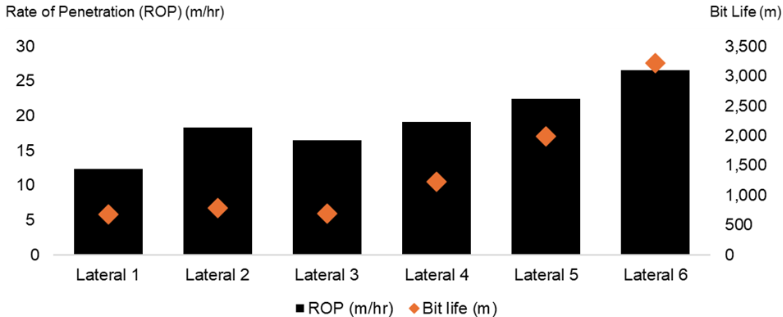
The drilling-execution section is the most valuable part for a drilling audience, because it is specific about what went wrong and what fixed it. The original mud system, borrowed from conventional southern-Germany wells, did not suit the carbonate laterals, so hole cleaning and wellbore stability suffered until an engineered mud system was adopted. Severe shocks, vibration, and torque dysfunction in long, deep, hard-rock laterals shortened bit life and forced extra trips, until bit and BHA redesign, parameter changes, better lubricity, and dynamics-mitigation tools brought rate of penetration and run length up. As we already reported in the 27th edition of GeoNerd, the learning curve is the headline engineering result: across the six laterals, penetration rates roughly doubled and the length drilled per run rose several-fold, ending with a lateral pair drilled in a single run per rig.
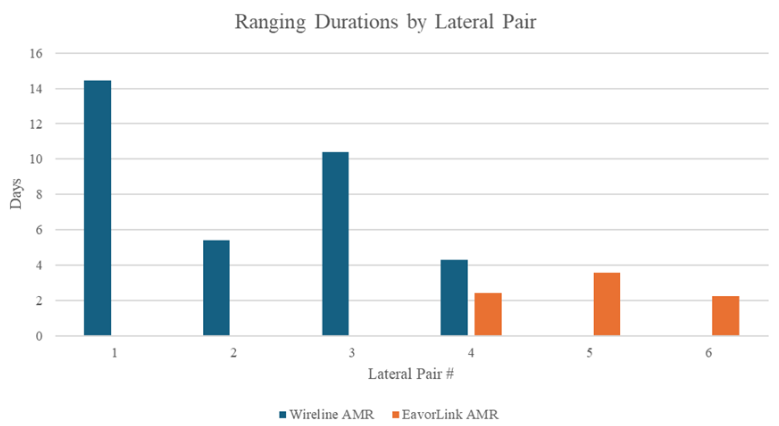
The intersection story is the most quietly impressive bit. Connecting two horizontal wells at around 8,000 m measured depth, repeatably, was widely assumed to be impractical, and Eavor reports first-attempt intersections on all six pairs. Just as interesting for our field, they moved from slow, expensive wireline-conveyed magnetic ranging to ranging-while-drilling with their Eavor-Link active magnetic ranging system, cutting ranging and intersection time substantially. That is a real, transferable drilling-technology gain, independent of whether the loop economics ever close.
The most consequential problem, by Eavor's own admission, was hydraulic communication between the two rigs. Poor cement jobs on the cased motherbores left an annular channel behind the casing that connected the lateral pairs, so fluid, pressure, and cuttings could migrate between previously drilled laterals. That broke the parallel two-rig model, forced sequential one-rig drilling, roughly doubled time and cost, and let cuttings-laden mud backflow into five of the six pairs. Three were later flushed, leaving four pairs flowing today. The honest framing here matters: Eavor attributes this not to the closed-loop concept but to cementing design and execution, and says the fix is well-understood industry best practice, now baked into future loop designs. A drilling reader will recognise that diagnosis immediately, and will also recognise how expensive a bad primary cement job can be.
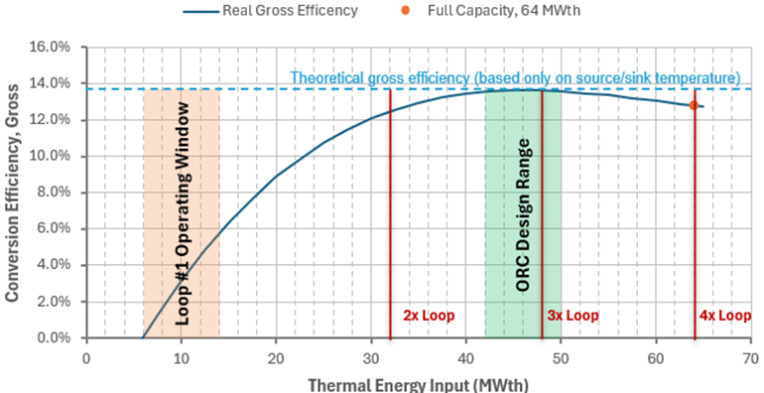
On performance, the document is careful rather than triumphant. With four of twelve pairs contributing, Eavor expected roughly a third of design thermal output and reports about 8.5 MWth, which is close to that prediction; per pair output is currently above 2 MWth and is modelled to settle toward 1.3 MWth after five years. The ORC plant, supplied by Turboden S.p.A. and sized for a full loop, is running far below its design point and therefore at low conversion efficiency, around 4.3 percent, which is exactly what an oversized heat engine on an under-built loop should do.
Their Rock-Pipe sealing reportedly cut near-wellbore permeability by more than an order of magnitude, holding leak-off to roughly 0.5 to 2 percent of throughput. The throughline is consistent: the loop performs as predicted for the size it actually is; it is just smaller than planned.
The forward-looking section is where Eavor stakes its real claim. Because the loop is conduction-dominated, output scales with surface area, so the lever is to drill deeper, hotter, and longer; they argue a 15 km loop in a 30 C/km gradient could reach around 20 MWe versus roughly 2 MWe at Geretsried. Combined with a Wright's-law learning curve on drilling cost and a capital-light licensing model, they claim a line of sight to "geothermal anywhere" at under 75 dollars per MWh of electricity in average gradients. That is the optimistic case, and it rests almost entirely on the drilling cost curve bending the way they expect.
So... who is right?
Here is the part that surprised me. McClure and Eavor do not actually disagree about the physics. McClure's whole argument is that conduction sets a low ceiling on power per metre of wellbore. Eavor's own production section invokes Fourier's law and concedes that output is proportional to heat-transfer surface area, which is precisely why losing eight of twelve pairs cost them two-thirds of the loop. Both sides agree the heat transport is conduction-limited and that the only way to scale electricity is more length, more depth, more temperature. On the science, this is closer to a consensus than a fight.
The genuine disagreement is economic, and it is about trajectory, not principle. McClure's position is static and conservative: with today's costs and materials, the numbers do not work, and even large drilling improvements might be better spent on conventional or EGS wells. Eavor's position is dynamic: the first unit always carries the cost of solving the hard problems, and repetition plus deeper loops will drag cost down a learning curve, as it did in shale, wind, and solar. Geretsried is being offered not as the destination but as the expensive first data point on that curve.
What is striking is how closely Geretsried maps onto McClure's narrow "best case" list. He said closed-loop could make sense given cheap drilling, perfect sealing of long open wellbore, a site lacking permeable formations, and a market for direct-use heat. Geretsried sits on a "hot but dry" site that conventional geothermal could not use; Rock-Pipe is an explicit attempt at the sealing requirement; the learning curve is the bet on the drilling-cost requirement; and the eventual offtake is district heat to the municipality, not just power. In other words, Eavor is not ignoring the skeptic's constraints. It is trying to satisfy them one by one, in the field, with public money and full visibility. Whether that is vindication or a very expensive way to confirm the skeptic depends entirely on Loop 2.
Final thoughts
The honest reading is that both documents are correct within their own frame. The physics ceiling McClure describes is real and is not going away; closed-loop will always produce less per metre than a well that flows hot fluid to surface. But "less per metre" is an economic problem, not a physical impossibility, and economic problems can sometimes be engineered away with enough repetition and depth. The cement-job failure at Geretsried is the cleanest illustration of the whole debate: it was not a flaw in the concept, it was ordinary execution, and it still nearly sank the loop. That is the closed-loop story in miniature. The concept can be sound and the project can still struggle, because at these depths and lengths, execution is the technology.
For our part, the most transferable lessons are not even about geothermal: ranging-while-drilling intersections at 8 km, mud and BHA redesign for long hard-rock laterals, and the brutal cost of a compromised primary cement job in a multilateral architecture are all directly relevant to complex wells everywhere.
Questions for discussion
- Is closed-loop geothermal limited by physics, or only by a drilling learning curve that has not yet matured?
- Should closed-loop chase electricity at all, or commit to direct-use heat where the conduction penalty hurts less?
- For publicly funded first-of-a-kind energy projects, how much drilling data should operators be obliged to share, and when?
- And finally: which Geretsried learnings, ranging-while-drilling, long-lateral dynamics, multilateral cementing, transfer straight back to oil and gas?
Curious to hear your perspective.
#GeothermalEnergy #Drilling #ClosedLoopGeothermal #Eavor #Geretsried #ResFrac
Copyright notice: This summary is based on the article "Technical barriers for deep closed-loop geothermal" by Mark McClure (2023) and the technical update "What we built, what we learned, and what comes next" by Matthew Toews (2026). Background context on the Geretsried results draws on reporting by Carlo Cariaga (ThinkGeoEnergy, 2026) and Henk Kombrink (GeoExpro, 2026). All figures referenced are reproduced from the original sources under fair use for review purposes.


