
GeoNerd Digest – 41st Edition: The 7 km Well That Stopped at 6,103 m
Bańska PGP-4 in Szaflary, Poland is one of the deepest vertical geothermal wells ever drilled anywhere. It was designed to reach 7,000 m and it stopped at 6,103 m, not because of permitting, not because of money, and not because the reservoir disappointed. It stopped because the rock got too hard to drill at a sensible rate.
That is the kind of case I want to read a proper technical paper about. I have been waiting for one since the well was completed in April 2025. It has not appeared. The Polish country update presented at the European Geothermal Congress in Zurich in October 2025 mentions the well twice and, because the paper was written in spring 2025, records only that drilling and research works had not yet been completed. So this edition is an assembly of what is publicly known, with the sources marked, rather than a review of a paper.

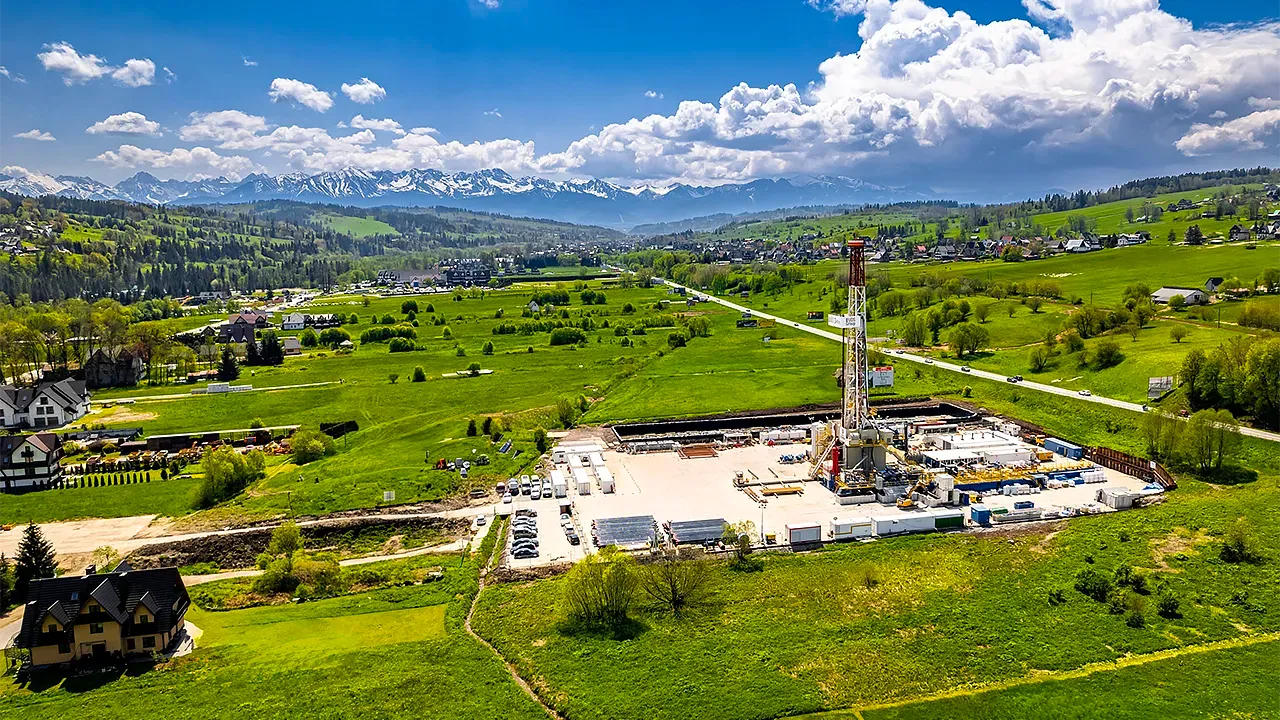

What the well was for
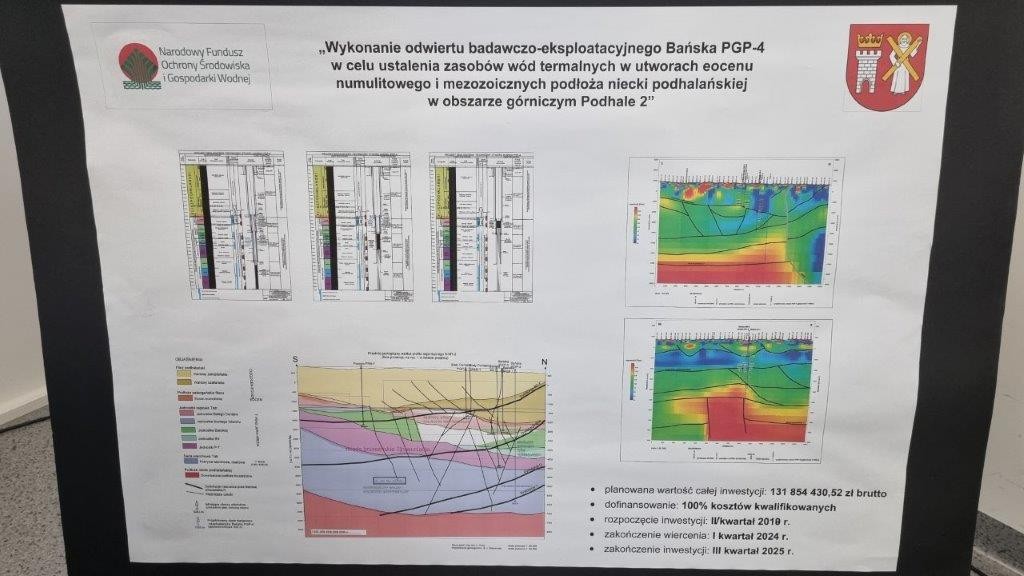
The tender documentation from 2022 describes Bańska PGP-4 as a vertical exploration and production hole with a final depth of 7,000 m. The primary geological objective was thermal water from the High Tatric units of the Podhale Basin basement, referred to as the lower thermal water collector, with an outflow temperature above 100 °C at a minimum of 50 m³/h.
What I find unusual, and worth noting for anyone who writes well programmes, is that the fallback was written into the tender from the start. If the main objective could not be reached, the investor planned to complete in the Sub Tatric units at an estimated 3,750 to 4,650 m, where 110 to 120 °C was expected. A third variant targeted carbonates of the Biały Dunajec unit.
The well designer expected the boundary between the Mesozoic sedimentary cover and the granite basement at around 7,000 m. Combined with existing 3D seismic, the well was meant to underpin a detailed 3D structural model of the whole Podhale Basin.
Total cost was reported at over PLN 132 million, financed by the National Fund for Environmental Protection and Water Management together with the Szaflary commune. The funding came through the priority programme Recognition of the geological structure of the country, with the decision issued before 2022. Drilling contractor was UOS Drilling S.A..
What happened during drilling
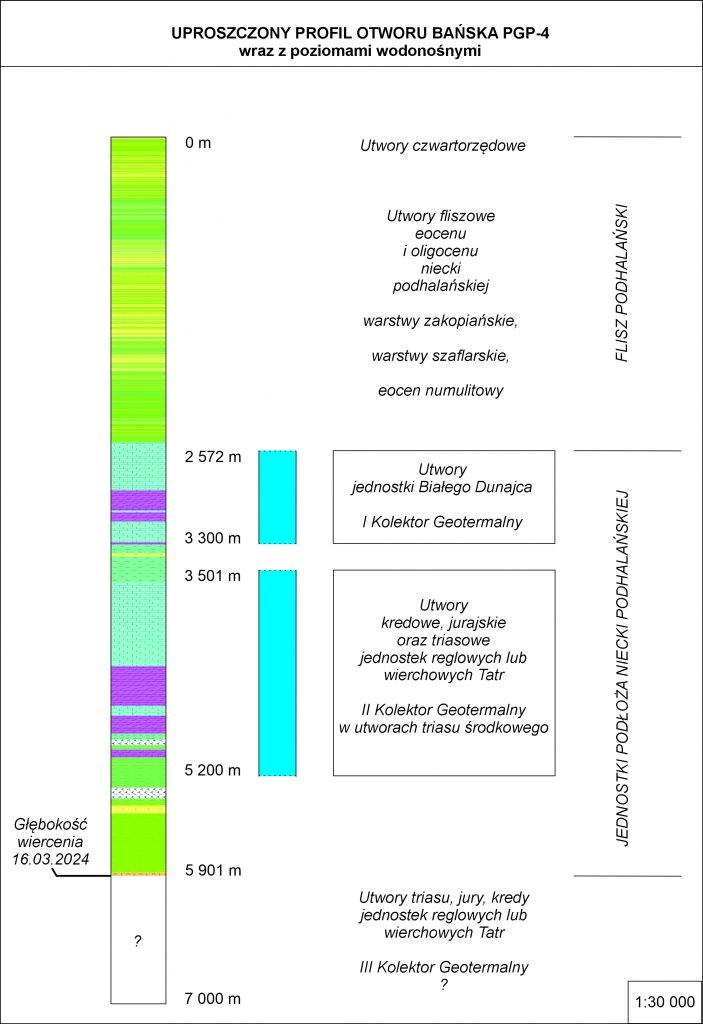
Drilling started on 18 April 2023. By early October 2023 the well was at roughly 3,800 m, about halfway. By the end of 2023 it had passed 5,000 m.
Two feed zones were encountered on the way down. One at around 3,000 m with about 85 °C, and one at around 5,000 m with about 120 °C. The expectation for the third aquifer at 7,000 m was reported at times as 150 °C and at times as above 180 °C, which is itself a signal of how little was known about that depth interval in this basin.
Work was suspended at approximately 5.900 m. The reason given publicly is a very hard formation and a rate of penetration that collapsed. In the last two weeks before the stoppage, the well advanced five metres. Drilling later resumed and the hole was finally terminated at exactly 6,103 m, with equipment failure also cited among the reasons. The well was completed in April 2025, two years after spud. The project board put the end of drilling in the first quarter of 2024, so the well finished roughly a year late and 900 m short of its target.
I want to be careful here. The five metres in two weeks figure and the equipment failure both come from press reporting and municipal statements rather than from a drilling report. What is not public, and what would make this a genuinely valuable case study, is the depth versus days curve, the bit records, the BHA configurations, the mud programme, the actual lithology and strength of the section below 5,900 m, and what exactly failed.
What the well delivered
On the reservoir side the result is better than the drilling story suggests. Testing indicated water at around 120 °C, flow rates up to 400 m³/h, and low mineralisation. The mayor of Szaflary has stated that both temperature and flow rate exceeded expectations, and electricity production is now being considered, which would be a first for Poland.
For context on how significant that would be, the Polish country update lists zero geothermal power plants in operation, under construction, or projected through 2032, with a note that commercial scale plants may appear in single cases at most 0.5 to 2 MWe in cogeneration. Geothermal accounted for 0.2 percent of Polish renewable energy production in 2023.
In August 2026 contracts were signed for the local heating network in Szaflary. The first section will connect at least 80 buildings, construction runs 2026 to 2027, and the construction contract was worth PLN 10.7 million. The main pipeline from Bańska Niżna to Szaflary is already well advanced.
Why the context matters
Podhale is not a frontier. The geothermal district heating system there has run since 1993 and is among the largest in continental Europe. Three wells deliver roughly 1,070 m³/h of artesian flow at 82 to 86 °C, the installed geothermal capacity is 94.8 MWth out of about 134 MWth total, and in 2024 geothermal supplied around 99 percent of heat sales in that system, about 512 TJ, to roughly 2,000 buildings. It covers about 40 percent of Zakopane's heat demand. Spent water is reinjected through three wells. The operator is PEC Geotermia Podhalańska S.A.
So this was a mature operator, a well understood shallow reservoir, public money covering the full cost, and a clear heat offtake. Everything that usually kills a European deep geothermal project was handled. The limiting factor was the drill bit in hard rock at six kilometres.
Set that against the rest of Polish drilling activity. Between 2022 and 2024 at least ten prospecting and production wells were drilled in Poland, at depths between 1,130 and 2,930 m. PGP-4 sits at more than double the deepest of them. There was no comparable well depth in the region to calibrate against.
One point on the record claim
Polish coverage has described PGP-4 as the world's deepest geothermal well. That does not survive checking, and the reason is worth understanding.
The usual reference point is OTN-3 at Otaniemi in Finland, completed in 2018 and normally quoted at 6.4 km. That figure is measured depth. Published work on the Otaniemi stimulation describes the well as near vertical down to about 4.7 km, with an inclined open hole section below that reaching roughly 6.1 km depth, and an injection interval at 5.7 to 6.1 km. On true vertical depth, Otaniemi and Szaflary are therefore effectively level, and on measured depth Otaniemi is the deeper of the two.
What does appear to set PGP-4 apart is the trajectory. The tender documents specify a vertical hole, and the well was reported as terminating at 6,103 m. If that depth is true vertical depth in an essentially vertical well, it is very likely the deepest hole ever drilled straight down for geothermal purposes. Everything else in the same class is either deviated, such as Otaniemi, United Downs at 5,275 m measured and IDDP-2 at 4,659 m measured, or shallower, such as Sinopec's Fushen-1 in Hainan at 5,200 m, which is China's record.
I am stating this as the best reading of public sources rather than as a verified fact. I do not have the deviation survey for PGP-4, only the design intent, and vertical wells drift. If someone has the survey, or a better figure for Otaniemi's true vertical depth, I would rather be corrected than repeat a record claim that does not hold.
Final thoughts
Two things are worth to mention and consider.
The first is that a 132 million złoty (35 million USD) publicly funded well, drilled by a competent contractor for a mature operator, was stopped by rate of penetration. Not by anything exotic. The section that beat the programme sits in a basin that Europe has been heating houses from for thirty years. If that is where the ceiling is in Podhale, it is worth asking where it is in every other European basin where the interesting temperatures sit below the sediments.
There is a second way to read the 5,900 m problem. When rate of penetration collapses in hard rock at that depth, the bit is rarely the only limitation. By six kilometres a surface driven string is a long and compliant spring. A large share of the torque and axial load applied at the rig never reaches the cutting structure, and what does reach it arrives unsteadily, which is how stick slip and destructive vibration take over. Recent experimental work on percussive tools points at the same wall from the other side, showing that the pre damage created ahead of the bit weakens sharply as confining pressure rises, so mechanisms that work well in the first kilometres quietly stop working in the last ones. Both observations lead to the same design question. If the binding constraint is the delivery of energy to the rock rather than the strength of the rock itself, then the place to intervene is at the bottom of the hole, with drive systems that generate and react their own load against the formation instead of inheriting it from several kilometres of steel above.
The second is the silence. This well was fully publicly financed and was explicitly designed as a research well. Its stated purpose included building a 3D structural model of the Podhale Basin. Eighteen months after completion, the detailed technical account is not in the literature. The most instructive deep drilling case in Central Europe in years is currently a set of news articles and a tender notice.
If anyone from UOS Drilling S.A., PEC Geotermia Podhalańska S.A., the Szaflary commune, AGH University of Krakow or any other research organisation is planning to publish this, I will read it the day it comes out. And if it is already published somewhere I have missed, please tell me in the comments and I will correct this.
Questions for discussion
- What other European deep wells stopped for reasons that were never written up? I suspect this is not a rare case, only a visible one.
- How much of what looked like a rock problem in this well was actually a load delivery problem, and would the answer have been different if the axial force and rotation had been generated at the bottom of the hole rather than at surface?
- For publicly funded research wells whose stated purpose was to improve knowledge of the geological structure of the country - eighteen months after completion there is no public drilling record. Should a published depth versus days curve, bit record and lithology log be a contractual deliverable on any publicly funded well, in the same way the geological result already is?
- Which geothermal well actually holds the record for true vertical depth? Otaniemi is quoted at 6.4 km but that is measured depth on a hole that deviates below 4.7 km, PGP-4 is 6,103 m in a hole designed vertical, and I could not find a published deviation survey for either. If you have the numbers, or know of a well I have missed, post it and let us settle this.
Copyright notice
This summary is based on the paper by Marek Hajto and Beata Kępińska, "Geothermal Energy Use – Country Update for Poland, 2022–2024", European Geothermal Congress 2025, Zurich, 6 to 10 October 2025. Well objectives, variant targets and the vertical well design from the contract notice for Bańska PGP-4, TED 396427-2022. Drilling progress, the termination depth, and the test results from contemporaneous reporting by ThinkGeoEnergy and from statements by the Szaflary municipal office and UOS Drilling S.A.. Figures sourced from press reporting are not independently verified and are identified as such in the text.


