
GeoNerd Digest – 42nd Edition: How Deep Before the Tools Cook? A Calibrated Answer from Texas
With this edition the GeoNerd Digest moves to the Geothermal Rising Conference 2026 (GRC). Over the next several editions I want to work through the papers from GRC that I found genuinely useful. I am starting with this one for a simple reason. Its title is a topic I discussed with many people over the last two years, and I have never once got the same answer twice.
Ask a drilling engineer how hot a formation you can realistically drill into today and you will hear one of four things. Some say it is purely an electronics problem, buy high-temp rated MWD and stop worrying. Some say chill the mud at surface and you buy yourself thousands of feet for very little money. Some say surface chilling is theatre, because the fluid re-equilibrates with the formation long before it ever reaches the bit. And some say insulated drill pipe is the only thing that actually works, but it is too expensive and too fragile to run as standard.
Those positions cannot all be right. The paper titled "What Maximum Formation Temperature Can Be Reached in a Drilling Test Site with Insulated Drill Pipe and Mud Chiller" by Guizhong (Gary) Chen et al. puts numbers on all of them at the same site, with the same model, calibrated against real downhole measurements.

The Site
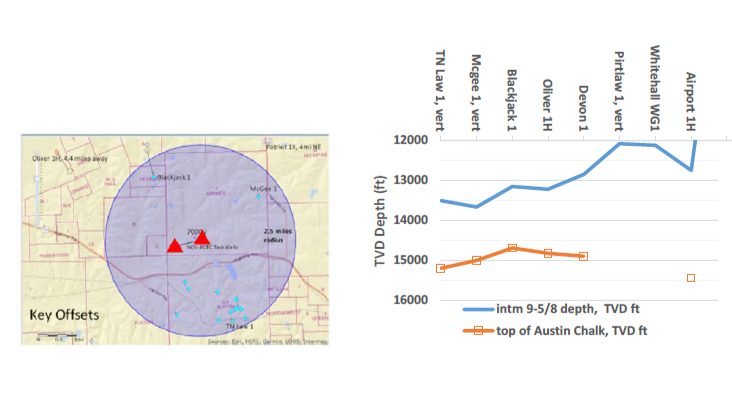
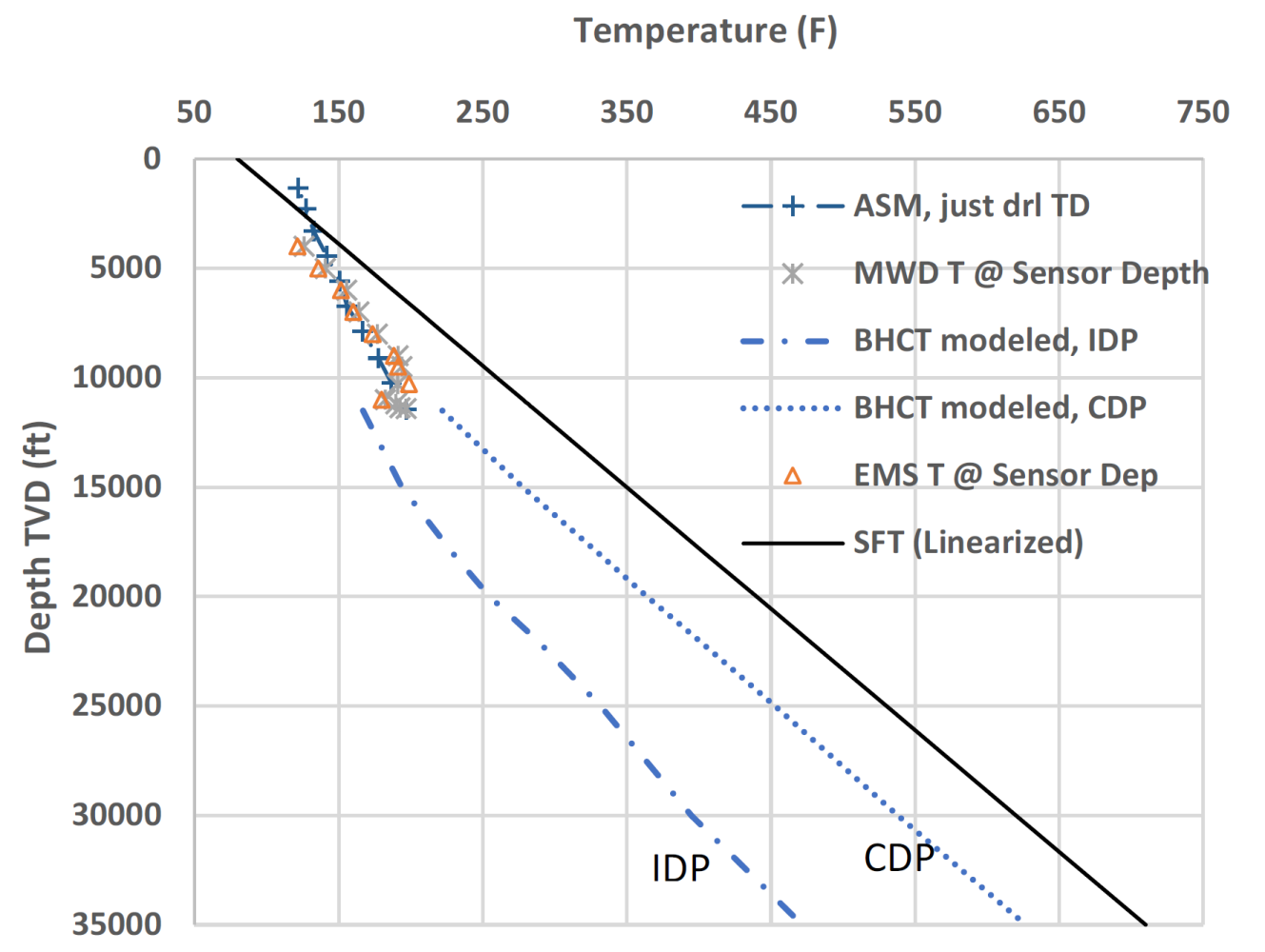
A vertical geothermal test well was drilled to 11,518 ft (3,511 m) in Navasota, Grimes County, Texas in 2020, with a fibre-optic distributed temperature system permanently cemented behind the 6-in. casing. Most temperature datasets in drilling are a handful of bottomhole readings taken hours after circulation stopped. This one is a continuous profile at every foot of wellbore, read after roughly 99 days of shut-in.
The result is an unusually clean static formation temperature profile. The authors linearise it as 80°F (27°C) at surface plus an 18°F/kft gradient, which is about 32°C/km. Static formation temperature at total depth was 278°F (137°C). Five offset wells within a 4.4-mile radius were all dry holes, plugged and abandoned, which is exactly why the site works as a geothermal test bed. There is no hydrocarbon production to complicate deep drilling.
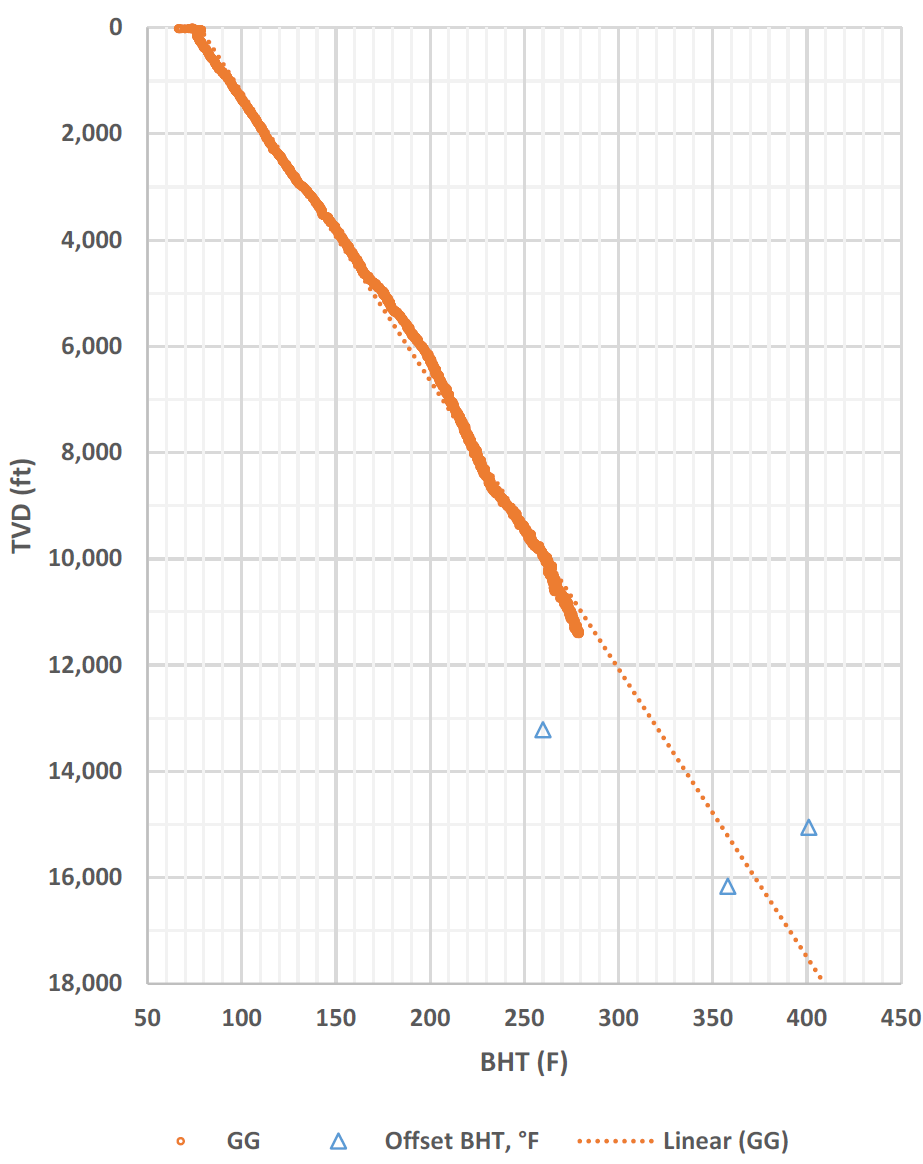
I want to flag the 18°F/kft gradient early, because it shapes every headline number in the paper. This is a Gulf Coast sedimentary section with a fairly ordinary continental gradient. It is not Utah FORGE or Krafla.
The Proposed Well
The plan on the table is a new vertical well from the same pad, drilled with the onsite 1500-HP rig to somewhere between 18,000 and 22,000 ft. The casing programme runs 16-in. conductor, 11-3/4-in. surface casing to around 3,000 ft, 8-5/8-in. intermediate set at 11,500 to 13,000 ft at the top of the pressure transition zone, and a 6-5/8-in. liner at total depth, with 1,000 to 2,000 ft of open hole left for possible stimulation.
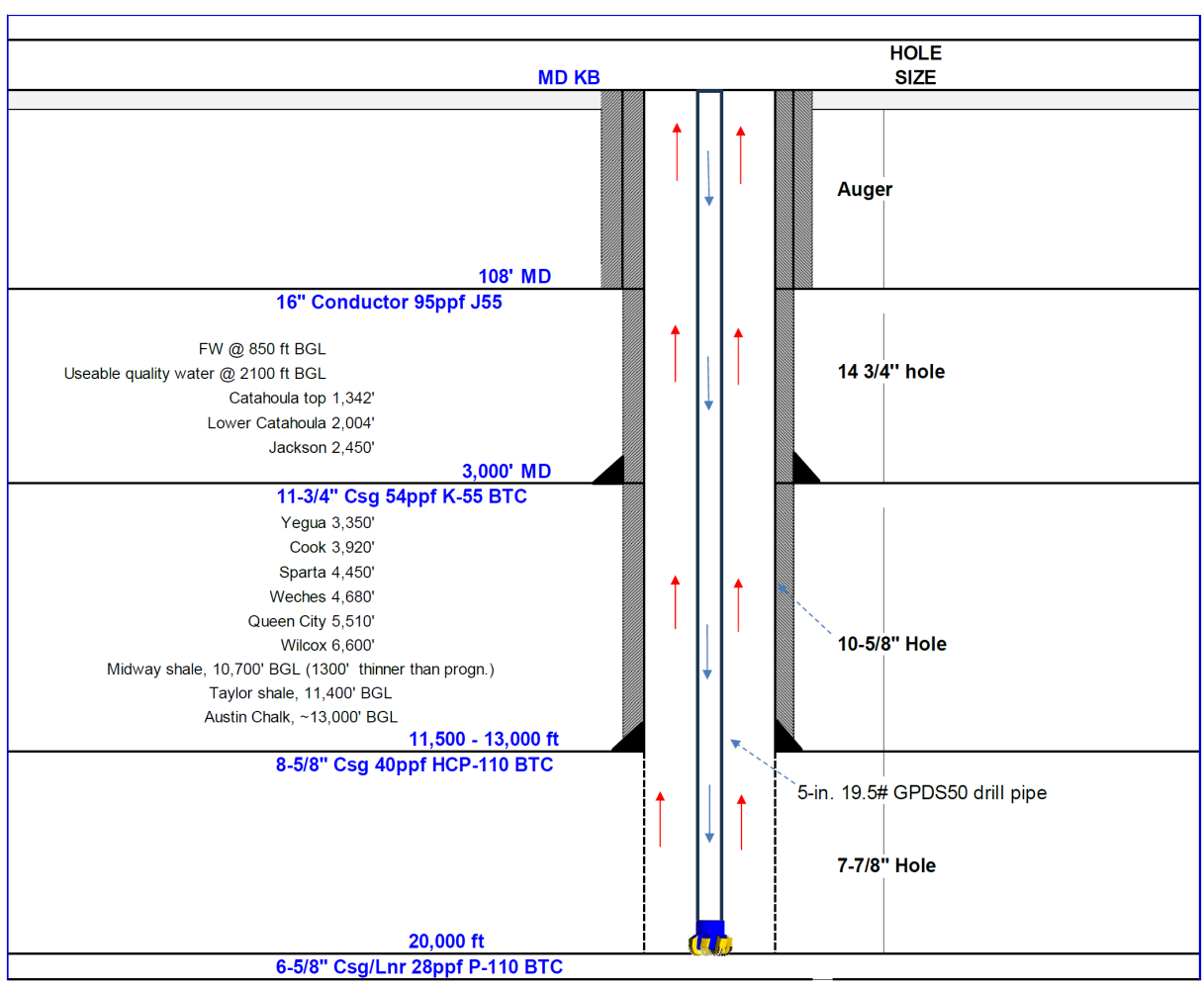
The rig has 750 kilopounds (kips) of static hookload capacity, and they write plainly that it may be challenged by the casing design loads that next-generation geothermal wells require, because commercial heat or power production needs large-bore casing for flow. A 6-5/8-in. liner at 30,000 ft is a research well, not a production well.
The Part That Makes It Credible
The model calibration section is the most interesting part of the paper. During the drilling of the 11,500-ft well the drillstring was fully wired, with a wired MWD tool about 107 ft off bit, a conventional pulsing MWD tool about 80 ft off bit, and eleven along-string measurement tools distributed up the wellbore. That gives a temperature profile along the whole string at the moment the bit reaches total depth, not a single point.
The authors use that to pin down one modelling choice that usually gets waved through. They define the bottomhole circulating temperature as the circulating temperature at bit depth after a pseudo-steady-state circulation time, and they fix that time at 6 hours by matching the model against the actual MWD readings.
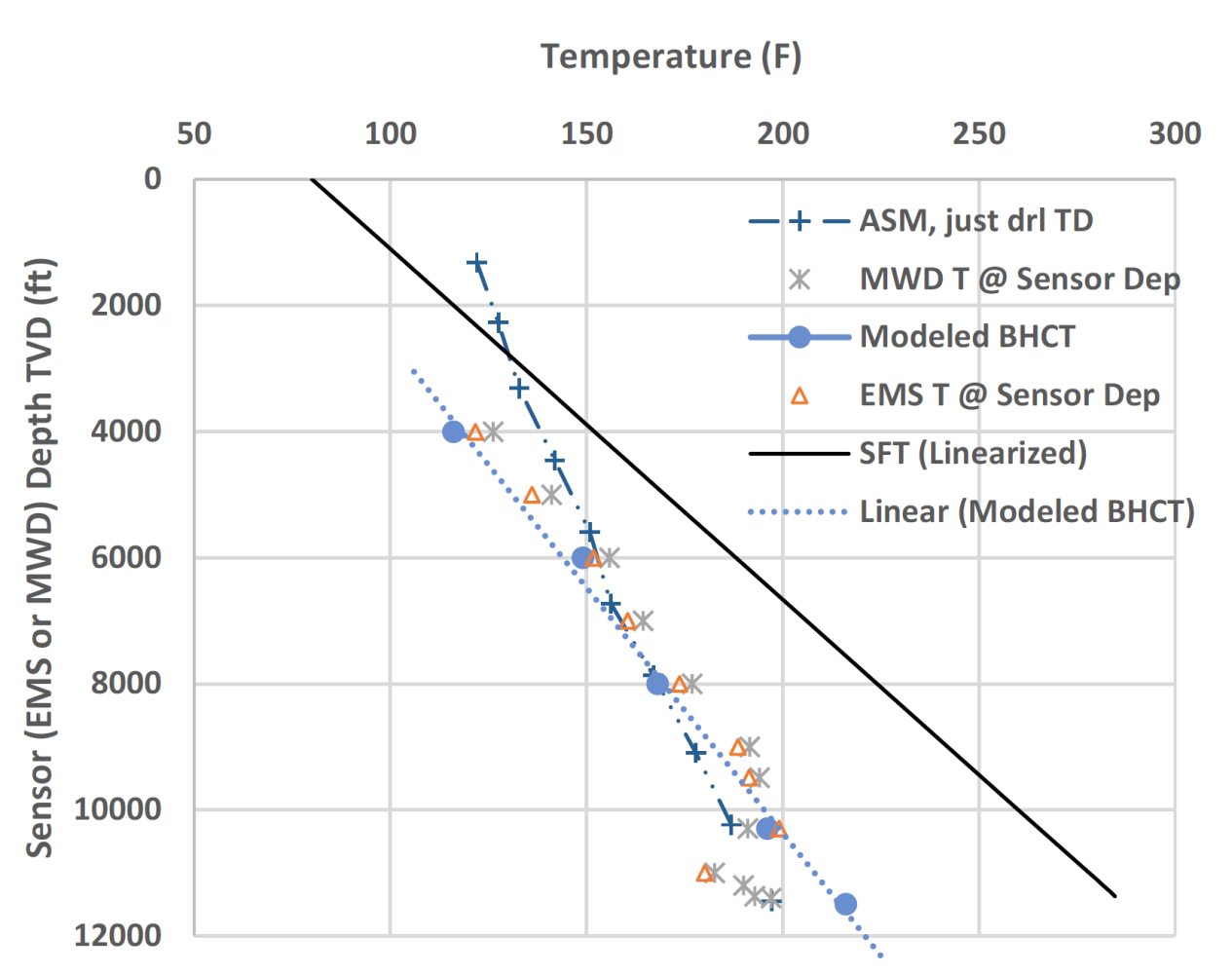
The wellbore temperature profile shifts steadily towards higher temperature as the bit drills deeper, except between 10,000 and 12,000 ft, where it moves the other way. The authors attribute that to a severe lost circulation event. Cold mud going into the formation cools the wellbore.
The Main Result
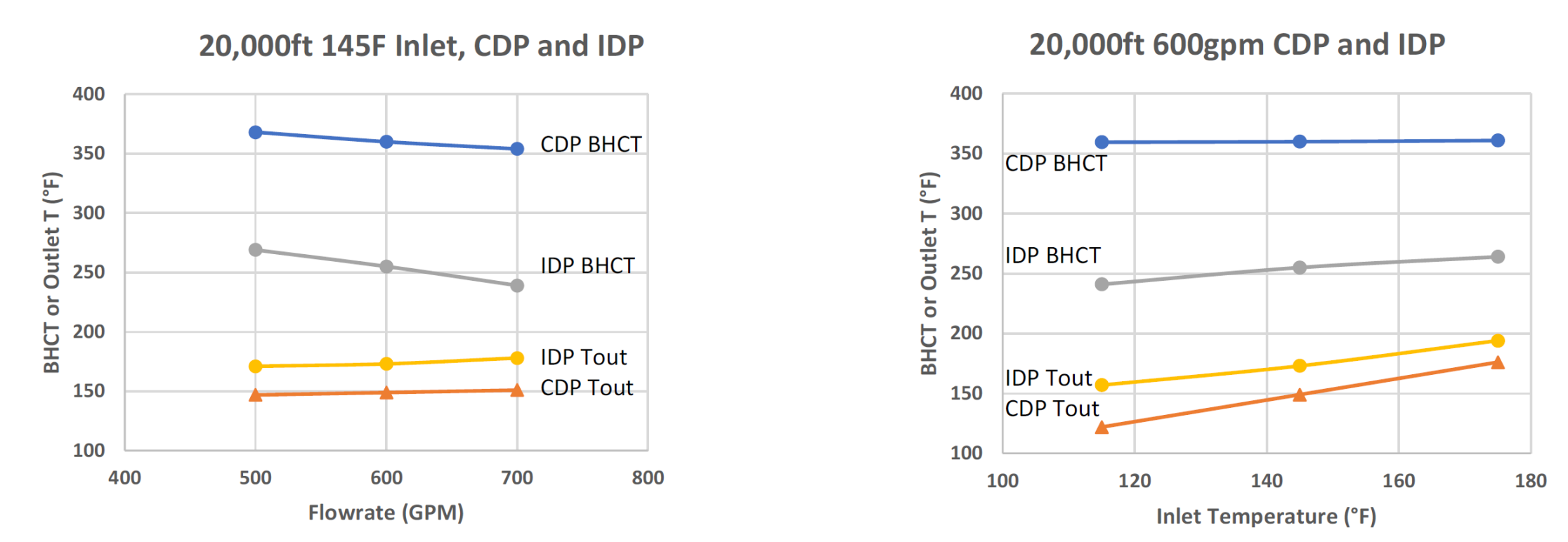
For a 20,000-ft vertical well at 600 gpm with 12.5 ppg water-based mud and a 145°F (63°C) inlet, the predicted bottomhole circulating temperature is 364°F (184°C) with conventional drill pipe and 255°F (124°C) with insulated drill pipe. That is a reduction of 109°F (60°C) from the pipe alone. The paper quotes that same delta as 43°C, which does not follow from its own two numbers, so I have used the correct conversion here.
Extrapolating the modelled trend, the depths at which the three common tool ratings are reached come out as follows. For conventional drill pipe (CDP), 302°F (150°C) at about 16,500 ft, 347°F (175°C) at about 19,000 ft, and 392°F (200°C) at about 22,000 ft. For insulated drill pipe (IDP), the same three marks should be reached at about 23,000 ft, 26,000 ft and 30,000 ft.
The authors cite work at Utah FORGE where IDP reduced recorded circulating temperature at the MWD tool by up to 75°F (42°C), from 225°F (107°C) down to 150°F (66°C), in formations above 302°F (150°C). That is measured, not modelled, and it is in hard rock rather than sediments.
The paper reports depths. The question in the title is about formation temperature. Using the authors' own linearised profile of 80°F (27°C) plus 18°F/kft, the static formation temperature at those depth limits works out at roughly 476°F (247°C) for CDP and roughly 620°F (327°C) for IDP at the 200°C tool limit. At the cheap 150°C tool limit it is roughly 377°F (192°C) and 494°F (257°C). That calculation is mine, not the authors', but it follows directly from their stated gradient and it is the number I actually wanted. IDP roughly doubles the gap between what the rock is and what the tool feels.
Why The Mud Chiller Argument Is Over
The authors ran inlet temperature from 115°F (46°C) to 175°F (79°C) at constant 600 gpm. With IDP, every 30°F (17°C) change at the pump suction moves the bottomhole circulating temperature by 9 to 14°F (5 to 8°C). With CDP, the same 30°F change at surface moves the bottomhole temperature by about 1°F (0.6°C).
The reason is thermal short-circuiting. Steel drill pipe has a thermal conductivity of roughly 43 W/(m.K) against about 3 W/(m.K) for the coated insulated pipe used here. Mud going down conventional pipe exchanges heat freely with the annulus on the way, so whatever you did to it at surface has been erased long before it reaches the bit. Chilling the mud without insulating the pipe is spending money to cool the top of the well.
The reverse is also true and it is worth understanding before anyone orders insulated pipe. With insulation, the returning mud arrives at the flowline hotter, 173°F (78°C) against 148°F (64°C) in the 20,000-ft case, because the annulus no longer loses heat into the downgoing stream. The insulated pipe is what creates the need for a chiller in the first place. They are not alternatives. One does not work without the other, and the authors say so.
Flow rate works in the same direction. Going from 500 to 700 gpm drops bottomhole circulating temperature by around 30°F (17°C) with insulated pipe, at 14 to 16°F (8 to 9°C) per 100 gpm, against 6 to 8°F (3 to 4°C) per 100 gpm with conventional pipe. One small note for anyone reading closely - there is a units slip where 347°F is written as 150°C (instead of 175°C) in the Conclusions.
Four Gaps of This Work
The model is calibrated at 11,500 ft and used to predict at 30,000 ft. That is a factor of 2.6 in extrapolation, on a well that has not been drilled. The linear trend in the results comes straight from the linear inputs, a constant gradient and constant thermal properties.
The model assumes non-stop, constant-rate drilling with no flat time. The authors state this limitation themselves. Every connection, survey and trip is time during which the wellbore heats back up, and the first reading you get on the way back down is the one that trips the tool. There is companion work by the same group on tripping and staging that addresses exactly this, which suggests they know it is the weak point.
Higher flow rate is offered without any discussion of what 700 gpm does to equivalent circulating density in a 7-7/8-in. hole at 30,000 ft. Questionnable in a well where you are already fighting losses.
This is a 32°C/km site. The cooling effect scales with how much pipe the fluid travels through, so a long, moderately hot well is the best possible case for insulated pipe. In case of a well with 60°C/km, where 250°C can be reached at 4 km instead of 9 km, and the fluid has less than half the residence time. My expectation is that the insulated pipe advantage shrinks substantially at high-gradient sites, which are exactly the sites the geothermal industry is targeting these days. I would like to see the same model run at a Utah FORGE or an Icelandic gradient before anyone treats 327°C as a general number.
Summary
The useful takeaway is that wellbore cooling is a system, and two thirds of the industry's intuition about it is wrong. Surface chilling without insulation does essentially nothing at depth. Insulation without chilling pushes heat back at the rig floor and the surface equipment. Together they move the accessible formation temperature by roughly 80°C at this site.
That also reframes the temperature problem for downhole hardware generally. Every downhole system, not only MWD, is specified against a temperature the tool actually sees. The gap between that temperature and the rock temperature is an engineering variable.
Questions for Discussion
- Why is surface mud chilling still the first thing most teams reach for, when the modelling here says it does almost nothing without insulated pipe?
- Does the insulated pipe advantage survive at 50 or 60°C/km, where the fluid has far less pipe length to shed heat on the way down?
- At what point does chiller duty, parasitic load and insulated pipe cost outweigh simply buying high-temp rated electronics and letting the well run hot?
- Nobody has drilled this well yet. If you were writing the measurement programme for the first one, what would you insist on recording to confirm the model?
Curious to hear from anyone who has actually experience with running IDP.
Copyright notice:
This summary is based on the paper "What Maximum Formation Temperature Can Be Reached in a Drilling Test Site with Insulated Drill Pipe and Mud Chiller" by Guizhong (Gary) Chen, Chuck Wright, Mark Canlas, Alexis Garcia, Luther Gressett (NOV), Patrick Mays GTO Technologies Inc.), and Yifan Zhang, Pradeepkumar Ashokkumar, Dongmei Chen and Eric van Oort (The University of Texas at Austin), GRC Transactions Vol. 50, 2026. All figures are reproduced from the paper under fair use for review purposes.


