
Geothermal Power Surge at the Massachusetts Institute of Technology
The MIT Energy Institute and the Clean Air Task Force brought investors, developers and oil and gas operators together for a GeoTech Summit in Cambridge. Greg Leveille, GA Drilling board member and former ConocoPhillips CTO, gives five takeaways, including why targeting higher reservoir temperatures is the biggest single lever on project economics, and why geothermal developers would do better as technology integrators than as specialists. Reposted with permission from Tidal Wave Technologies.

The MIT Energy Institute in conjunction with the Clean Air Task Force held a GeoTech Summit in Cambridge, Massachusetts on March 5th.
The event was attended by investors, bankers, power developers, technology startups, geothermal subject matter experts, service companies, and representatives from several oil and gas companies including ExxonMobil, Shell, Devon, and Equinor.
Here are my five key takeaways from the summit:
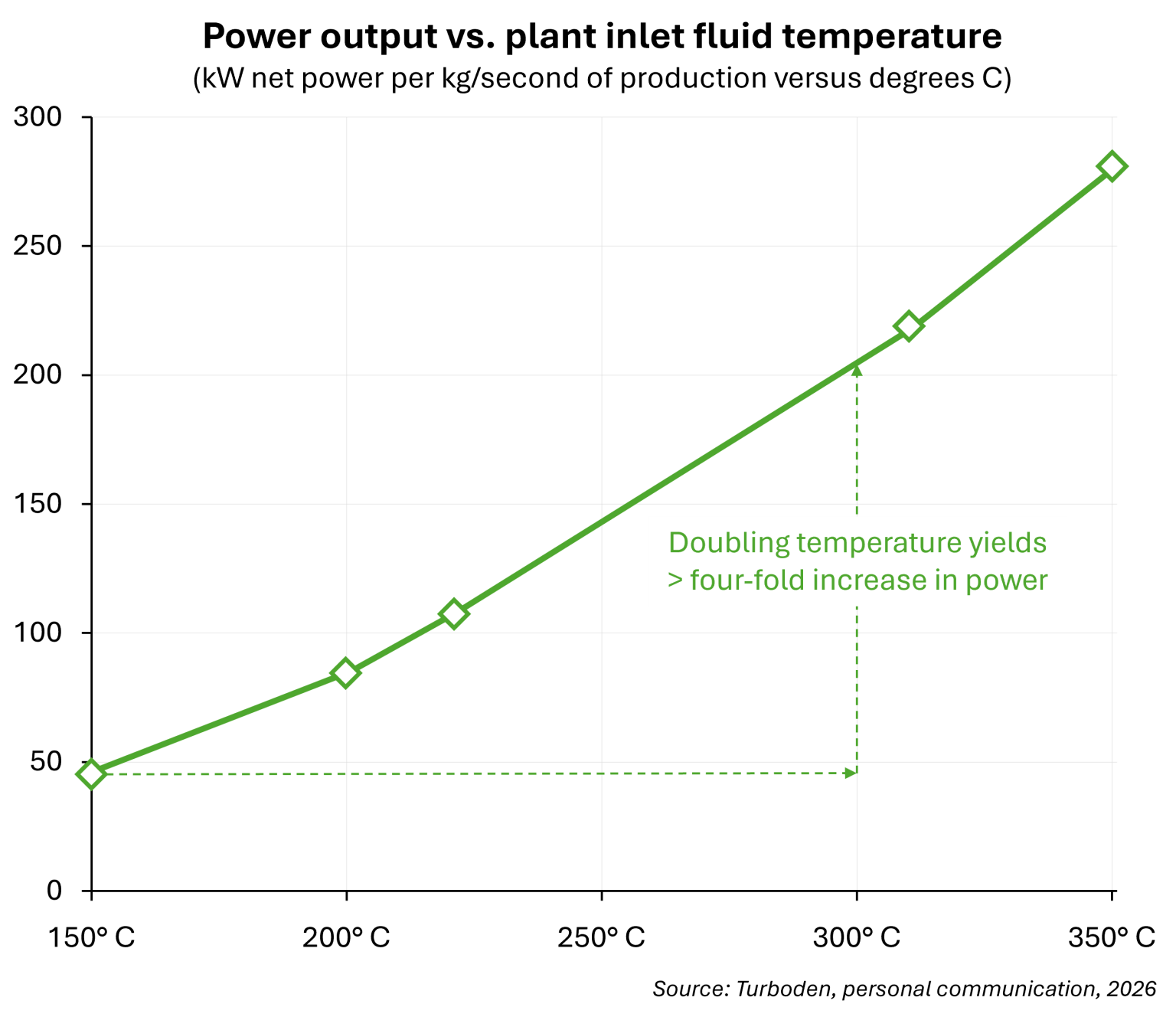
1) There was general agreement that targeting higher reservoir temperatures is the single biggest lever for improving economic outcomes since power output at 300° C is over four times greater than at 150° C (see figure below).
Outcomes and plans that indicate the geothermal industry is rapidly becoming more comfortable with operating at higher temperatures include:
- Mazama was able to establish fluid flow between an EGS injector-producer well pair at 331° C at the Newberry Volcano in Oregon and has plans to drill a vertical monitoring well and a horizontal EGS injector-producer well pair at 400° C.
- Fervo has moved from targeting 175° C reservoirs at Project Red to 200° C for their initial wells at Cape, to targets in the 225° to 250° C range, with indications they will move to even higher temperatures in the future.
- Zanskar spoke at the conference about targeting deeper conventional geothermal systems – systems that Joel Edwards, Zanskar’s CTO, described as likely maintaining fault related permeability down to depths where temperatures reach 375° to 400° C.
- Ralph Winmill with Geode Well Engineering indicated he’s involved with planning a New Zealand super-critical well that will target temperatures between 375 and 500° C at 15,000 to 16,500’. The well is currently slated to be drilled in 2027.
- Hephae Energy, a technology startup specializing in developing high temperature downhole electronics, indicated they are receiving considerable interest from geothermal developers and oil & gas operators in their tools.
During a talk I gave at the summit (LINK) I noted that higher temperatures not only improve power output but also vastly reduce the amount of fluid needed to generate a given amount of electricity. This is enormously helpful given concerns about high water losses for EGS projects and limited water supplies in many prospective areas.
2) There was considerable debate about whether the investment sweet spot for VC firms was “picks & shovels” geothermal technology startups or geothermal power developers. Torsten Kolind with Underground Ventures advocated for picks & shovels investments. Johanna Wolfson with Azolla Ventures made the case for focusing on geothermal power developers, especially those that have developed a technology that differentiates them from other developers. In my presentation I made the case for the differentiation of roles between geothermal developers and service companies / technology startups (see slide 18). This of course implies that this should not be an either or choice, but that rather investments in both “picks & shovels” technology startups and geothermal developers are both necessary.
3) I also discussed during my talk how developers would benefit from being technology integrators rather than technology specialists (see slide 19). This is in my mind an enormously important concept, one that from an oil and gas operator’s perspective seems obvious given the approach taken to development in the oil and gas industry is to select the optimal development approach for the characteristics of the reservoir to be developed. Surprisingly, this is not the approach most geothermal developers currently employ, with developers placing themselves into narrowly defined technology specialist categories, namely Hydrothermal developers, EGS companies, Closed Loop firms, Pressure Geothermal System enterprises, and Sedimentary Geothermal Systems developers. The reason this makes little sense is that for at least the first four of the five above noted specialty categories, it is likely that a prospect a company believes is highly prospective for the deployment of the type of technology their company specializes in may be more profitably developed using a different approach. For example, a company looking for hydrothermal fields may find sufficient heat but not sufficient permeability and decide to abandon the project whereas the thermal anomaly could be developed profitably using EGS. Or an EGS developer might upon drilling its first few horizontal wells find a blind hydrothermal system, making it better to develop the area without using hydraulic fracturing or with a hybrid hydrothermal / EGS approach. Or a closed loop firm may drill into a prolific hydrothermal system and rather than sealing it off to deploy a closed loop solution would be far better off developing it using conventional geothermal technologies. Specialization therefore strikes me as a hinderance to maximizing industry profitability rather than an enabler. Look for more about this topic in upcoming talks I give and panel sessions I participate in.
4) There was considerable discussion during an investor led portion of the event about the benefit of investing in a portfolio of geothermal development companies to minimize risk and maximize the probability of exposure to successful outcomes. Sarah Black with alfa8 and Stan Miranda of the True North institute both spoke about methods for building co-investment vehicles to achieve such an outcome. This approach makes perfect sense from an oil and gas industry perspective where operating companies often form multi-company joint ventures when pursuing high risk, high reward opportunities (such as deepwater exploration and production).
5) In response to a question from the audience, I shared a slide noting how achieving a critical mass of hydrocarbon production potential in several areas in the United States had been a game changer as far as attracting outside investment to build pipelines to transport the hydrocarbons to market (see slide 24). This by analogy is an enormous opportunity for geothermal developers, who today are scrambling to secure small to modest amounts of available high-voltage transmission capacity but who could potentially be able to attract investment in new transmission capacity if enough power output potential can be established in reasonably close proximity, with such an outcome most likely involving several operators working together to find enough resource to attract the infrastructure buildout. This kicked off discussion about how much output would be required, which nobody in the room had an answer to, which suggests this is a topic worth looking into.
In summary, the MIT / CATF event was an extremely worthwhile forum. One that brought together leaders and experts from a wide variety of backgrounds. One that led to much useful discussion. One that seemingly encouraged nearly all participants to continue to or start pursuing geothermal power production related opportunities.
Next up for me as far as speaking engagements will be participating on two panels at CERAWeek. These will be but a few of the geothermal related sessions at the conference, with Project InnerSpace having worked with S&P Global (the conference organizers) to organize a “Geothermal House” element to the Innovation Agora portion of the conference (LINK). Hope to see you there.


