
Morpheus Research’s Recent Report on Fervo Energy: A MythBusters Like Approach to Assessing Their Claims
Morpheus Research published a short-seller report claiming Fervo Energy hid a 90°F temperature drop at Project Red and has hit a plateau on drilling costs. Greg Leveille, GA Drilling board member and former ConocoPhillips CTO, tests both claims against Fervo’s own published data and explains why the US shale learning curve points to EGS drilling costs continuing to fall. Reposted with permission from Tidal Wave Technologies.



Have you ever read a technical report that was so flawed that it made you question how the leaders of the organization that generated the report approved publishing the document?
Well, I had just such an experience. And because the report was about a topic that I have considerable familiarity with (i.e., subsurface aspects of geothermal power production), I felt compelled to take a moment to debunk several of its claims.
The report I’m referring to was generated by Morpheus Research. It is titled “Fervo Energy: Big Tech’s Clean Energy Bet is Unraveling — Hidden Setbacks, a Litany of Existential Issues, and a Commercial Build Out Destined for Failure”.
With a title like that – a title that makes sensational claims about a publicly traded company – one would expect the report to contain rock solid evidence (pun intended) of impending doom.
Fortunately for Fervo, this is not the case. Rather, the report is riddled with errors – errors that would be obvious to any competent technical expert – errors so egregious as to call into question the motivation of the authors.
For example, Morpheus claims to have uncovered a 90° F drop in produced fluid temperature at Fervo’s Project Red that they claim Fervo concealed. If this were true, it would be headline news. A major scandal. But is this really the case?
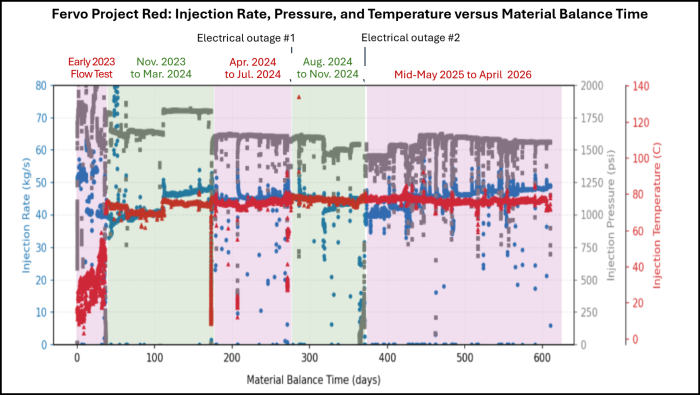
To answer this question, let’s start with a chart from a Fervo post that Morpheus reference in their report.
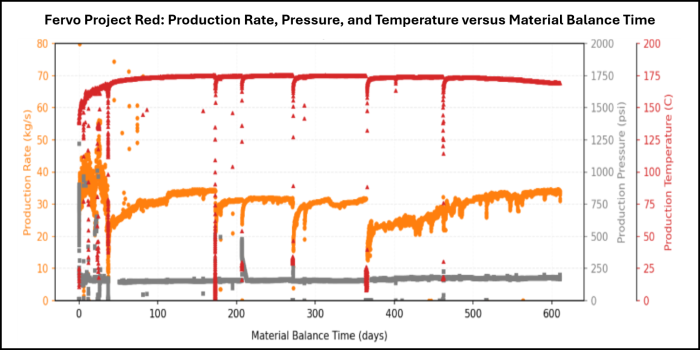
As you’ll note, the chart shows produced fluid temperatures holding steady except for during a few short duration drops associated with times when production was shut in for non-subsurface related reasons, with a modest drop off in temperature beginning about 550 “material balance days” after first production.
So, what is Morpheus’ evidence that Fervo concealed a 90° F drop in temperature? A drop so large that it should literally jump off the page.
Well, here it is – a plot of monthly average wellhead temperatures reported to the State of Nevada by the operator of the Blue Mountain Field (which isn’t Fervo, whose two well EGS demonstration project at the site is tied into another operator’s power plant).
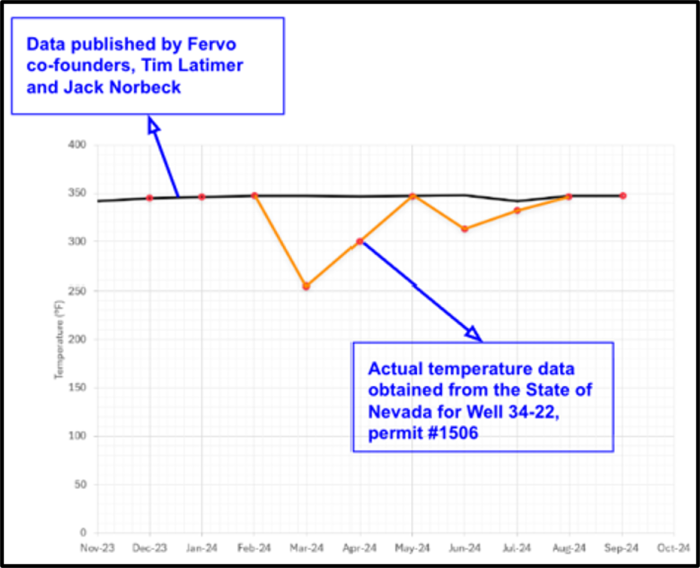
This is Morpheus’ smoking gun! And okay, to a layperson it might look like Morpheus has caught Fervo in a lie since the graph they present looks nothing like Fervo’s chart. At least not at first glance. Case closed. Fervo can’t be trusted. If you own their stock, you best sell it as soon as you can. It’s time to get out.
But wait a second. Monthly average temperatures? That’s different from temperatures measured over material balance time. Way different in fact, as any qualified technical expert would know. So, what’s going on here? Well, it turns out that the answer to this question can be found by doing a bit of detective work. So, let’s put on our Sherlock Holmes deerstalker cap and dive in.
Firstly, we need to look at the operating history of the Project Red wells, which is shown on another figure out of Fervo’s April 2026 blog.
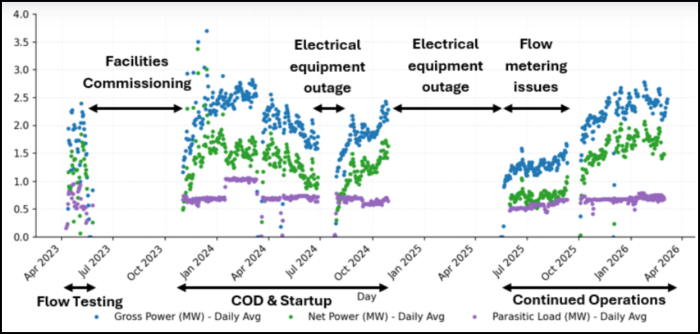
As you’ll note, there were several interruptions in production from the time that the Project Red well pair was first put on production in early 2023 up until when Fervo published its blog in April 2026. And as you’ll remember from having inspected the “Project Red production rate, pressure, and temperature versus material balance time” plot, there were also significant differences in production rates during the various flow periods.
Episodic production. Varying producing conditions. This is a situation in which a technical expert (like Jack Norbeck, Fervo’s CTO) might elect to build a material balance time plot to: (a) be able to do high end technical analysis from noisy data (e.g., use Gringarten’s analysis techniques), and (b) present in a blog a less noisy depiction of how a well performed.
Unfortunately for a lay person, on such a plot, time, as depicted on the horizontal axis, no longer is measured in calendar days. So here is where a bit of technical knowledge becomes important.
For to understand whether the March 2024 drop in temperature that Morpheus claims to have uncovered has an innocent explanation or represents fraud on a massive scale, we need to transfer the operating history of the Project Red wells onto Fervo’s material balance time plots, which I’ve done in the figures below.
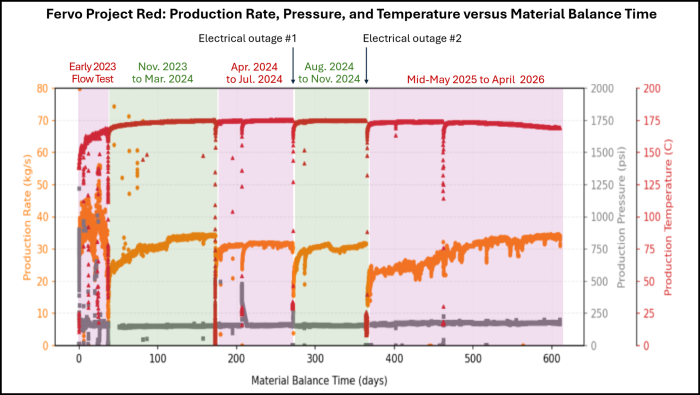
What do these figures reveal? Well, they show that yes, there was a large cooling event in March 2024. So perhaps Morpheus is on to something, especially since Fervo didn’t provide an explanation for this event like they did for some of the other (larger) cooling events.
But alas, if we dig a bit deeper, as any qualified technical expert would know to do, one will notice that the temperature of both the injected and produced fluid falls all the way down to single digit Celsius readings during this event, which makes no sense if this was an early time thermal breakthrough event as Morpheus claimed. The temperatures do however towards the end of the event match the average temperature for March 2024 in the part of Nevada where Fervo’s Project Red is located, which is a valuable “clue”.
So, what does this “clue” mean? What it means is that during a very short period in March 2024, injection and production at Project Red were throttled back and then stopped, which caused temperatures to drop towards zero degrees Celsius, which makes perfect sense, since with little and then no flow going into or out of the reservoir, the fluid in both the injection and production wells at the surface would cool off rapidly, approaching the temperature of the surrounding air. And when the operator of the Blue Mountain Field added a modest number of very cold readings to the temperature readings measured in March while the production well was flowing at a full rate, the average reading for the month turned out to be approximately 90 degrees Fahrenheit lower than during periods of uninterrupted flow. Case closed.
So no, Fervo did not conceal a drop of 90° F in the produced fluid temperature at Project Red. Rather the cause for the drop in temperature was hiding in plain sight in the data Fervo presented in their April 2026 blog, one just needed to know how to interpret the data. And no, there wasn’t a massive cold-fluid thermal breakthrough event in the subsurface that occurred in March 2024 and then miraculously disappeared, thereby allowing the produced fluid temperature to recover to exactly where it was before the 90 degree F drop in temperature occurred (which would almost surely be a first-ever type of outcome for a geothermal field – one that would be really hard to explain – one that Morpheus evidently didn’t realize challenges both common sense and the laws of physics).
Claim debunked. Shame on Morpheus for not hiring a technical expert to check their conclusions before publishing their report.
As a second example of garbled thinking on Morpheus’ part, they indicated in their research report that they “question whether Fervo has truly made any advancements in reducing drilling cost since the initial advancements after its first few wells”.
By way of evidence for this claim, they included the following plot in their report, arguing that this was an indication that Fervo “may be very close to the plateau on drilling cost reductions”.
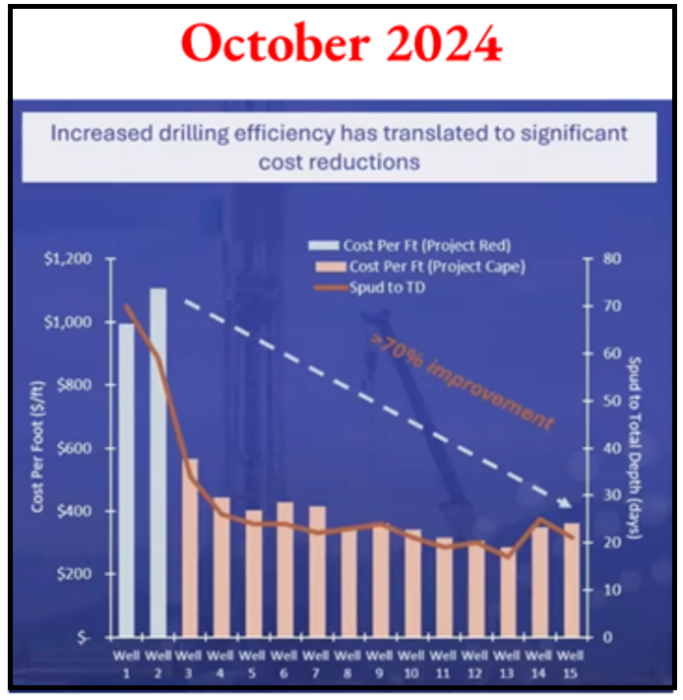
And yes, the plot does show a flattening of progress over the first fifteen of the over one-hundred wells that Fervo will drill at their Cape Project, and even a slight uptick at the end. So perhaps Morpheus has identified a valid concern. Perhaps Fervo won’t be able to further improve drilling performance.
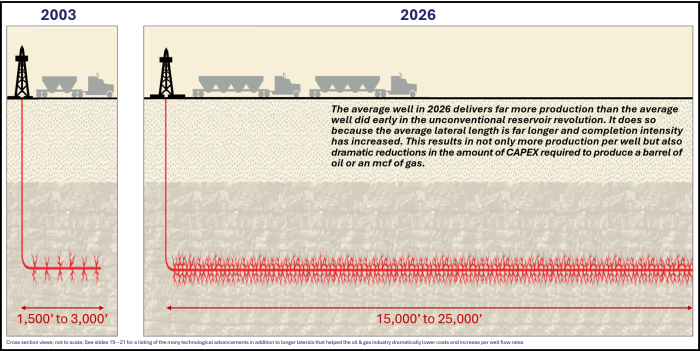
However, before jumping to this conclusion, it is worth considering that the oil & gas industry has demonstrated innumerable times over the past quarter century that there is more than one way for drilling progress to lower the cost per unit of energy produced. For example, as is shown in the figure below, by extending the length of horizontal laterals, the U.S. unconventional industry greatly improved overall profitability even though from a purely drilling perspective, drilling longer wells takes more time and therefore costs more than drilling shorter laterals.
So why is this important? Well frankly, if Morpheus had been paying attention, or more likely, if they weren’t trying to present an extremely biased report to drive down the price of Fervo’s stock to maximize the value of the (large?) short position they hold in the company, they would have noted that Fervo is following the oil & gas playbook, with each generation of wells that they are drilling being designed to deliver more heat and power per dollar of capital expended, as is shown in the table below that Fervo published in a press release on July 8, 2026.
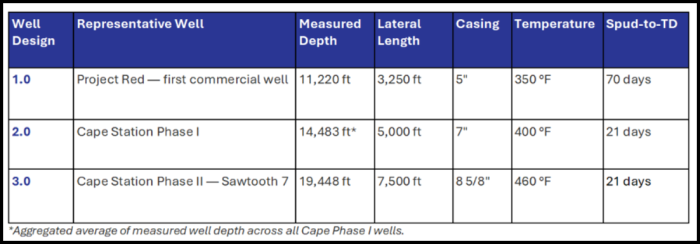
So no, Fervo’s progress towards improving drilling performance has not plateaued! At least not if you consider the metrics that count, which are all related to maximizing value creation rather than optimizing a single drilling KPI (i.e., key performance indicator).
Claim debunked.
Here are a few final observations and thoughts about Morpheus’ report:
- The use of unattributed quotes, especially quotes by former employees, is a questionable practice in this situation given that we have no way of knowing whether Morpheus have cut the former employees in on their short position or the employees have taken out short positions of their own.
- The uses of only snippets of what Morpheus claims someone said preceded and/or followed by “…” suggests many of the unattributed claims contained in the report may have been reported out of context (this has happened to me more than a few times in the past; perhaps it has happened to you as well).
- Before massively shorting a company, which presumably Morpheus has done, one should hire a technically competent consulting group (such as Jacobs Engineering, GeothermEx, Halliburton, Baker Hughes, or Geothermal Insights) to help you understand technical topics that are beyond your grasp. Or said another way, don’t utilize people of Inspector Lestrade’s caliber to write your reports when you need someone of Sherlock Holmes’ capabilities instead.
My thoughts about Fervo: I’m impressed by their technical capabilities. They appear to be fast learners. They’re certainly innovators. They also appear to be competent managers of large drilling and completion programs. And they have undoubtedly benefited from engaging with high-caliper technical review teams from the numerous institutions that have “looked under the hood” before making sizable investments in Fervo, including teams from the likes of Devon Energy, one of the oil & gas industry’s leading unconventional reservoir developers. That being said, Fervo is pioneering the application of a new approach to EGS by using horizontal hydraulically fractured wells. Thus, there will be unexpected and under-appreciated challenges that they will have to deal with (challenges much like those the company I worked for during most of my career, ConocoPhillips, had to deal with numerous times during its over 100 year long history). That’s what you get when you go first. However, with more and more companies deploying rigs to drill these types of wells (e.g. Mazama and Quaise at the Newberry Volcano in Oregon), which increases the ability for Fervo to learn from others, and with plentiful opportunities to learn from their own experiences, Fervo will almost certainly continue to improve performance over time, with their Cape Phase 1 project likely to be their highest cost per kwh project, with their Cape Phase 2 performance being better than that achieved during Phase 1, and their next development being better still, and so on and so on. That’s how learning curves work. And that is how a company becomes an industry leader in a resource class poised to undergo rapid growth.
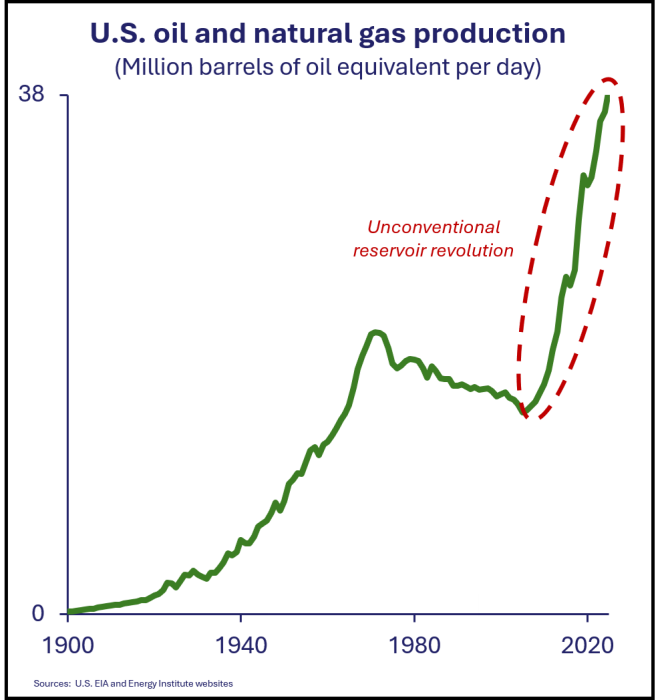
And while some may see this as an extravagant claim, I say this with confidence since this is what we (the U.S. oil & gas industry) achieved in unconventional reservoirs over the past two decades, with the result being so spectacular that nobody would have believed that delivering such an outcome would have been possible back at the start of the 21st century. For we delivered a result that has made America the largest oil and natural gas producing country on the planet by far. A result that has enhanced the country’s economy, geopolitical status, and energy security. A result that geothermal power producers have a good chance of replicating if they work together to overcome technical challenges, as I believe they will.
Disclaimer: Neither Tidal Wave Technologies LLC, a one-person consultancy company, or Greg Leveille, its founder and CEO, now hold or have ever held a financial interest in Fervo Energy. Nor has Fervo Energy ever paid these parties to do work for them.


