
Tales from Two Conferences
Two conferences in two weeks: the SPE Hydraulic Fracturing Technology Conference, then the Stanford Geothermal Workshop. Greg Leveille, GA Drilling board member and former ConocoPhillips CTO, reports on the push towards hotter reservoirs, Mazama’s 331°C EGS well pair at the Newberry Volcano, Fervo’s Blanford discovery, and what the geothermal and oil and gas industries are now learning from each other. Reposted with permission from Tidal Wave Technologies.

I participated in the Stanford Geothermal Workshop (SGW) earlier this week. Presented a paper about the importance of knowledge sharing amongst development companies for accelerating progress (LINK). The week prior I was at the Society of Petroleum Engineers’ Hydraulic Fracturing Technology Conference (HFTC). Both events were well attended. Numerous important technical talks were delivered. The networking was superb. The level of enthusiasm sky-high.
Highlights from the Stanford Geothermal Workshop (from my perspective) included:
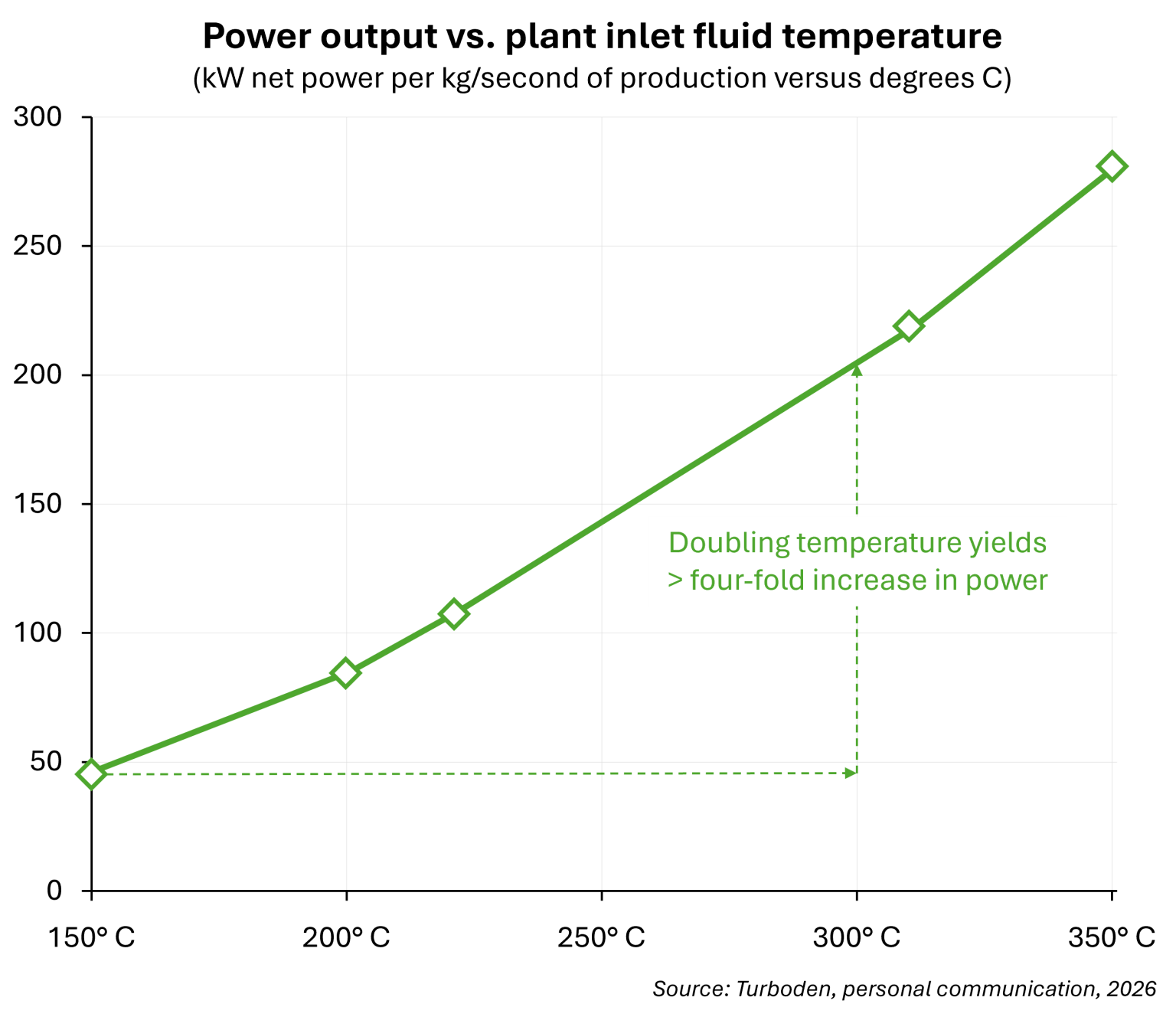
- Geothermal is getting hotter: The payoff from placing wells into higher temperature formations is enormous, as is shown in the plot below. For example, in going from 150° C (302° F) to 300° C (572° F), power output per unit of production increases by over four fold. Because of this, power developers are testing methods for drilling, completing and operating wells at ever higher temperatures. Records are being set. Plans to push the envelope even further are being developed. Project execution timelines are being pulled forward.
Graph showing the relationship between the temperature of produced fluids and power production. Data shown is for an Organic Rankine Cycle (ORC) geothermal power plant.
- Deploying an Enhanced Geothermal System at 331° C: Mazama Energy presented several technical papers detailing how they established flow between an EGS injector – producer well pair at 331° C (629° F) at the Newberry Volcano in Oregon. This is a phenomenal result. One that represents the world’s hottest EGS system successfully deployed to date. Must read papers Mazama presented during the workshop include those that describe the project’s geologic setting (LINK), drilling program (LINK, LINK), and hydraulic fracturing operations and production results (LINK).
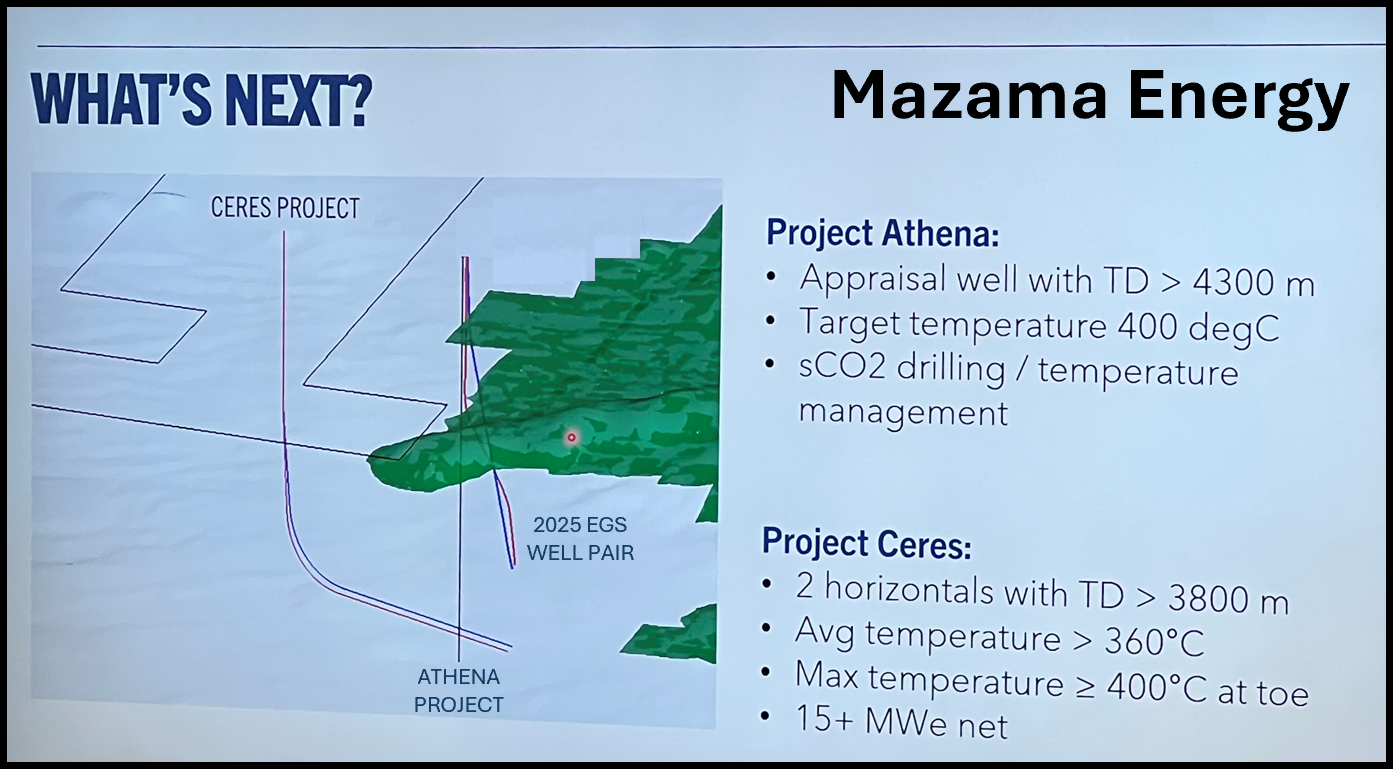
- Newberry Volcano – a hotspot for geothermal power activity (pun intended): Mazama Energy shared plans to drill a vertical appraisal well to depths at which they expect to encounter formation temperatures of 400° C (752° F). This will be followed by the drilling and completion of an EGS injection-producer horizontal well pair (see first of two figures below). Generation of > 15 MWe of electricity from the well pair will be accomplished by installing a fit-for-purpose power plant. And given success, a 200 MWe development will follow. In addition, Quaise Energy announced plans during the conference to develop a 250 MWe project at Newberry on a separate track of land (LINK). The project, dubbed Obsidian (which is a type of volcanic rock), is already under construction, with power output being anticipated as early as 2030 (see second figure).

- Fervo Energy Cape Project Phase 2: Fervo Energy has begun drilling Phase 2 wells at their Cape Project in southwestern Utah. The wells will be deeper, hotter, and longer than the Phase 1 wells (11,000’ TVD vs. 9,000’; 225 to 250° C vs. 200°C [437 to 482° F vs. 392° F]; 7,500’ long laterals vs. 5,000’). Whereas 24 months ago Fervo was planning to execute the entire Cape Project at bottom-hole temperatures around 200° C (392° F), they too have seen the advantage of targeting higher temperatures. They’ve also developed sufficient confidence in their drilling and completion prowess to have increased lateral lengths and drill larger hole sizes (i.e., hole sizes large enough to run 9 5/8” casing in the horizontal section versus 8 5/8” casing on recent Phase 1 wells).
- Fervo Energy Blanford Discovery: The first well drilled at Fervo’s Blanford prospect encountered a bottom-hole temperature >290° C (555° F). The well was drilled vertically to 11,200’ in under 11 days. Here’s a LINK where you can access Fervo’s press release about the discovery. Interestingly, the geothermal reservoir at the Blanford site consists of sedimentary formations including sandstones, claystones, and carbonates instead of the more commonly targeted igneous and metamorphic rocks from which geothermal production has traditionally come from in the western United States.
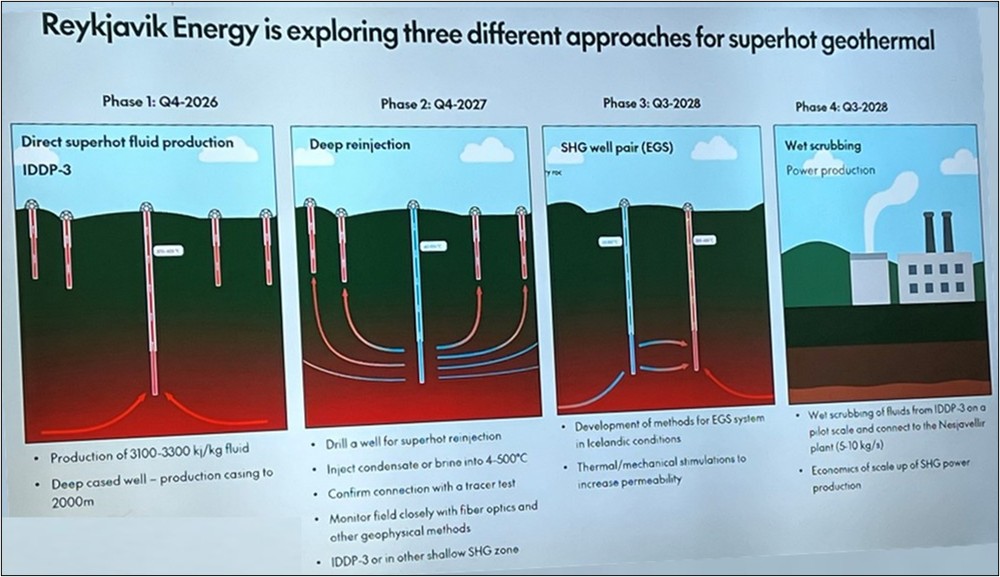
- Japan, New Zealand, and Iceland: During a Supercritical/Superhot Geothermal session held over lunch on the first day of the workshop, presenters from Japan, New Zealand, and Iceland shared plans they have for pushing beyond current temperature limits. Two speakers from Japan described plans for drilling into ductile rocks on the edge of magma chambers. For New Zealand, a decision will be made next month on whether to proceed with drilling a superhot geothermal well beneath a currently productive geothermal field (see first of two figures below). And in Iceland, planning is underway to drill what will be a third deep superhot well (IDDP-3). A well that researchers hope will lead to commercial development of the country’s vast superhot geothermal resources (see second figure below).

- U.S. Department of Energy: Kyle Hausveit, the Assistant Secretary for Hydrocarbons and Geothermal, gave one of the keynote talks in the opening session. Kyle indicated that the incorporation of geothermal into the name for his office was a reflection of the importance that the Trump administration placed on growing U.S. geothermal power production. Lauren Boyd, who leads the Geothermal Technologies Office, reenforced Kyle’s messaging in a talk she gave later in the conference. See the figure below for a slide she showed describing GTO’s goals and objectives.

- Mitigating the impact of critically stressed faults in EGS developments: Taeho Kim described hydraulic fracture-fault interactions observed at the Cape Station EGS project operated by Fervo Energy. This is a must-read paper for anyone involved with EGS developments (LINK) – a paper that documents fault related negative impacts that Mark Zoback and I warned of in a paper presented during the 2025 Stanford Geothermal Workshop (LINK). If you wish to dig deeper into this topic, here is a LINK to a presentation Fervo gave in October of last year that provides further useful information.
- Utah FORGE: There were numerous papers presented about the Utah FORGE project, which continues to be an invaluable site for testing EGS related technologies. It was announced during the meeting that Kristie McLin, who holds a geoscience PhD from the University of Utah and subsequently worked for nearly two decades in the oil and gas industry, will take over from Joe Moore as the principal investigator on the project. Joe’s shoes will be big ones to fill as evidenced by the many expressions of thanks he received during the conference for his enormous contributions towards improving the economic competitiveness of EGS developments.
- Resource Classification: Steve Gardner and Allen Chen with Ryder Scott presented a paper describing work being done to produce a Geothermal Resource Classification System (LINK) based upon the oil and gas industry’s Petroleum Resource Classification System, which has been in use for over 60 years. This is important since having a consistent method of describing geothermal resources will promote reliability, transparency, and confidence in estimates and reporting, which in turn will encourage greater investment in geothermal power production.
- SGW attendance: The conference set a record for attendance. There were over 500 people onsite and another 100 participating virtually. Geothermal power developers attending the event in person included Fervo, Mazama, Quaise, Zanskar, EGX, IGNIS, Sage, TLS Geothermics, AlterG Resources, Power Planet, Ormat, Reykjavik Energy, Philippine Geothermal Production Company, Star Energy Geothermal, and Davinci. Oil and gas operators who had staff onsite included Chevron, ConocoPhillips, Devon, ExxonMobil, OXY, and Shell.
Highlights from the Hydraulic Fracturing Technology Conference (HFTC) from my perspective included:
- Executive summary: This is for me always one of the best conferences of the year. The networking is amazing. The quality of technical papers presented superb. The exhibit hall packed and vibrant. This year’s event was exceptional. I especially liked the fact that oil and gas operators allowed their staff to share much valuable information. This bodes will for the industry’s future given that open-source-like knowledge sharing accelerates innovation. The high degree of knowledge sharing will also benefit the geothermal industry, especially regarding projects to be developed using horizontal hydraulically fractured wells, a quarter million of which oil and gas operators have drilled since the start of the 21st century compared to 25 to 30 for the geothermal industry.
- Keynote address: Chris Wright, the U.S. Secretary of the Department of Energy, gave the keynote talk. He called out three attributes that the administration is focusing its energy strategy towards delivering: energy security, energy reliability, and energy affordability. Conspicuously missing was any discussion about clean energy, which has for almost two decades been a focus of America’s energy policy.
- Plenary Panel: The plenary panel was made up of heavy hitters. It included Kyle Hausveit, the Assistant Secretary for Hydrocarbons and Geothermal, senior technology leaders from ExxonMobil and Chevron, and Jennifer Miskimins, SPE’s current president. Themes ranged from: 1) the need for innovation in order to keep production rates up and costs down as U.S. unconventional reservoir drilling programs run out of Tier 1 locations, 2) the importance of identifying actions that can be taken to help the industry deal with the 20 million barrels of water produced each day in the Permian Basin, 3) increasing recovery rates from unconventional reservoirs, and 4) how to attract students to petroleum engineering and geoscience careers.
- Increasing recovery factors: Throughout the conference there was much discussion about the importance of optimal perforating for maximizing hydrocarbon recovery. Finding ways to minimize near-wellbore complexity was also a recurring theme. Companies are using frac sleeves more and more. Advances in fracturing fluids, proppants and chemicals also received considerable attention. And there were numerous presentations on diagnostics, especially those associated with fiber optic measurements.
- HFTC attendance: Over three thousand paid the conference registration fee. It seemed like even more were present the first two days of the event. There were numerous “SPE Completions Legends” on hand. Even more future legends in the audience. All the major operators sent large contingents. I can’t wait for February to roll around again so that I can participate in the next hydraulic fracturing technology conference (followed by the Stanford Geothermal Workshop!).


