
GeoNerd Digest – 29th Edition: Closing the loop on GRC 2025 with Closed Loop Geothermal
The GeoNerd Digest wraps up its Geothermal Rising Conference (GRC) 2025 paper review series with a final installment spotlighting two standout studies on closed-loop geothermal systems. Over the past weeks, we’ve explored cutting-edge research pushing geothermal’s frontiers. Today, we compare a broad "Multi-Site Techno-Economic Analysis of Closed-Loop Geothermal Systems" by Raquel Hakes et al. with an in-depth "Heat Extraction from Granites with Closed-loop Geothermal Systems and Sensitivity Studies" by Sai Liu et al., distilling what they mean for the future of geothermal energy.


1. Multi-Site Techno-Economic Analysis: Big Picture Insights
This study tackled the “where and how” of closed-loop geothermal viability by modeling 11 diverse sites across the United States.

The multi-lab team (the DOE’s Closed Loop Geothermal Working Group) ran simulations for different closed-loop designs (including vertical coaxial wells and U-tube laterals) at each location, then evaluated the economics of a hypothetical 10-well power project in those settings. The sites spanned high-heat volcanic areas, Basin-and-Range geothermal fields, and lower-gradient sedimentary basins – offering a comprehensive reality check on performance and cost across geology types.

Key findings from the multi-site analysis:
✅ Location Matters – A Lot: The models showed huge variability in economic outcomes by site. High-heat “Volcanic Region” sites (e.g. Newberry Volcano, Fenton Hill) could deliver much lower costs – even approaching competitive levels – while low-gradient sedimentary basins yielded prohibitively high costs. In fact, only the hottest sites produced sub-100 $/MWh electricity, even under optimistic assumptions. Cooler areas simply couldn’t produce enough heat to be economically viable, emphasizing that geology is destiny for closed-loop projects under current tech and cost levels.
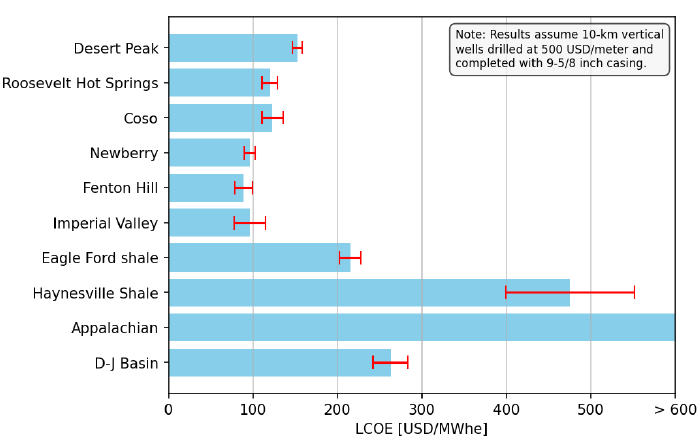
✅ Deeper + Cheaper Drilling is Crucial: To tap hotter rock, the study assumed deep wells (~7–10 km) and optimistically low drilling costs ($500 per meter, far below industry norms). Even so, most sites struggled to hit attractive economics, implying that ultra-deep drilling must get much cheaper to make closed-loop geothermal widely feasible. The good news: in high-grade areas, going deep did pay off – volcanic sites reached ~200°C fluid temperatures, enabling those sub-$100/MWh outcomes. The bad news: in average areas, deeper drilling alone wasn’t enough without major cost reductions. This drives home a clear message – drill deeper, and drill smarter (cheaper) is the order of the day.
✅ Flow Rate Goldilocks: Interestingly, the modeling found that each site had an optimal fluid circulation rate for maximizing efficiency. Lower flow rates often yielded better economics because the fluid had more time to absorb heat (raising outlet temperature). Push the flow too high and the fluid stays cooler, tanking power output. It’s a classic trade-off between flow and heat uptake. The takeaway: closed-loop designs will need to tune flow rates carefully – sometimes less is more when it comes to extracting quality heat.
✅ Toolsets for Developers: As a side benefit, the team has integrated these learnings into GeoCLUSTER, an open-source web tool. It lets users play with different locations and designs, running “what-if” scenarios on closed-loop performance and economics. This kind of accessible modeling platform is a boon for would-be developers and investors to explore projects virtually before ever picking up a drill. It shows how far the community has come – from theory to user-friendly simulators accelerating real-world innovation.
To sum up, the study gave us a reality check: closed-loop geothermal isn’t one-size-fits-all. In certain sweet spots with high heat flow, it could soon be competitive. Elsewhere, the hurdles are steep – unless we slash drilling costs or boost heat extraction. That sets the stage for our second paper, which attacks that very problem of boosting heat uptake…
2. Granite Case Study: Maximizing Heat with Multilateral Wells
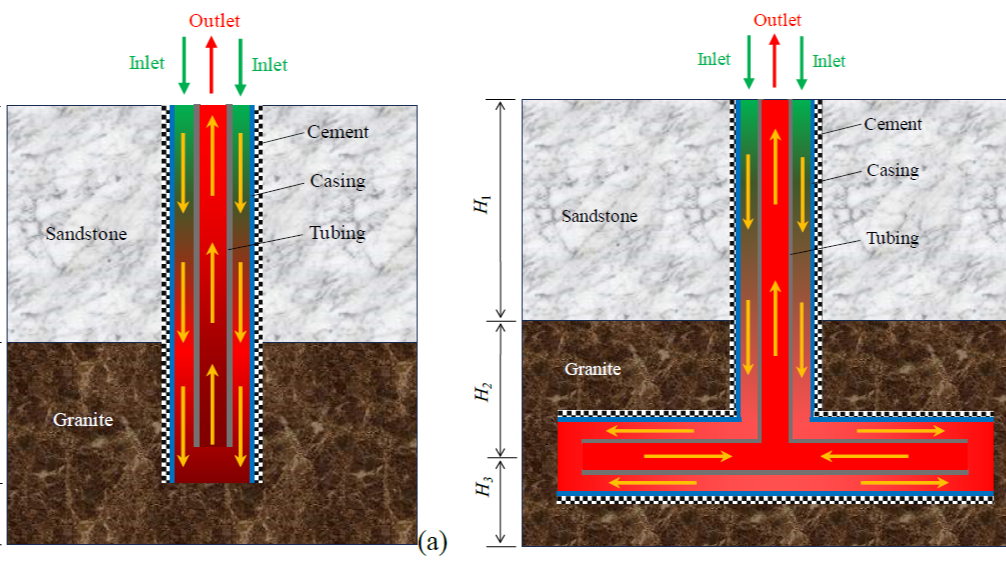
Shifting from a broad survey to a deep dive at one site, this paper zeroes in on a hard rock granite formation in Southwest Texas (part of the Rio Grande Rift region). Granite is hot but tough – low natural permeability, meaning it’s ideal for closed-loop (no need for water or fractures) but also a challenge because heat transfer is purely conductive. The authors asked: How can we supercharge a closed-loop system in granite to extract more heat? They built a detailed 3D simulation of a coaxial closed-loop well, then experimented with two big levers: injection temperature and well architecture (adding horizontal laterals). The result is a sensitivity study that reveals how operational tweaks and advanced well designs can dramatically improve performance in a single site scenario.

Key insights from the study:
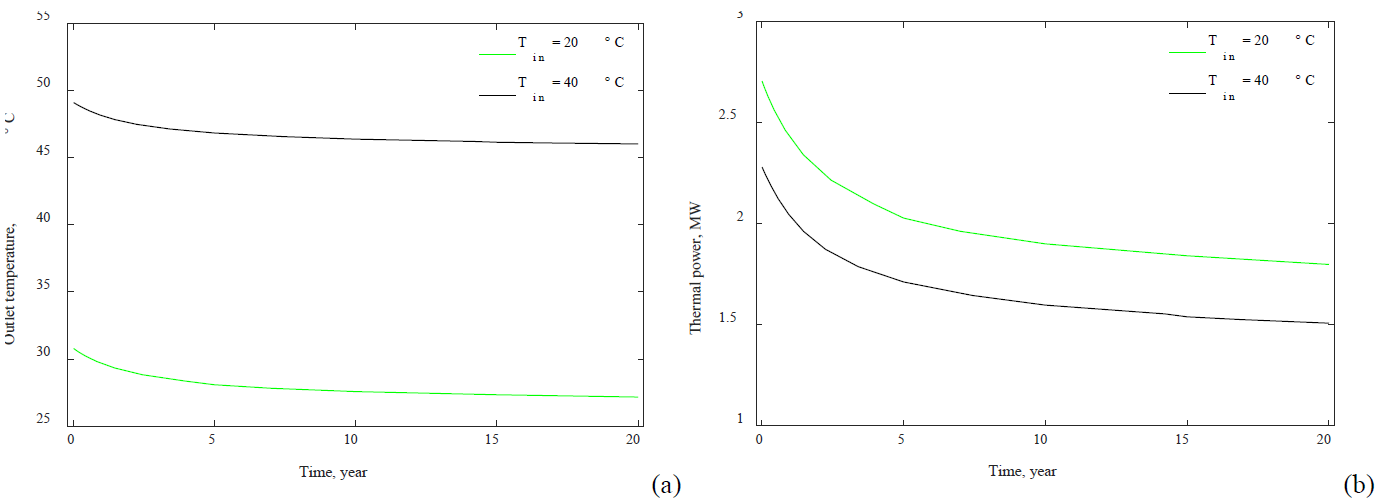
✅ Hotter Injection = Hotter Production (But Less Total Heat): The team found a nuanced trade-off with injection fluid temperature. If you inject warmer fluid (40°C vs 20°C in their tests), the circulating fluid returns about 19°C hotter after 20 years. In other words, a hotter injection yields a higher outlet temperature – which could be useful if you need high-temperature output for power plants. However, the total thermal power extracted actually drops by ~20% with warmer injection, because the smaller temperature difference means the system pulls less heat from the rock. Takeaway: if you’re chasing raw heat output (e.g. for building heating), inject cooler fluid to maximize energy extracted. But if you need higher quality heat (temperature), a warmer injection can help – albeit at the cost of some efficiency. It’s a design decision akin to “do we want a bigger heat quantity or a hotter fluid?”
✅ Multilateral Magic – 10× Boost in Energy: The real headline is what happened when they introduced eight horizontal lateral wells branching off the vertical well. This multilateral closed-loop design blew away the single-well performance. After 20 years, the outlet fluid temperature was over 120°C higher than the no-lateral case, and the system’s thermal power output jumped by an astounding 902% (nearly tenfold increase!). Essentially, laterals change the game by exposing vastly more pipe surface to the hot rock, overcoming the limited heat conduction around a single well. The model shows that even a “dry” granite can deliver huge amounts of heat with an engineered well geometry – no permeability needed, just clever drilling.
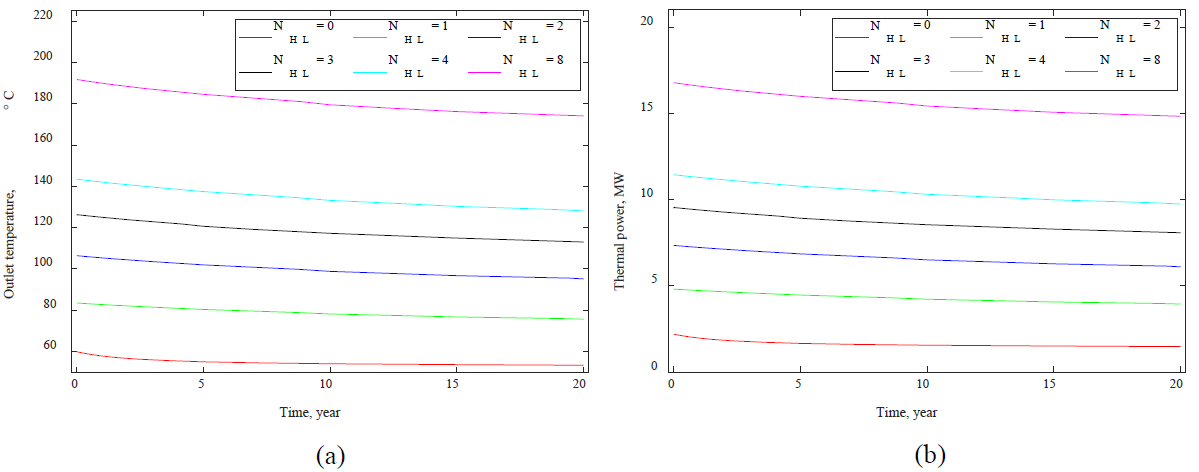
✅ Diminishing Returns and Design Optimizations: While 8 laterals were great, the authors note that going from, say, 4 to 8 laterals yielded less incremental benefit than going from 0 to 4. There are diminishing returns as each additional lateral contributes a bit less extra heat (the rock volume starts to overlap in the thermal drawdown). Meanwhile, every added lateral adds significant drilling and completion cost. This hints at an optimal number of laterals where the trade-off between extra heat vs. extra cost is balanced. The study deliberately focused on thermal performance, deferring economics to future work – but the implication is clear: there’s a sweet spot in well design that maximizes bang for buck. Ongoing research will need to find that magic number of laterals (and it likely depends on rock conditions and cost factors).
✅ Towards Real-World Impact: Importantly, this granular study in granite gives a template for how to unlock geothermal in otherwise unyielding rock. Granite formations are common around the world; turning them into producers via closed-loops with laterals could open vast new regions for geothermal development. The authors emphasize that while their results are theoretical, they used realistic field data (e.g. injection parameters informed by the Utah FORGE project) to ensure relevance. Their work is a stepping stone toward actual demonstrations of multilateral closed-loop wells. It also flags what’s next: we need to assess the practical drilling challenges of multi-laterals in deep, hard rock and evaluate the economics. In essence, they’ve shown the thermal potential is there – now it’s up to engineers (and economists) to make it feasible.
Comparing the Approaches: Broad Strokes vs. Fine Detail
Taken together, these two papers highlight complementary angles on advancing closed-loop geothermal. The Hakes et al. study zooms out to the macro scale, asking: “Where could closed-loops work best, and under what conditions?” It gives us a strategic map – pointing to high-heat areas and cost levers like drilling improvements as keys to success. In contrast, Liu et al. zoom in to the micro scale: “How can we get more heat out of this particular granite?” This delivers a tactical toolkit – demonstrating that well configuration (laterals, injection strategy) can hugely improve performance in a given geology.
It’s striking that both studies, despite their different scopes, arrive at a common theme: To unlock closed-loop geothermal’s promise, we must innovate on multiple fronts. You need favorable geology and advanced engineering. High temperatures help a lot – and so do smart designs to capture that heat. Lowering drilling cost is vital – and so is increasing the heat transfer surface area (via longer wells or more laterals).
In other words, the path to viable closed-loops isn’t either-or, it’s “all of the above.” There’s also a nice continuity here: the multi-site study identified the limited heat transfer area of closed-loops as a fundamental challenge (needing long laterals for multi-MW outputs), and the granite study directly tackles that by adding laterals. Meanwhile, the granite study acknowledges that economics must be addressed next – circling back to the big-picture questions raised by the multi-site analysis. Together, these papers sketch a future where: Developers target the hottest available resources, drill deeper but also drill smarter (with novel well architectures), and relentlessly drive down costs through technology and scale.
The industry leverages robust modeling tools (like GeoCLUSTER and detailed 3D simulations) to design projects for optimal performance before steel hits the ground. Closed-loop systems progressively improve, making previously untenable sites gradually feasible as innovations stack up (and as super-hot rock targets – even supercritical regions – come within reach using these methods).
These studies tell a story of both potential and pragmatism. Closed-loop geothermal can indeed be a game-changer – accessing heat almost anywhere – but we must confront the engineering and economic realities head-on. The direction of innovation is set: toward hotter, deeper wells, more sophisticated well designs, and aggressive cost reduction at every step. The excitement is tangible: multi-lab collaborations, field trials (as we saw in earlier digests), and simulation breakthroughs are all converging. Closed-loop systems are steadily moving from theoretical concept to proven practice. There’s a pioneering spirit reminiscent of the early oil amp; gas wildcatters, but with 21st-century modeling and materials science in our toolbox.
What’s next? We’ll be looking for demonstrations of these ideas: perhaps a pilot project with multilateral closed-loops in a granite or basalt formation, or new drilling techniques that cut costs enough to revisit “uneconomic” sites. The community is also eyeing superhot rock where closed-loops could thrive. The coming years will be about breaking thresholds: temperature thresholds, cost thresholds, and length/depth records – all in pursuit of making geothermal energy ubiquitous.
Now it’s your turn:
- What do you see as the next breakthrough needed for closed-loop geothermal?
- Is the key in better drilling, smarter well architecture, or targeting hotter rocks (or all three)?
- How soon might we see closed-loop systems delivering competitive power in new regions?
The conversation doesn’t end here – if anything, it’s just getting started. The vision of geothermal anywhere is on the horizon, and with continued innovation, we’ll get there – closing the loop on clean, always-on energy for the world.
Copyright Notice:
This summary is based on the papers "Multi-Site Techno-Economic Analysis of Closed-Loop Geothermal Systems" by Raquel Hakes, Radoslav Bozinoski, Mohammad (Jabs) Aljubran, Gabriela Bran-Anleu, Anastasia B. and Alex Buchko and "Heat Extraction from Granites with Closed-loop Geothermal Systems and Sensitivity Studies" by Sai Liu, Shuvajit Bhattacharya, PhD and Seyyed Abolfazl Hosseini published at GRC 2025. All figures are reproduced from the reports under fair use for review purposes.


