
GeoNerd Digest – 39th Edition: Rodatherm´s Closed-Loop Test Bed in Utah
This edition breaks the usual pattern. Instead of a peer-reviewed paper or a conference proceedings, the source is a 246-page US federal permitting document: the Bureau of Land Management's Environmental Assessment for the Rodatherm Geothermal Test Bed in Beaver and Millard Counties, Utah. Why this document, and why now? Last week, Emissions Reduction Alberta (ERA) announced CAD 37 million across ten projects under its Drilling Technology Challenge. Two names on that list sit next to each other in my head: GA Drilling (NexTitan downhole drive system) and Rodatherm Energy Corporation (closed-loop geothermal demonstration, Milford, Utah).


That got me curious about what Rodatherm is actually building. It's worth noting that Rodatherm has kept a low public profile — much of its work sits outside the public domain. The Environmental Assessment (EA) is valuable precisely for that reason: it's one of the few detailed, publicly available descriptions of how the system actually works. Also, I chose this topic because the previous GeoNerd edition on Eavor Technologies Inc. closed-loop advanced geothermal system (AGS) drew far more comments than I expected — clearly this question is one this community wants to keep pulling at. Rodatherm offered a natural way to continue that thread: a different take on the same core idea, and one I'd been meaning to look at more closely ever since GA Drilling and Rodatherm turned up side by side in ERA's latest funding round.
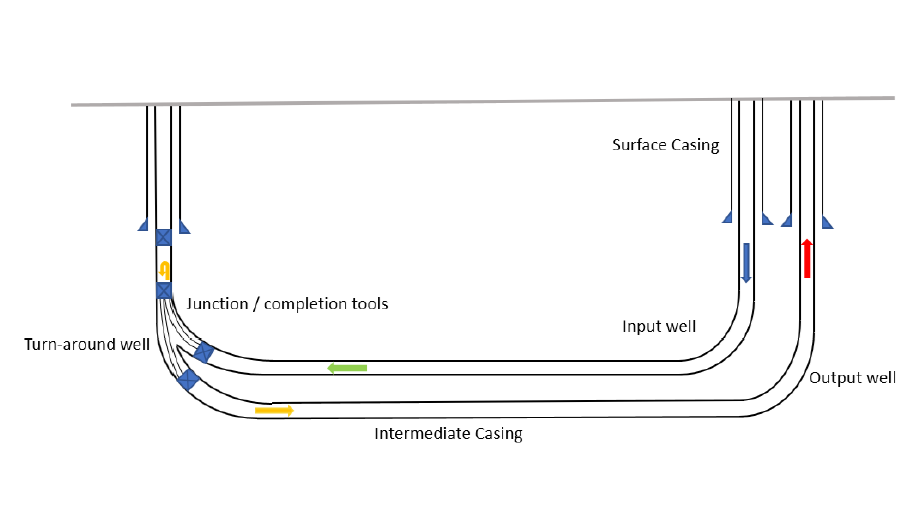
Rodatherm's central innovation is what it calls a Waterless Geothermal System (WGS™) — a sealed, refrigerant-based closed loop that borrows its physics not from conventional geothermal but from refrigeration and industrial heat recovery. A cool organic, low-GWP refrigerant flows down the wellbore into horizontal laterals, absorbs heat as it passes through permeable rock, vaporizes, and rises back to the surface under its own thermodynamic pressure — without continuous pumping — where it expands through a radial-inflow turbo expander to generate electricity before condensing and cycling again.
The cleverness is in the integration rather than any single component: extended-reach horizontal drilling refined in shale oil creates enough residence time for the fluid to fully vaporize, a multi-lateral "modular junction" architecture packs six loops into a single repeatable pad to scale capacity while minimizing surface footprint, and the working fluid is tunable to reservoir temperature. The strategic bet follows directly from what the design eliminates — no water extraction, no fracking risk, and permitting under existing safety and regulatory code — which is what Rodatherm argues makes the approach both bankable and deployable in the water-stressed Western US, though it's worth noting these are the company's own performance and economic claims rather than independently published results.
What Rodatherm is proposing
The Proposed Action is narrow and specific: drill and test up to five geothermal wells from two well pads, plus the associated on-lease access roads, on federal geothermal leases roughly 12 miles north of Milford, Utah — in the same Milford Valley corridor as Utah FORGE and a cluster of other geothermal leases.

The architecture is what makes it interesting. This is not a conventional hydrothermal well that produces reservoir fluid. It is a closed loop: input and output wells on Pad 1, a turn-around well on Pad 2, connected downhole. The system circulates a commercially available refrigerant / hydrocarbon working fluid that transfers heat from the hot rock to a surface generation system, with — per the document — no interaction between the working fluid and the surrounding geology or groundwater. Three consequences follow directly, and each is stated plainly in the EA:
- No hydraulic fracturing is required.
- No reservoir flow testing — the loops are pressure-tested, cleaned, then charged with working fluid.
- No water use during operation.
For anyone who has followed the closed-loop-versus-EGS debate in earlier GeoNerd editions, this is the closed-loop value proposition rendered as a permitting argument: you avoid the subsurface uncertainties (induced seismicity, fluid loss, short-circuiting) precisely because you never open the system to the reservoir.
The drilling program, in operational detail
This is the section where an EA quietly out-discloses a technical paper. Table 2-1 lays out the drilling specifics with a candour that press materials rarely match:
- Rig: mast rig, 160–170 ft
- Depth drilled: ~6,500–9,200 ft, with a maximum rig depth capacity of 14,763 ft
- Drilling time: ~30 days per well
- Crew: ~7 on-site, operating 24/7
- Logistics: ~50 tractor/trailer loads to mobilise; 43 move loads
The sequencing is explicit: Loop 1 (input + output wells) drilled over roughly three months with intermittent multi-day shutdowns; Loop 2 over roughly six months; the turn-around well drilled during Loop 1 but serving both loops. Commissioning is described down to the detail that early electrical output is dumped into a load bank — converted to heat and released — to calibrate equipment before any grid connection.
Two more numbers worth flagging. Drilling water is capped at up to 650,000 gallons total, drawn from existing water rights and lab-tested before cementing. And the geological context is anchored to a real offset: the Acord 1-26 well (1979), a few miles southeast, reached a total depth of 12,645 ft and logged roughly 10,400 ft of volcanic and sedimentary deposits. That is the hard-rock column this system has to reach through.

The footprint: smaller than the paperwork suggests
The disturbance it authorises is about 15 acres. That asymmetry is the point of NEPA, and it is worth sitting with: 11.5 acres for the two well pads (two ~5.8-acre pads) and roughly 3.8 acres of new access-road corridor, on soils rated low-to-moderate for erosion (wind erodibility index 86, well below the 134 high-erosion threshold).
The environmental analysis focuses on five issues flagged by the interdisciplinary team: soils, kit fox, migratory birds, pronghorn, and vegetation. The wildlife numbers are instructive because they quantify how little a closed-loop test bed touches its surroundings. For kit fox (Vulpes macrotis), the modelled direct habitat loss is about 0.02% of the 4.5-mile analysis area, with functional loss (surface disturbance buffered by 100 m) around 0.15% — and most of it temporary, reversing as reclamation restores the pads over a few years.
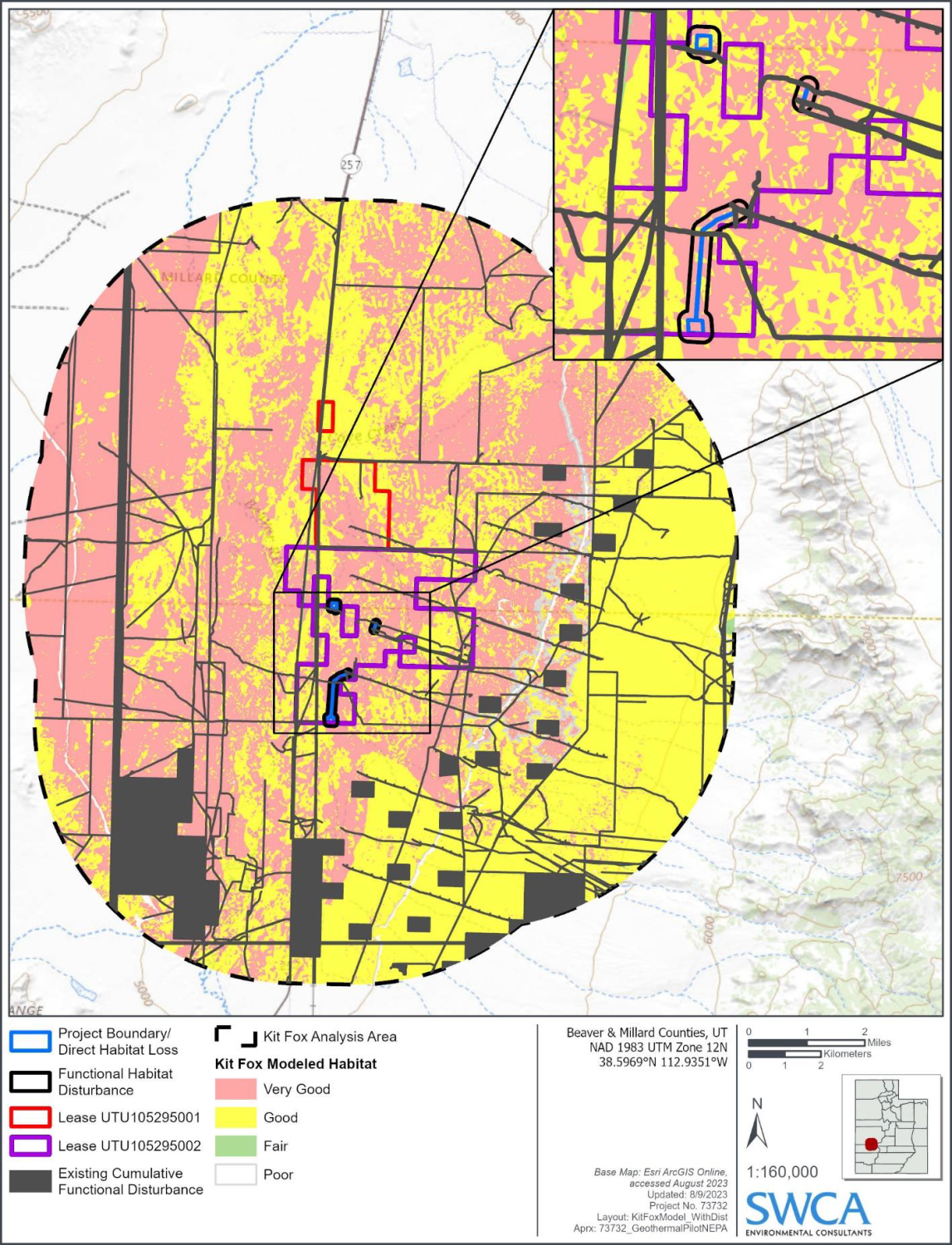
The more sobering figure is the cumulative one. The EA tallies reasonably foreseeable future actions in the analysis area at roughly 523 acres of quantifiable disturbance — Utah FORGE (its Milford site alone at 131 acres, plus seismic and strainmeter work), the Cape Modern geothermal exploration project (266 acres), Bailey Mountain (62 acres). Rodatherm's ~15 acres is a rounding error against that backdrop. Milford Valley is becoming a geothermal cluster, and the individual-project footprint is small precisely because the shared footprint is where the real land-use conversation will eventually sit.

Where this connects to hard-rock drilling economics
Here is the honest tension. A test bed like this is designed to prove the loop — thermal output, working-fluid behaviour, generation calibration. It is not, by itself, a statement about commercial cost. The EA is explicit that a development well field would trigger an entirely new NEPA analysis, and that the economics of that field are speculative today.
And that is exactly where the closed-loop critique has always bitten hardest — the same structural point Mark McClure ResFrac analysis made in an earlier Digest: closed-loop systems trade reservoir risk for conductive heat transfer over enormous wellbore length, which means the model lives or dies on how cheaply you can drill a lot of precise, deep, hard-rock footage. A five-well test bed doesn't resolve that. It defers it to the development phase.
If the closed-loop thesis is drilling-cost-bound in hard rock — and the Milford column above is exactly that — then the enabling technology is whatever lets you extend reach and increase penetration in ~30 ksi-class formations without the trip count and vibration penalties that dominate conventional runs. That is the specific problem downhole drive systems are built to attack, and it is why ERA funding for two very different-looking projects (a downhole drive system and a closed-loop demonstrator) under one Challenge is more coherent than it first appears.
Final thoughts
Two things stand out from reading a permit as if it were a paper.
First, the disclosure is real. An EA has to describe operations concretely enough for a regulator to bound the impacts — water volume, loop sequencing, commissioning method. That makes it one of the more trustworthy public windows into how a proprietary AGS actually runs.
Second, the footprint story is genuinely favourable, and the cumulative story is the one to watch. A single closed-loop test bed disturbs almost nothing. A valley full of them is a different question — and it is a good question, because it means the technology is working its way toward density.
The deeper point echoes the last edition: performance in geothermal is becoming a systems property. Here the "system" isn't just bit, BHA, and parameters — it's the well architecture, the working fluid, the permitting envelope, and the drilling economics that decide whether a test bed ever becomes a field.
Questions for Discussion
- Rodatherm targets "naturally permeable basins," but the Milford column their offset well logged is thousands of feet of volcanic rock. Are they drilling genuinely permeable sedimentary formations, or is "permeable" doing a lot of work here for what is effectively hard, abrasive rock at depth?
- An organic refrigerant is elegant thermodynamically, but what does a multi-year operational lifetime actually demand of it — thermal stability at reservoir temperature, resistance to degradation, and containment integrity across a sealed multi-lateral loop? What happens to performance as the fluid ages?
- Phase-change (liquid down, vapor up, no continuous pumping) is the core efficiency claim. How sensitive is that self-circulating behavior to reservoir temperature variability, and what's the fallback if a well underperforms thermally and the fluid doesn't fully vaporize?
Curious to hear your perspective — especially from anyone who has permitted or drilled in the Milford area.
#GeothermalEnergy #Drilling #AGS #Rodatherm
Copyright Notice:
This summary is based on the public document "Rodatherm Geothermal Test Bed Environmental Assessment, Beaver and Millard Counties, Utah" (DOI-BLM-UT-C010-2023-0008-EA), prepared by SWCA Environmental Consultants for the U.S. Bureau of Land Management, Fillmore and Cedar City Field Offices, September 2023. All figures referenced are reproduced from that assessment under fair use for review purposes. Funding context is drawn from Emissions Reduction Alberta's Drilling Technology Challenge announcement (July 7, 2026).


