What is coiled tubing drilling?
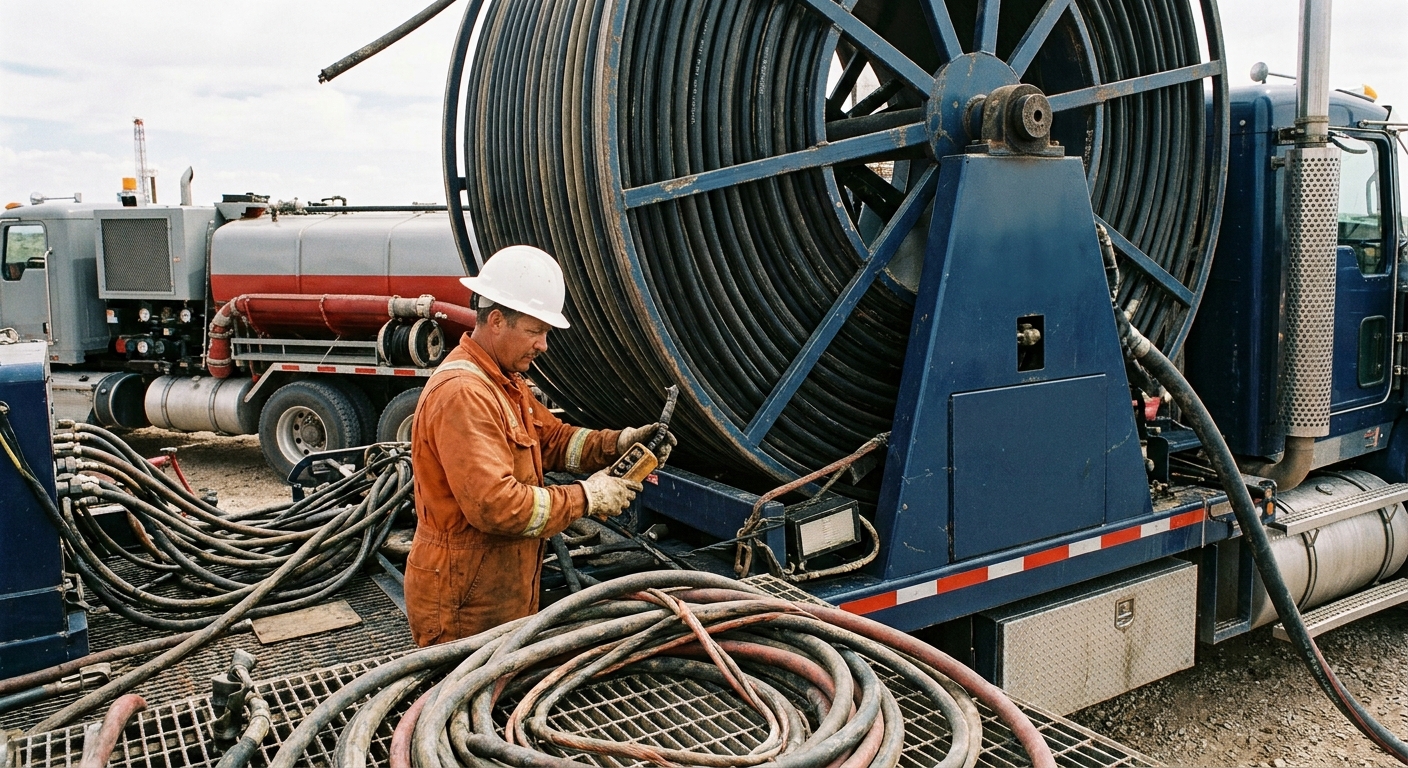
Coiled tubing (CT) drilling uses one continuous pipe made of steel or composite material that is stored on a large reel. In conventional drilling, individual lengths of rigid steel pipe, roughly 9 m each, are screwed together to build the drillstring.
How does coiled tubing drilling work?
An injector head at surface grips the pipe and pushes it into the well or pulls it back out, so tripping is a continuous motion rather than a series of connections. Drilling fluid pumped down the pipe drives a motor at the bottom that turns the bit.
What equipment does coiled tubing drilling use?
A coiled tubing drilling unit has five main parts: the reel that stores the pipe, the injector head that moves it, a control cabin, a pressure-control stack that keeps the well sealed, and a bottomhole assembly with the motor, bit, and steering and measurement tools. CT pipe typically ranges from 1 to 3.5 inches in diameter and can reach depths of more than 15,000 feet.
Coiled tubing drilling vs conventional drilling
The main difference is rotation. Conventional drilling turns the whole pipe string from surface. Coiled tubing cannot rotate, so the bit is turned by a downhole motor. That makes coiled tubing faster to set up and trip but limits hole size, depth, and weight on bit.
What are the main advantages of coiled tubing drilling?
The main advantages of coiled tubing drilling are:
Faster tripping: The pipe is one continuous length on a reel, so there are no connections to make or break. The injector feeds it in and out at a steady rate rather than in stop-start cycles, and circulation continues throughout the run, which cuts non-productive time.
Smaller rig and crew: A conventional rig needs a tall derrick to hold lengths of pipe upright while the crew joins them. Coiled tubing has no lengths to join, so it needs no derrick. The equipment arrives on a truck or as a single liftable unit, takes up less space, and is quicker to set up and pack away.
Work in a live well under pressure: A producing well has pressure pushing upward, and normally it has to be shut down with heavy fluid before anything goes in, then restarted and cleaned up afterwards. A coiled tubing unit has a seal at the wellhead that holds the pressure in while still letting the pipe slide through, so the well stays live and that whole shut-down and restart is skipped.
Lower cost on shallow, small-diameter, and re-entry wells: Less equipment, fewer people, and faster setup mean fewer days on site. The saving is largest on short jobs, where a full conventional rig would be out of proportion to the work.
Fewer hand and finger injuries: Most hand injuries on a rig floor come from making and breaking connections, where tongs, slips, and elevators create pinch points. Removing connections removes most of those points.
How much cheaper is coiled tubing drilling than conventional drilling?
A coiled tubing operation runs on roughly half the daily cost of a conventional rig, and a round trip out of and back into the well takes hours instead of days. How much that saves on a specific well depends on depth, hole size, and how many days the job runs. The drilling cost calculator works it out for your own well parameters.
What are the key applications of coiled tubing drilling?
The key applications of coiled tubing drilling are re-entry work, shallow gas wells, through-tubing drilling, underbalanced drilling, and slim holes.
- Re-entering existing wells to drill sidetracks or laterals
- Drilling shallow gas wells where a full rig costs more than the well justifies
- Drilling through the production tubing without pulling it
- Underbalanced drilling in low-pressure reservoirs, since the well stays under control
- Drilling slim holes where a small rig and fast setup matter more than hole size
Where has coiled tubing drilling been used?
Coiled tubing drilling has been used since the mid-1990s on Alaska's North Slope to redevelop aging fields such as Kuparuk and Prudhoe Bay at lower cost, and since the late 1990s in Saudi Arabia, where Aramco ran large coiled tubing re-entry and drilling programs that expanded over the following decades.
Can you use coiled tubing in onshore oil and gas wells?
Yes, onshore oil and gas wells are where most coiled tubing work happens, both for well maintenance and for drilling, because the small rig moves easily between well sites on land.
Can you use coiled tubing in offshore oil and gas wells?
Yes, coiled tubing is used offshore for well intervention, cleanouts, stimulation, and through-tubing drilling, and its small footprint lets it work from platforms or vessels without a full drilling rig, though deck space, weather, and the weight of the reel limit its use. The same small footprint suits offshore vessels and remote sites.
Can you use coiled tubing drilling in geothermal wells?
Yes, coiled tubing can be used to drill and maintain geothermal wells, but it is limited by high downhole temperatures, hard rock, and the large hole sizes most geothermal wells need, so it is mostly used for smaller-diameter sections, re-entry work, and well cleanouts rather than full well construction.
How deep can coiled tubing reach?
Extended-reach operations have shown what coiled tubing can do. On the Sakhalin-1 project (SPE-92783, 2005), record coiled tubing runs supported completions at 11,680 m measured depth, and modern systems reach depths of more than 25,000 feet with the right pipe specification.
What are the limitations of coiled tubing drilling?
The limitations of coiled tubing drilling are no pipe rotation, limited weight on bit, smaller and shallower holes, buckling in long deviated sections, and pipe fatigue.
- No rotation: the pipe cannot turn, so all rotation comes from a downhole motor
- Limited weight on bit: the flexible pipe cannot push hard enough in deep or horizontal sections
- Smaller and shallower holes than a conventional rig, with tensile strength setting the limit in deep wells
- Buckling in long horizontal or deviated sections, where the pipe bends against the wellbore wall
- Pipe fatigue: each pass over the reel bends the steel, so the pipe has a limited working life
Several of these limits trace back to the same cause. Weight on bit has to be pushed down from surface through a pipe that is flexible by design, so the deeper or more deviated the well, the less force reaches the bit. How NexTitan changes that.
Why does coiled tubing lose weight on bit?
Weight on bit delivered from surface is lost to buckling and friction as the well gets deeper and more deviated, because the flexible pipe bends against the wellbore wall instead of transferring force to the bit, which keeps coiled tubing drilling confined to shorter sections.
Why is drilling wells with coiled tubing not a widely used practice?
Coiled tubing drilling is not widely used because its limits on hole size, depth, and weight on bit rule it out for most wells, and because most operators have far more experience and equipment for conventional drilling.
How can you reduce buckling with coiled tubing drilling?
You can reduce buckling in coiled tubing drilling by lowering friction between the pipe and the wellbore with lubricants or friction-reducing fluids, using larger-diameter or heavier-wall tubing that resists bending, adding a downhole tractor or vibration tool that pulls or shakes the string forward, keeping weight on the bit low, and planning a smoother well path with fewer sharp turns.
A different approach is to stop pushing the coil from surface at all. NexTitan applies force at the bit itself, so the pipe above it is not in compression and has no reason to buckle. The coil only has to carry the tool and the drilling fluid.
Is there a tool that enables coiled tubing drilling?
Downhole force control systems address the weight-on-bit limit by generating thrust at the bit instead of pushing from surface, which allows drilling in well geometries where the flexibility of coiled tubing would otherwise prevent enough bit loading.
NexTitan, our downhole drive system, is designed to do this. NexTitan grips the wellbore and applies controlled force directly at the bit through a patented downhole hydraulic thrusting mechanism, so weight on bit no longer depends on pushing the coiled pipe from surface. The coil only has to carry the tool and the drilling fluid. This could allow coiled tubing drilling with smaller rigs and fewer people in wells that today need a full conventional rig, and could let operators drill faster, deeper, and with longer horizontal sections. The applications include the Permian Basin, Alaska's North Slope, Middle East oil fields, geothermal wells, and deepwater, where NexTitan-enabled coiled tubing drilling could reduce well construction cost, reduce the number of pads and platforms, and keep people off the rig floor.
If you have a specific well or field in mind, our team can walk through whether NexTitan fits the geometry and the economics.


