Drilling cost calculator
Model the savings on your own well.
Torque and drag (T&D) are the friction losses between the drill string and the wellbore. Drag is the axial friction: it adds to the load when pipe is pulled out of the hole and takes away from it when pipe is run in or slid down. Torque is the rotational friction: it adds to the turning load the top drive has to supply. Both grow with depth, inclination and doglegs.
Most models build on the soft-string model by Johancsik, Friesen and Dawson (SPE 11380, 1984). It treats the string as a flexible cable lying along the well path and adds friction at every contact as friction = friction factor × contact force. Stiff-string models also account for the bending stiffness of the pipe, which matters in tight doglegs and with large BHA components.
Typical friction factors are 0.15 to 0.3 in open hole and 0.125 to 0.4 in cased hole with water-based mud, and lower ranges with oil-based mud (Drilling Manual). The real value changes with depth and hole condition, so engineers calibrate it against measured hookload and torque.
A broomstick plot compares measured hookload with modelled values for picking up, slacking off and rotating off bottom, at several friction factors. Plotted against depth, the lines fan out like a broom. Readings that drift away from the expected lines can point to poor hole cleaning, ledges or a changing wellbore (Drilling Metrics).
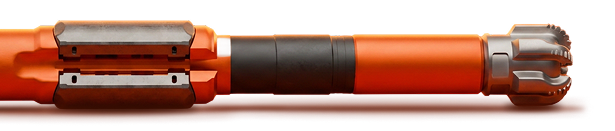
Drag limits how much of the weight set at surface reaches the bit. NexTitan applies weight on bit from inside the BHA by gripping the wellbore, so the force at the bit does not depend on pushing weight through the drag of the string above it.
To estimate what steadier weight at the bit is worth on your section, use the drilling cost calculator.

The tool, step by step.
Ask about your well or formation.