← Back to glossary
Home
GLOSSARY
Drilling Automation

Drilling Automation

Advanced Technology
Definition
Drilling automation is the use of sensors, software and control systems to adjust drilling parameters, such as weight on bit, rotary speed and flow rate, without waiting for a person to act.

What is drilling automation?

Drilling automation, also called automated drilling, is the use of sensors, software and control systems to adjust drilling parameters, such as weight on bit, rotary speed and flow rate, without waiting for a person to act. It ranges from surface systems that automate tasks on the rig floor to downhole tools that control what happens at the drill bit. The goal is the same at every level: drill faster and more consistently, with fewer tool failures and less non-productive time (NPT).

‍

How does drilling automation work?

Every automated drilling system runs the same loop: measure, decide, act.

  • Measure: sensors on the rig and in the bottom hole assembly (BHA) read torque, weight on bit, rotary speed, vibration and pressure.
  • Decide: software compares the readings with a target, for example the highest rate of penetration (ROP) within safe vibration limits.
  • Act: the system changes a parameter, either at surface through the top drive, drawworks and pumps, or downhole at the bit.

How fast that loop runs decides what the system can control. Surface loops work on a cycle of seconds, because data has to travel the length of the drill string. That is fast enough for many tasks, but too slow to stop drilling dysfunction such as stick slip, which starts at the bit.

‍

Surface vs downhole drilling automation

  • Surface automation controls the top drive, drawworks, pumps and pipe handling from the rig. It brings consistency to connections, tripping and parameter settings. Its limit is distance from the bit.
  • Downhole automation puts the control in the BHA, close to the bit. It can respond to changes in rock and vibration as they happen. It needs tools built to survive downhole temperature, pressure and shock.

Many operators combine the two: surface automation runs the rig, downhole force control manages conditions at the bit.

‍

What results have automated drilling systems shown?

Published field results show automated and autonomous systems drilling faster than manual operation:

  • SLB autonomous directional drilling reached 25% higher ROP than advisory mode and 48% higher than manual operations in an offshore campaign run at 85% autonomy (SPE/IADC 223649).
  • Halliburton's LOGIX platform recorded a 43.6% average ROP increase across several well sections, with more than 30% improvement in well delivery time (SPE/IADC 223800).
  • A Halliburton study in the Permian Basin reported a 20% average ROP increase compared with human-led operations (SPE/IADC 223824).
  • A closed-loop study across 100 wells in the Bakken, Delaware and Eagle Ford basins found ROP gains of 1 to 22% in laterals and up to 58% in intermediate sections (SPE/IADC 223804).
  • A field test in Malaysia raised ROP from 10.4 to 31 m/h over a 136 m interval using machine-learning optimization (SPE 214521).

The range is wide. Results depend on the formation, the well path and how much of the operation is automated.

‍

What is drilling automation worth?

The return on drilling automation comes from four places:

  • Rig time: days saved multiplied by the daily rig rate.
  • Fewer trips: longer bit runs mean fewer round trips to replace worn bits or failed tools.
  • Less NPT: drilling dynamics are linked to 20 to 30% of downhole tool failures (SPE 127413), so keeping vibration under control avoids repair and fishing costs.
  • Borehole quality: a smoother borehole makes running casing and later operations easier.

For a closer look at the numbers, see drilling automation ROI. To model them for your own well, use our drilling cost calculator.

‍

Can drilling automation be added to existing rigs?

Yes. Modular drilling automation adds standalone components to an existing rig and BHA instead of replacing the whole control system. It uses standard interfaces, so it can work alongside third-party equipment, and operators can start in the part of the operation where the return is highest.

This suits geothermal developers and independent operators who need one specific improvement, such as vibration control or weight on bit control, without paying for a full rig upgrade. It also lets older rigs take on automation without a new build.

‍

Is drilling automation the same as autonomous drilling?

Not quite. Drilling automation covers any system that adjusts parameters automatically, including advisory systems where a driller confirms each change. Autonomous drilling is the far end of that range: the control system makes and carries out decisions on its own, in real time, using sensors and control algorithms. The SLB campaign above is an example, with the system running 85% of the time without a person approving each change.

‍

Where does NexTitan fit?

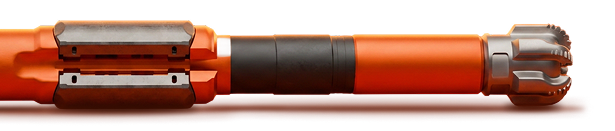
NexTitan is an autonomous downhole drive tool from GA Drilling. It sits in the BHA and applies weight on bit at the drill bit, adjusting to downhole conditions in real time instead of waiting for surface commands. It is designed as a modular addition to existing rigs.

If you want to know whether it fits a specific well, talk to our engineers.

Estimate what NexTitan could save on your well

Enter your section length, spread rate and bit cost. Get a modeled savings report.

Take the next step

Drill hard rock with NexTitan

Designed for longer Oil & Gas wells and deeper, hotter geothermal wells.