Drilling cost calculator
Model the savings on your own well.
Hard rock drilling is drilling through high-strength, often abrasive rock such as granite, basalt and other crystalline basement rock. It is common in geothermal wells, deep scientific wells, mining and the deeper sections of some oil and gas wells.
Granite has an unconfined compressive strength of roughly 100 to 250 MPa, several times that of the sandstone and shale most drilling equipment is built around. Cutting it takes more force per millimetre, and the quartz in granite wears the cutters at the same time, so penetration drops further as the run goes on. Vibration compounds it, because hard interbedded rock drives stick-slip, which chips PDC cutters and costs more rate of penetration.
Modern PDC bits with tougher cutters now drill much hard rock that once needed roller cone bits. Roller cone insert bits are still used in some very hard or broken rock, and impregnated diamond bits grind the hardest, most abrasive formations at high speed.
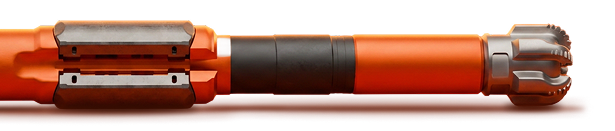
Get high, steady weight on bit, and keep vibration low enough that the cutters survive the run. Bit selection from offset data and parameters set using mechanical specific energy are routine practice and they matter, but weight on bit is where most hard rock sections fall short, because friction takes much of the weight applied at surface before it reaches the bit. GA Drilling's NexTitan is one of the tools built for that: it applies weight on bit at the bit rather than relying on what survives the journey down the string.
GA Drilling's NexTitan grips the borehole wall and reacts weight on bit and torque directly into the formation, so the load at the bit does not depend on what survives the journey down a long, compliant drill string. See downhole force control.
Three field test phases ran during 2026 at the NORCE Ullrigg test facility in Stavanger, Norway, in hard crystalline rock.
Full method and results: Field Demonstration of Downhole Drive Units in Hard Crystalline Rock (2026). Earlier Houston field tests measured a 35% reduction in lateral vibrations, in the Houston field test case study.
These are results from specific test phases in one test well. Results on another well depend on formation, well design and parameters.
To estimate what faster hard rock drilling would be worth on your well, use the drilling cost calculator.

The tool, step by step.
Ask about your well or formation.