← Back to glossary
Home
GLOSSARY
Horizontal Drilling

Horizontal Drilling

Directional Drilling
Definition
Horizontal drilling is a directional drilling method in which the wellbore is turned to run along the target formation, to increase contact with the reservoir.

What is horizontal drilling?

Horizontal drilling is a form of directional drilling in which the well turns until it runs roughly parallel to the rock layers, at or near 90° inclination. The horizontal part is called the lateral.

How is a horizontal well drilled?

  • A vertical section down to the kickoff point.
  • A build section, or curve, that turns the well toward horizontal.
  • The lateral, drilled along the target layer and often steered with LWD data.

Steering uses mud motors or rotary steerable systems.

Why drill horizontal wells?

A horizontal well can stay inside a thin reservoir layer for thousands of feet, giving much more contact with the rock than a vertical well. Combined with hydraulic fracturing, it made shale oil and gas commercial. In geothermal, horizontal wells are used to connect injection and production wells and to build closed-loop systems.

What limits lateral length?

  • Friction between the drill string and the low side of the hole, which reduces the weight on bit that reaches the bit.
  • Torque limits of the pipe and top drive.
  • Hole cleaning, as cuttings settle on the low side.
  • Running casing or liner to the end of the lateral.

How do you keep weight on the bit in a long lateral?

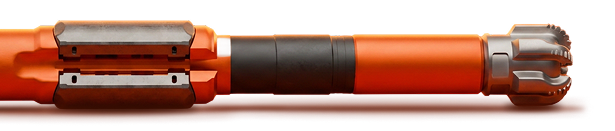
NexTitan is designed to anchor in the wellbore and apply weight on bit downhole, so the force at the bit does not depend on how much of the surface weight gets past friction in the lateral. See extended reach drilling.

To estimate what steadier weight at the bit would be worth in a long lateral, use the drilling cost calculator.

Estimate what NexTitan could save on your well

Enter your section length, spread rate and bit cost. Get a modeled savings report.

Take the next step

Drill hard rock with NexTitan

Designed for longer oil & gas wells and deeper, hotter geothermal wells.