Drilling cost calculator
Model the savings on your own well.
Unconfined compressive strength (UCS), also called uniaxial compressive strength, is the highest axial stress a rock sample can take before it fails, with no pressure applied around its sides. It is the most common single number used to say how strong a rock is.
A cylinder of rock core is loaded along its length in a press until it fails. UCS is the peak load divided by the original cross-section area. The test follows ASTM D7012 or the ISRM suggested method. Under ASTM the sample is 2 to 2.5 times as long as it is wide, and at least five samples are usually tested for a reliable value (Geoengineer.org).
Core is expensive, so UCS is also estimated along the whole well from sonic and density logs using correlations calibrated to lab tests.
Ranges from Attewell and Farmer (1976), as cited by Geoengineer.org. The crystalline basement rock targeted by many geothermal wells sits at the high end.
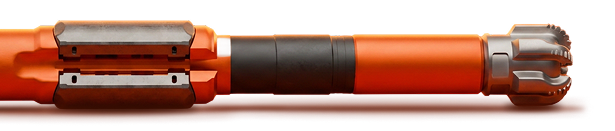
High-strength rock is slow to drill and wears bits quickly, which is why hard rock drilling is a large share of the time and cost of deep geothermal wells. Holding high, steady force on the bit matters most in this rock. NexTitan is designed for it.
To estimate what faster drilling in hard rock would be worth on your well, use the drilling cost calculator.

The tool, step by step.
Ask about your well or formation.