Drilling cost calculator
Model the savings on your own well.
Start from what is limiting the section, not from the catalogue. Three things usually bind, and each points at a different tool.
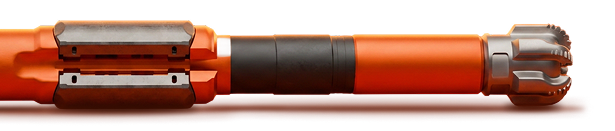
There is no single best tool, because the limit changes section by section. A PDC bit matched to the formation handles most sedimentary drilling. A mud motor or rotary steerable system handles trajectory. In hard rock sections and long laterals the limit is usually weight transfer rather than the cutting structure, and that is what a downhole drive tool addresses. GA Drilling's NexTitan is built for hard rock and long laterals: it grips the borehole and applies weight on bit at the bit, so the force the bit receives does not depend on what survives the friction on the way down. It adds little in soft sediments or very short runs.
Geothermal wells are hard on tools in two ways at once: hard crystalline rock that wears cutters, and temperatures that shorten the life of downhole electronics. A tool has to be rated for the temperature at depth and able to hold force steady through an abrasive section, or the run ends early and costs a trip. PDC bits with impact-resistant cutters handle the rock, and high-temperature electronics handle the heat. GA Drilling's NexTitan is rated to 175°C circulating and reaches reservoirs up to about 300°C with active mud cooling, and it applies weight on bit at the bit so penetration does not fall away through the run. See hard rock drilling.
One way to see what is genuinely new is to look at what has not changed. Drilling has had three step changes in how the bit is turned, and almost none in how weight reaches it.
Greg Leveille, a GA Drilling board member and former CTO of ConocoPhillips, has made the point that the top drive is now more than forty years old, and that through all three eras the weight on the bit has still come from the pipe above it. Rotation was solved three times. Weight delivery was not solved once.
That is why the current wave of innovation is about moving force and decisions closer to the bit. Rotary steerable systems did it for direction, replacing sliding with steering while the string rotates. Autodrillers did it for surface parameters, holding a weight on bit or rate of penetration setpoint without a driller working the brake. Downhole drive tools do it for weight on bit: GA Drilling's NexTitan uses a hydraulically activated mechanical device a few tens of feet behind the bit to apply weight there, and adjusts as the rock changes instead of waiting for a command from surface. Timing is why that last step matters, because in a deep well the round trip from bit to surface and back takes seconds, long enough for cutters to be damaged before a correction arrives.
Leveille's view of where this leads is a downhole drive tool coupled with a downhole motor and a machine-learning control system, which he describes as "self-driving-like" drilling. See downhole force control and drilling automation.
A bit that cuts, drill collars that load it, a motor or rotary steerable system that turns or steers it, MWD and LWD tools that measure, and stabilizers and shock subs that keep the assembly steady. See downhole tool for the full list and bottom hole assembly for how they fit together.
Across three field test phases during 2026 at the NORCE Ullrigg test facility in Stavanger, Norway, GA Drilling's NexTitan delivered 32,000 lbf of open-hole thrust with the string rotating at 36 rpm, drilled 66 ft (20 m) of hard Phyllite over 7.5 continuous hours at about 50 ft/hr, and reached rates of penetration up to 25 m/hr (82 ft/hr). The same programme recorded no gripper-induced sticking across borehole diameters up to 10 inches, in sections that were deliberately oversized, ovalised and spiralled. Full method and results: Field Demonstration of Downhole Drive Units in Hard Crystalline Rock (2026).
These are results from specific test phases in one test well. Results on another well depend on formation, well design and parameters.
To compare the cost of a section with and without steadier force at the bit, use the drilling cost calculator.

The tool, step by step.
Ask about your well or formation.